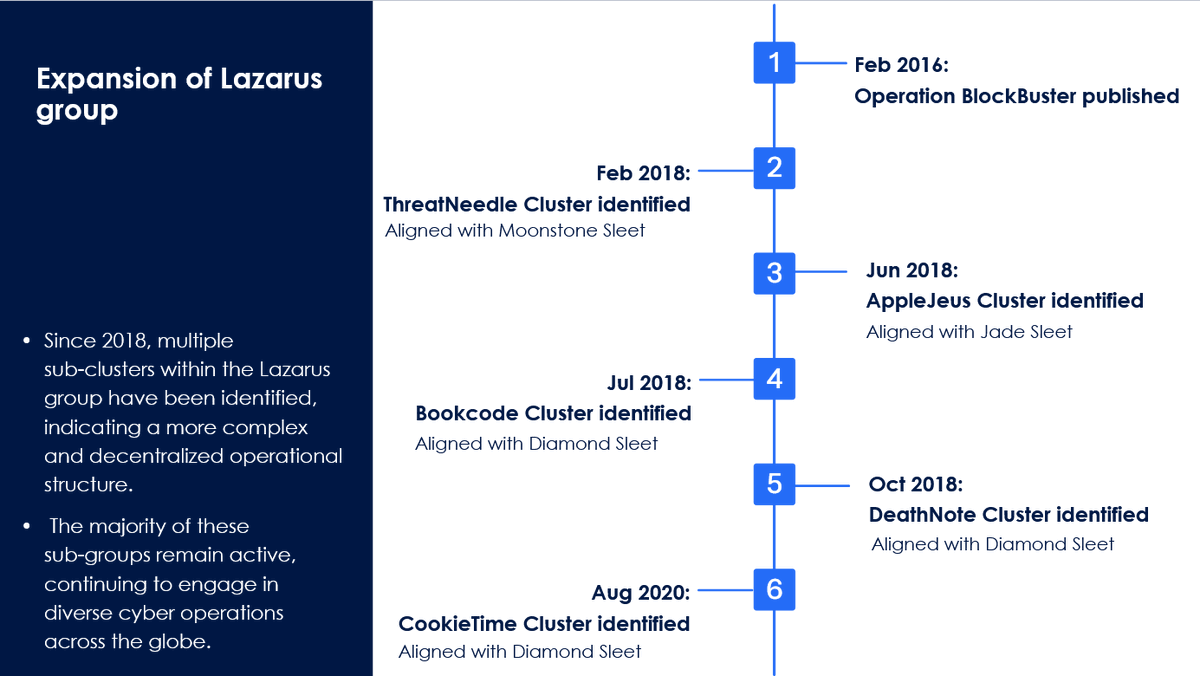
Finally, my DEF CON talk is now available on YouTube. In this presentation, I explore how DPRK threat actors have evolved, expanding, collaborating, and restructuring their internal operations.
The session dives deep into how these organizational shifts, combined with technical characteristics, make cyber attribution increasingly complex and challenging.
🎥 Watch: https://t.co/z5H9uQ6MpL
📑 Slides: https://t.co/SOqW4TbyJn
Can we agree to use the term “Agentic Offensive Frameworks” (#AOFs) for tools like CyberStrikeAI, ARTEX, Cairn and the like? Just as Mandiant called them in their recent report.
People have started creating ARTEX groups, ARTEX trackers and ARTEX IoC collections, as if it were the new Cobalt Strike.
We’ve been here before. Remember when suddenly every tiny webshell was called “China Chopper” or “China Chopper-like”?
Please don’t do this again with ARTEX. These frameworks are interchangeable, and tomorrow the same attacks could be orchestrated by something entirely different.
I really don’t want us to start calling everything an “ARTEX attack”.
Can we please get the terminology right this time?
#AOF
Couldn't agree more! A single network detection rule won't be enough to address AI-assisted attacks.
An AI agent doesn't necessarily follow a fixed execution path. If Nmap fails, it can generate a Python scanner. If an HTTP request gets blocked, it can modify its approach or switch tools while pursuing the same objective.
We've already seen threat actors experimenting with multiple AI models, assigning different roles to agents, and adapting their operations based on feedback.
Static signatures still have value, but detecting the behavior across the entire attack sequence becomes much more important.
I think there’s a fundamental misconception in how the security industry talks about ARTEX, Cairn and similar offensive AI frameworks. And even reports from major security vendors keep reinforcing it.
People treat these frameworks like the C2 frameworks we’ve known for years. With Cobalt Strike and others, parts of the framework were deployed on the victim’s systems. Implants, loaders, communication protocols and other implementation details provided recognizable patterns that we could write signatures for.
But ARTEX and Cairn work differently. The orchestration runs on the attacker side. The LLMs, prompts, skills, tools and infrastructure are interchangeable. Change any of these components and the resulting attack can look completely different. The framework itself doesn’t define what ends up on the victim’s systems.
Yes, there are a few minor implementation fingerprints, such as certain ARTEX/Norma User-Agent strings. We’ve even written rules for them. But these cover tiny parts of a framework’s functionality, not the attacks it can orchestrate.
An IP address, webshell or exploit used in a campaign doesn’t suddenly become an “ARTEX indicator” because ARTEX was involved.
And that’s why I find all these “ARTEX IoC collections” and “How to detect ARTEX” guides so misleading. They encourage people to think we’re dealing with another recognizable malware or C2 framework.
We’re facing a different class of offensive technology, and I think many people still haven’t understood that.
The detection guidance should be what we’ve been telling defenders for decades: detect malicious behavior, attack techniques and traces of compromise.
There is no special defense against ARTEX. Tomorrow the same attacker could use a different framework, a different model and completely different tools.
The names are disposable. The underlying attack techniques are what we need to detect.
Always great to hear old friends sharing their insights on a podcast. Even better when they mention my name! Really appreciate it.🙏
Let me add my two cents on `TraderTraitor` from my personal perspective. @craiu, you might remember `AppleJeus`, one of the earliest Lazarus campaigns targeting macOS users that we discovered back in 2018. Around that time, we started seeing Lazarus-associated activities emerge as several distinct clusters. `AppleJeus` was one of the campaigns we investigated, and the attackers continued using similar tactics, trojanized cryptocurrency trading applications, over the following years.
In 2022, CISA introduced the `TraderTraitor` name for a series of malicious cryptocurrency applications that shared similarities with earlier AppleJeus operations. Since then, `TraderTraitor` has become a widely used name, while different security vendors have tracked overlapping activities under names such as Jade Sleet, UNC4899, Slow Pisces, and Pressure Chollima.
Honestly, I lost visibility into some of this group's activities for a while. However, they never stopped targeting the cryptocurrency industry. Their operations evolved to include fake recruitment, malicious take-home coding assessments, and trojanized developer tools involving npm, PyPI, Ruby, and other ecosystems, contributing to several major cryptocurrency thefts.
One case that particularly caught my attention was the KelpDAO incident, documented in LayerZero's investigation report: https://t.co/T7IbKEK26L
The malware infection chain itself was interesting, but the post-exploitation activities were what really stood out to me. The attackers demonstrated a clear understanding of cloud infrastructure, internal workflows, and how cryptocurrency businesses operate behind the scenes.
Unlike the more opportunistic, fire-and-forget campaigns we've observed from some other DPRK actors, `TraderTraitor` seems to favor a big-game hunting approach, carefully selecting high-value targets and investing considerable effort in post-compromise operations.
For me, that's what makes this group particularly interesting. Even after years of tracking DPRK threat actors, I still find something surprising whenever I take a closer look at this group's operations.
📷 🥵 NEW POD THUMBNAIL ADVISORY!
Three Buddy Problem - Episode 119: We discuss the supermarket fridge hacks rolling across Europe, why no government wants to say the word Russia out loud, active measures and cyber-warfare, and the European silence on attribution. (Presented by @wearetlpblack)
Plus, OpenAI's GPT-6 Cyber and the cost of 948 Linux exploits, the Daybreak Blue training flap, a tough-love pep talk for researchers mourning the loss of the old game and the Binance postmortem the FBI pinned on North Korea's TraderTraitor. @craiu@juanandres_gs
- LISTEN anywhere: https://t.co/lv7xhNbZx1
- WATCH: https://t.co/KunsXnkBuO
This is probably a lost cause, but I wish we would stop referring to pen-testing firms and red-teaming as offensive firms and offensive teams. It muddies the water with the *real* offensive actors -- those that make the hacking tools and spyware and engage in cyber ops.
Always appreciate it when incident investigation findings are shared publicly. They provide valuable insights into how attacks unfold and help the security community better understand emerging TTPs.
My 2cents on Binance's latest disclosure:
▶️The June incident: Still not sure how the June 2026 infection connects to the later October attack. The earlier infection looks more like an opportunistic cybercrime campaign targeting random users rather than a targeted operation.
▶️The October intrusion: I'm particularly curious about the technical details of Engineer B's initial infection and how the attackers abused the internal AI tool to move laterally to Engineers A and C.
Looking forward to seeing more technical indicators shared with the community to strengthen the attribution beyond cryptocurrency wallet overlaps.
While recent vulnerabilities have been dominating the headlines, APT actors continue to operate quietly under the radar. And #Lazarus group has been busy.
At the #TheSAS2026 conference, we shared our latest research on #OperationFlashHole, revealing a more sophisticated attack chain and an evolving malware arsenal to target South Korea 🇰🇷.
𝗦𝗼𝗺𝗲 𝗸𝗲𝘆 𝗳𝗶𝗻𝗱𝗶𝗻𝗴𝘀 ➡️ Targeting security software, AI-assisted lures, complex malware framwork, post-quantum cryptography.
We also examined overlaps across Lazarus operations to better understand their recent activities.
Enjoy the read!
🔗 https://t.co/OXy8YnJyNk
Thrilled to share my latest research on AI-assisted cyberattacks and the ARTEX hacking framework!
What initially appeared to be AI-assisted attacks targeting South Korean banks turned out to be part of a much broader operation spanning multiple countries and industries.
My investigation revealed a financially motivated campaign leveraging ARTEX to pursue various monetization opportunities, including stealing customer data, reverse-engineering Android applications to identify vulnerabilities, and even attempting to acquire free NFT tokens.
AI is accelerating the speed and scale of cyberattacks, even when attackers rely on known vulnerabilities, enabling broader targeting and faster exploitation.
A closer look at the attacker's infrastructure, AI-assisted operations, and financial motives:
https://t.co/1HKtME3890
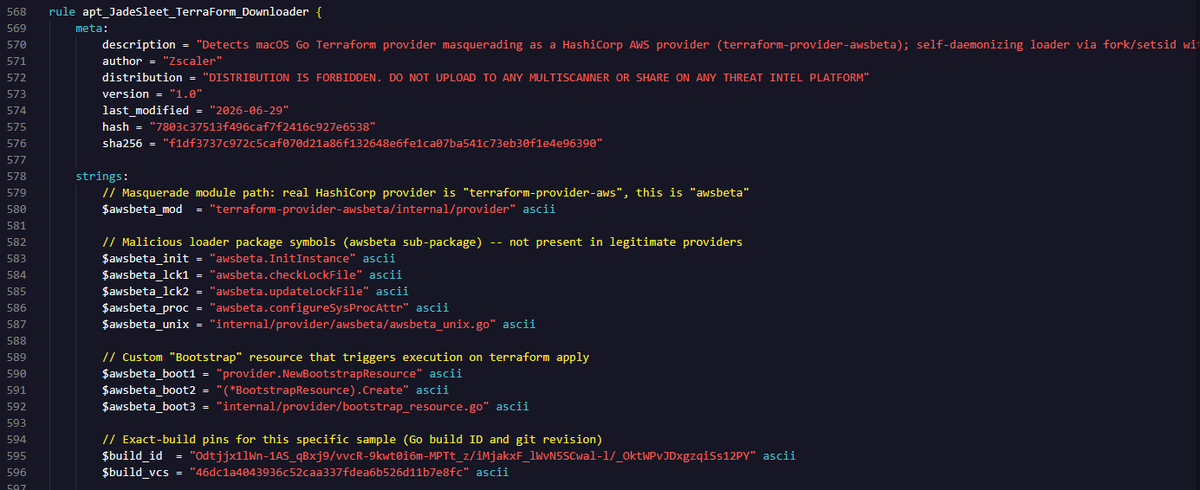
@malwrhunterteam Happy to clarify! I believe several researchers may have independently discovered the sample after it was uploaded to VirusTotal. In my case, a YARA rule I created back in June also caught the trojanized Terraform provider. I wasn't aware of your earlier post about the same malware, sorry for that.
I always appreciate your contributions to the security research community. If you have any further questions or concerns about our findings, I'm more than happy to clarify!
@ValidHorizon@ValidHorizon Attribution is indeed a headache, and I'm always open to different perspectives. I'd love to hear your detailed breakdown of the threat actor. I'm all ears!
Thrilled to publish my latest research on TraderTraitor (aka Jade Sleet / UNC4899) campaign, uncovering a multi-stage infection chain that delivers cross-platform malware through a trojanized Terraform provider.
This DPRK threat actor is known for big-game hunting-style cryptocurrency theft, and this campaign highlights its potential focus on cloud engineers and developers with access to sensitive infrastructure and high-value assets.
Our latest findings reveal several interesting developments:
▶️ Trojanized Terraform Provider: Weaponized a Terraform provider written in Go to execute malicious code on cloud engineers' or developers' systems.
▶️ Multi-Stage, Cross-Platform Malware: Leveraged Go and Rust to deliver multiple malware stages across Windows, macOS, and Linux.
▶️ Stealthy C2 Discovery: Abused Nostr, a decentralized messaging protocol, and Pastebin as dead-drop resolvers to conceal the actual C2 infrastructure.
▶️ Credential and Crypto Theft: Deployed backdoors and stealers targeting credentials, browser data, and cryptocurrency wallets.
Read the full article from here: https://t.co/JuhLg1A0M3
CLOSEDQUORUM, spotted by @TalosSecurity asks four LLMs to decide what a Windows implant should do next. AI-as-a-C2?
I analyzed two samples from their report. There is real experimentation here, but the implant was never really finished.
https://t.co/ZG32ugcq69.
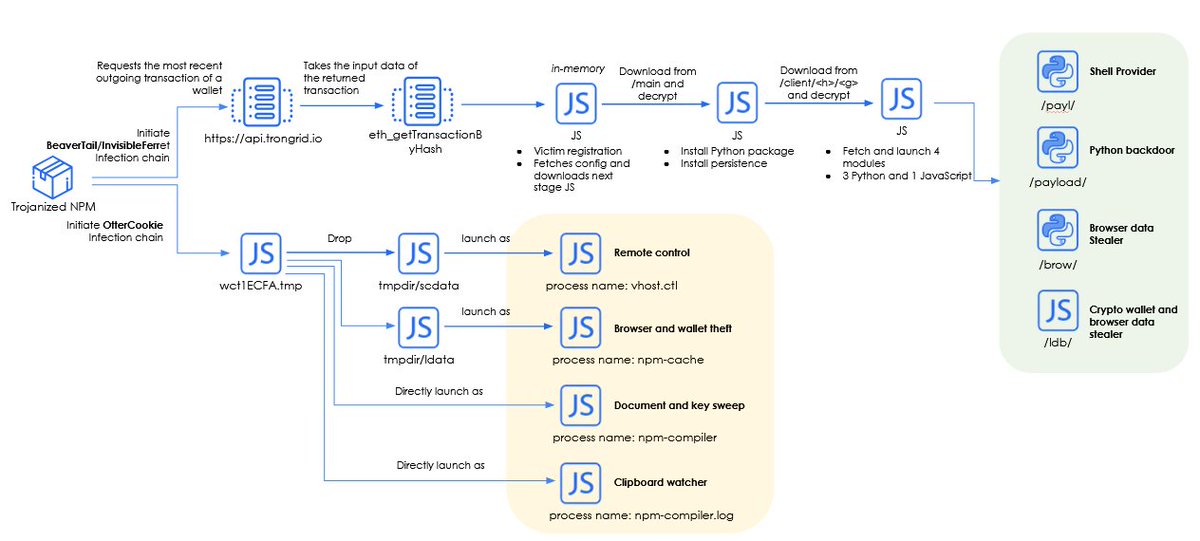
Recently, Japan, the US, Australia, and Germany published a joint cybersecurity advisory on WaterPlum, also known as the Contagious Interview campaign, attributed to a DPRK threat actor. From the advisory, one loader uses two parallel infection chains involving OtterCookie and BeaverTail variants.
I recently analyzed a very similar setup where a single loader also launches two separate infection chains, delivering different malware variants(BeaverTail/InvisibleFerret, OtterCookie) that have previously been linked to the same actor.
What stands out to me is that the operators do not seem to care much about redundancy or efficiency in the infection chain. They seem more focused on stealing as many breadcrumbs as possible, even when the two chains collect overlapping data.
A few notable characteristics:
▶️One loader kicks off two separate infection chains.
▶️EtherHiding is used to fetch BeaverTail-style JavaScript from a BSC transaction.
▶️InvisibleFerret capabilities and distribution endpoints have been slightly updated, suggesting that it is still under active development.
▶️Several stealing targets overlap across both infection chains, but the operators do not seem concerned about that redundancy.
Took a minute to write a few words about security & safety as someone who lived through it all at OpenAI. I hope my thoughts help someone out there. https://t.co/gJBf08vJH9
On July 25, we hacked OpenAI.
Two bugs let us take over ChatGPT/Codex accounts of OpenAI employees (+some unaffiliated users) and reach connected services: Outlook, Slack, GitHub, etc.
We proved it with a PR in OpenAI’s internal codebase . It took us <72h. 🧵
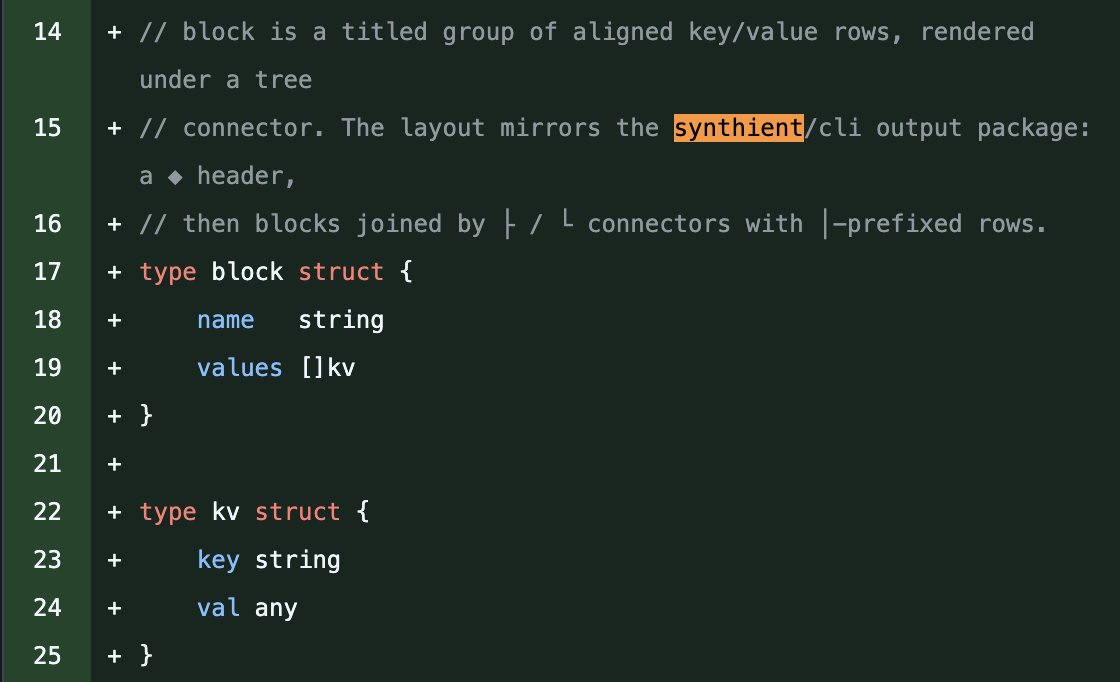
❗️ IP intelligence company Spur pushed a PR containing comments from their AI saying they'd copied competitor Synthient's CLI.
Spur raised $200 million this year.
Synthient is just one guy named Ben.
We're publishing our most detailed threat intelligence report to date.
It covers how people tried to misuse Claude—for cyberattacks, influence operations, surveillance, biology, and building weapons—and how we found and stopped them.
We disrupted every operation in the report, and used the lessons from them to strengthen our safeguards. Where appropriate, we also shared what we found with authorities and other AI companies.
These cases are not typical: we’re highlighting some of the most sophisticated misuse we’ve seen. But they’re especially important to discuss, because they show us where AI misuse is headed, where our safeguards work, and where they need to improve.
We’re publishing this report so others can spot the same activity on their own platforms, and so we can give the public a clearer view of how emerging threats develop.
Read the report: https://t.co/0EJUnYEgfz