@rrwilliams@ziv_ravid But this is not that interesting because matrices we care about might still be cheaper to multiply, similar to how the worst case growth factor would render Gaussian elimination useless but for all cases we care about it happens to be fine.
Update: I am on leave from @Harvard and am joining @spacexai to work on @grok model post-training. Excited to join the exceptional and relentless team to help build the defining technology of our time 🚀
I remember when everyone was scared of "model collapse" (models iteratively getting worse as they get trained on outputs from previous models) and then everyone got convinced it's not that much of a problem.
A new test-time form of this I've been seeing recently is that models have a strong prior that something on arXiv is an authoritative source of truth. This is now increasingly not the case, but frontier models (even if they easily found flaws in the underlying work when prompted to do so) will happily assume something is correct and continue reasoning from this false starting point.
Models might pick up on this through RL and start verifying prior art in context, but that would be a huge waste if it does that for everyone individually.
I think the only way to fix this is a new open centralized source of scientific truths that uses both human and AI input to continuously verify/reproduce things.
It’s not about distillation really, it’s just about the fact that frontier improvements have probably not come from any proprietary architectural/algorithmic/learning paradigm innovations and it’s mostly been about acquiring data that captures the failure frontier (tasks that stump the model) — something that you can’t really protect once a new generation of models comes out
https://t.co/G7Z7NvhGvY
The only thing I can think of is that if model improvement is mostly data-constrained and US frontier labs have to foot the bill for curation of problems that stomp the current gen of models and high-quality solutions, the fact that open weights models can be trained on an exponentially cheaper dataset by just running inference on a new frontier model eats away the value capture and ultimately leads to reduced capex and deceleration.
so much research on architectures and their inductive bias but it was always the optimizer that enabled generalization in deep neural networks. if not for the spectral bias of gradient descent, we would just be fitting noise...
The only thing I can think of is that if model improvement is mostly data-constrained and US frontier labs have to foot the bill for curation of problems that stomp the current gen of models and high-quality solutions, the fact that open weights models can be trained on an exponentially cheaper dataset by just running inference on a new frontier model eats away the value capture and ultimately leads to reduced capex and deceleration.
🚨New Paper: Training Small LLMs to Introspect!🚨
We create two rigorous evals of LLM introspection and:
- we show introspection emerges with scale
- we *train-in* introspection (even on llama 1B!) by SFT'ing on perturbed forward passes, and performance generalizes! 🧵(1/5)
Next week I’ll be in🇰🇷Seoul for ICML 2026!
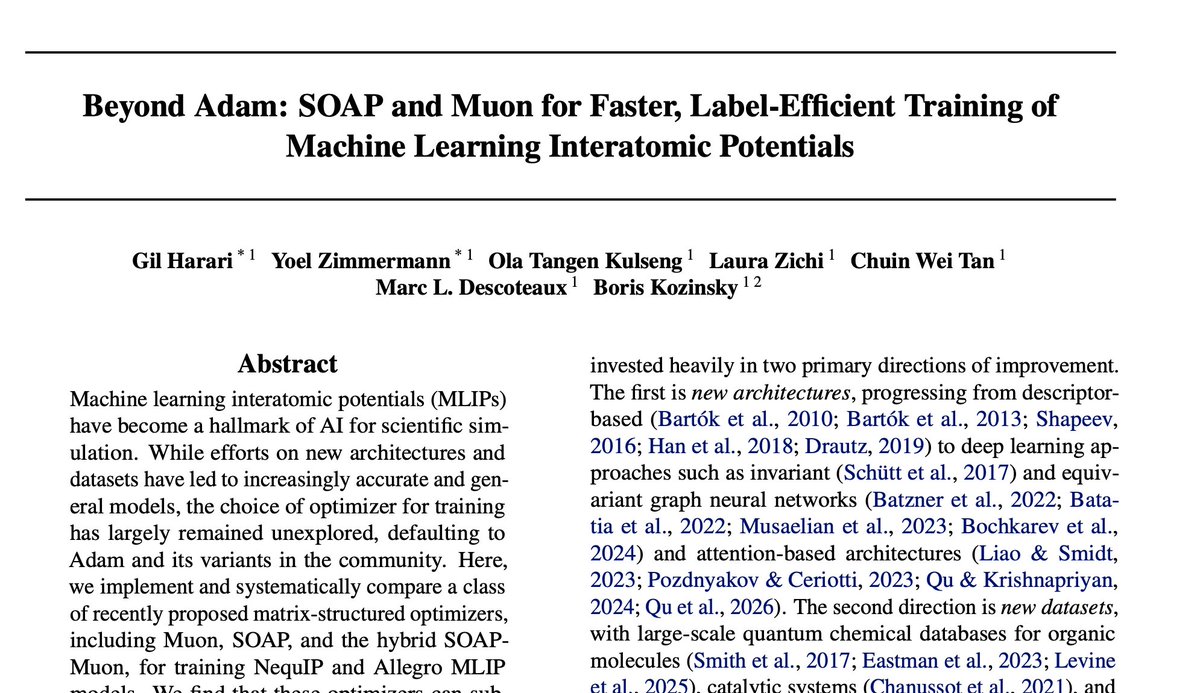
Our paper “Beyond Adam: SOAP and Muon for Faster, Label-Efficient Training of Machine Learning Interatomic Potentials” was accepted as an oral at the AI for Science Workshop. 1/5 🧵