An old friend saw a Western Slender Glass Lizard (Ophisaurus attenuatus attenuatus) on the beach at Padre Island this weekend and mentioned it to me. Naturally, I went down a rabbit hole ....
Slender glass lizards are primarily diurnal, meaning they are active during the day, and they are surprisingly fast movers. Their name comes from their easily broken tail which they can break off themselves without ever being touched. It is difficult to find a specimen with an undamaged tail. When threatened or captured, they often thrash violently, causing part of their remarkably fragile tail to break off, sometimes in several pieces. As the detached tail continues to wriggle, it distracts the predator long enough for the lizard to make its escape. They can even shed part of their tail without being touched. Although a new section eventually grows back, it is typically plain tan and lacks the original pattern, so the tail becomes shorter and more irregular with each subsequent injury. Contrary to popular folklore, the detached pieces cannot grow into new lizards or reattach themselves.
Western slender glass lizards have also been observed swimming considerable distances to evade predators. They spend much of their time in burrows, often taking over those dug by other animals, though they are also capable of excavating their own burrows in sandy soil. During the cooler months they hibernate communally in underground shelters known as hibernacula, remaining dormant from roughly October until April or May. Their daily activity also changes with the seasons. In cool weather they remain active throughout the day, but during the heat of summer they are most active around dawn and dusk.
Despite their snake-like appearance, slender glass lizards are true lizards and generally have a gentle disposition. They rarely bite when handled or threatened. More often, they rely on camouflage, remaining perfectly still in hopes of blending into the surrounding vegetation until danger passes. A 1989 study found that 79 percent of the individuals examined had lost at least part of their tails, making an unbroken tail something of a rarity in the wild.
Photo by William L. Farr
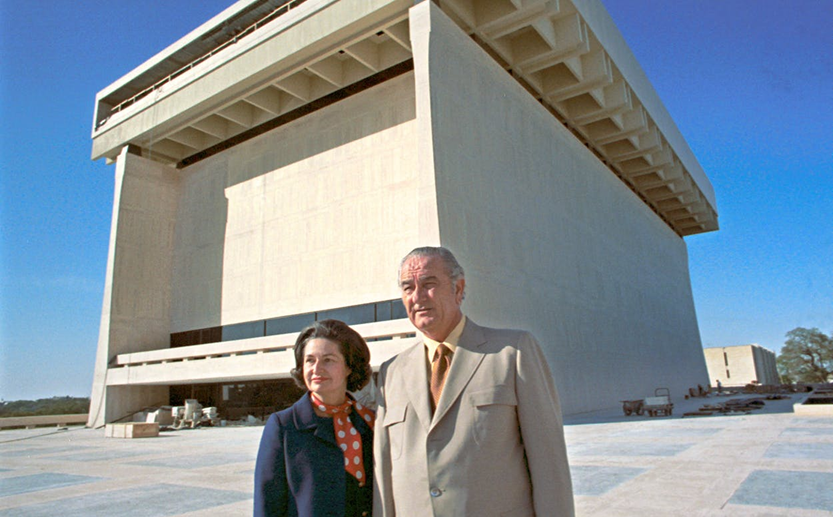
On May 22, 1971, the historic Lyndon Baines Johnson Library and Museum, our nation’s fifth presidential library, was dedicated on the University of Texas at Austin’s campus.
Following the Battle of San Jacinto, Major Isaac Watts Burton led a small group of cavalrymen in successfully capturing three Mexican Navy ships on the Texas coast. #SaveTexasHistory
Stance and his men fought against a band of Apaches and saved a kidnapped farmboy without losing a single soldier, this week in Texas history.
Watch the full video: https://t.co/a0c810hvta
Sgt. Emanuel Stance became the first Buffalo Soldier to be awarded the Congressional Medal of Honor after heroically leading a rescue mission near Fort McKavett.
This remarkable photograph captures a train paused on the Waller Creek bridge in Austin on Christmas Day, 1871—the very first train ever to reach the city. On that day, the Houston and Texas Central Railway extended its line to Austin, making it the westernmost rail terminus in Texas at the time, just 35 years after the Alamo.
An inscription on the back of the photograph reads: “With a little steam left, this forerunner of a soon-to-be speeding civilization has stopped on the little Waller Creek bridge in Austin to let passengers from Houston and other points disembark at the Depot House, Christmas Day, 1871.”
Photo courtesy the @AustinPublicLib
Following a tense city election in 1886, two political factions, the Botas (“Boots") and the Guaraches (“Sandals”), engaged in a violent confrontation that ended with as many as thirty people dead and forty-five wounded.
Read more:
https://t.co/E4aWz3YlDv
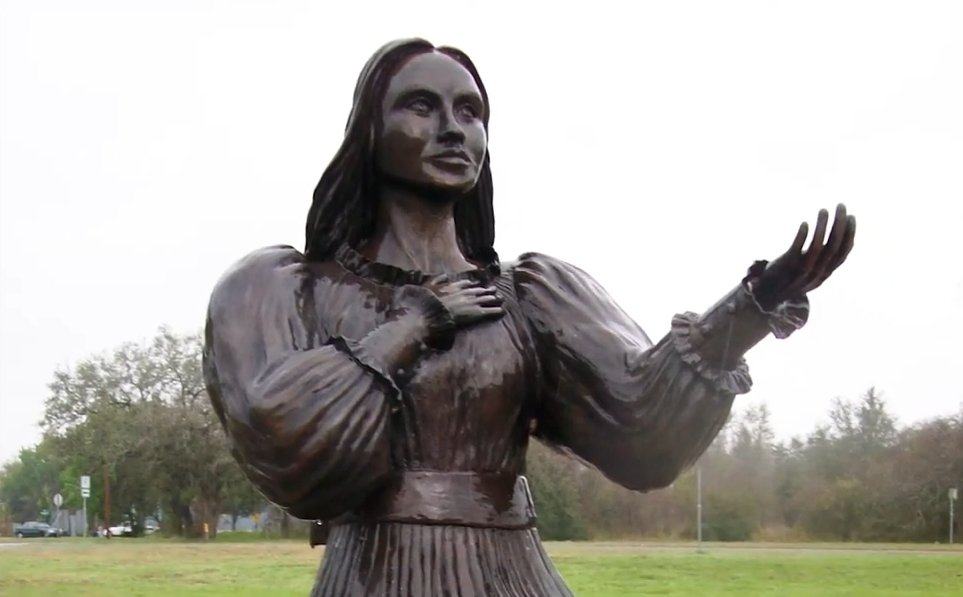
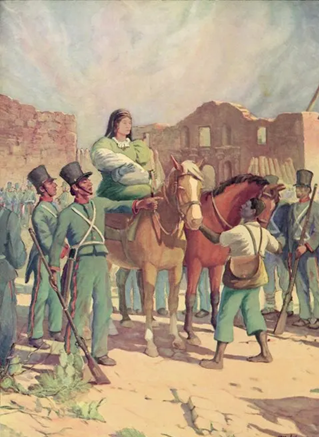
Francita Alavez, the wife of a Mexican officer, begged Santa Anna to spare the lives of about twenty Texan prisoners who were set to be executed in Goliad.
The Angel of Goliad appeared this week in Texas history.
Watch the full video here:
https://t.co/13CiSz2ib4
Fighting a fire in the Spindletop oilfield near Beaumont, 1902. This was only a year or two after oil was discovered there in one of most momentous events in Texas history. I can't imagine how calamitous this scene might have been. The fighting of oilfield fires was in its infancy, of course, and this beast appears to be really roaring. It would take considerable courage to even get close to it. As always, I'm interested in your thoughts/experiences.
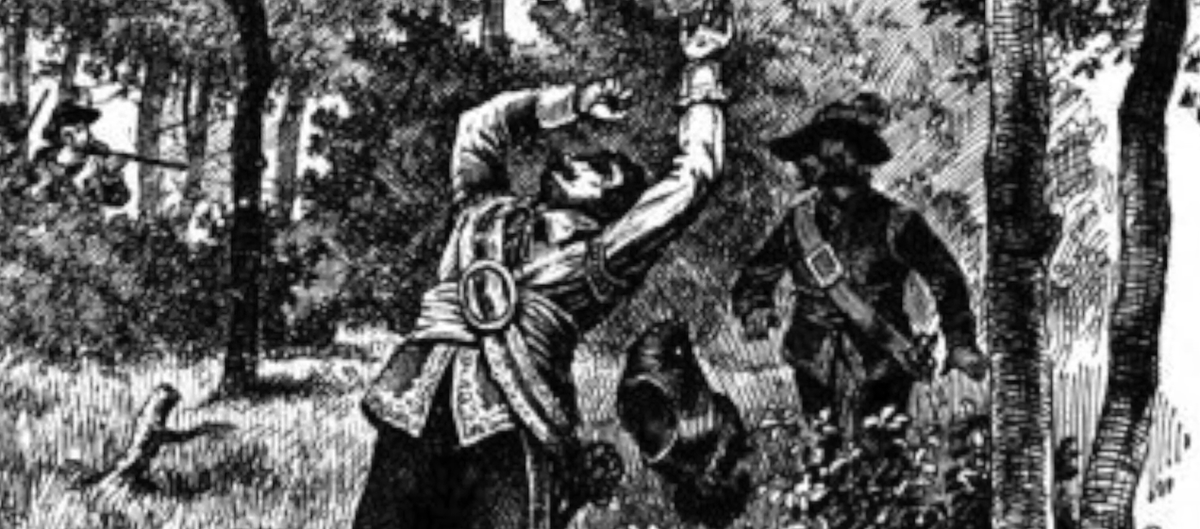
This week in Texas history, French explorer René Robert Cavalier, Sieur de La Salle, led a group on a northern expedition to seek aid for their struggling colony in Texas.
When two followers suspected he’d gotten them lost, Pierre Duhaut shot La Salle to death.
On this day in 1836, Texas Revolutionary soldier Lewis T. Ayers was captured by the Mexican forces of Gen. José de Urrea. Ayers was involved in the series of skirmishes between March 12 and March 15 that came to be known as the battle of Refugio.
Pictured, Gen. José de Urrea
Susanna Dickinson, one of the survivors of the Battle of the Alamo, played an integral role in securing land grants for the relatives of the deceased Alamo defenders. #SaveTexasHistory
Did you know that Houston once had a population of only twelve people in 1837?
Below is P. Whitty’s map of Houston in 1900, featuring its five wards, railroads, streetcar tracks, roundhouses, and rail yards throughout downtown. #MapMonday
Learn more:
https://t.co/LoAX5fWhBm
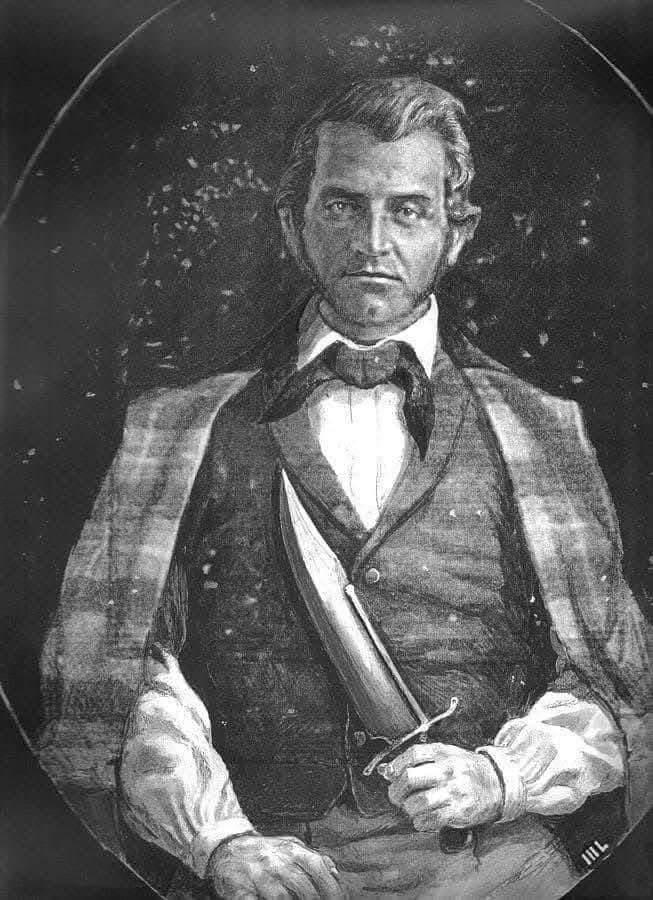
This is Don Enrique Esparza, the last surviving witness of the Battle of the Alamo, late in his life. In November, 1902, the San Antonio Light Newspaper published the following article about Enrique Esparza and it is fantastic. Here is the text, verbatim:
"Since the death of Senora Candelaria Villanueva, several years ago at the age of 112 there is but one person alive who claims to have been in the siege of the Alamo. That person is Enrique Esparza, now 74 years old, who, firm-stepped, clear-minded and clear-eyed, bids fair to live to the age of the woman who for so long shared honors with him.
Enrique Esparza, who tells one of the most interesting stories ever narrated, works a truck garden on Nogalitos street between the southern Pacific Railroad track and the San Pedro creek. Here he lives with the family of his son, Victor Esparza. Every morning he is up before daybreak and helps load the wagons with garden stuff that is to be taken up town to market.
He is a farmer of experience and contributes very materially to the success of the beautiful five acres garden, of which he is the joint proprietor.
While claims of Enrique Esparza have been known among those familiar with the historical work done by the Daughters of the Republic, an organization which has taken great interest in getting first-hand information of the period of Texas
Independence, the old man was not available up to about five years ago, for the reason that he resided on his farm in Atascosa county. This accounts for the fact that he is not well enough known to be included in the itinerary when San Antonians are proudly doing the town with their friends.
Esparza tells a straight story. Although he is a Mexican, his gentleness and unassuming frankness are like the typical old Texan. Every syllable he speaks to uttered with confidence and in his tale, he frequently makes digressions, going into details of relationship of early families of San Antonio and showing a tenacious memory. At the time of the fight of the Alamo he was 8 years old. His father was a defender, and his father's own brother an assailant of the Alamo. He was a witness of his mother's grief, and had his own grief, at the slaughter in which his father was included. As he narrated to a reporter the events in which he was so deeply concerned, his voice several times choked and he could not proceed for emotion. While he has a fair idea of English, he preferred to talk in Spanish.
"My father, Gregorio Esparza, belonged to Benavides' company, in the American army," said Esparza, "and I think it was in February, 1836, that the company was ordered to Goliad when my father was ordered back alone to San Antonio, for what I don't know. When he got here there were rumors that Santa Ana was on the way here, and many residents sent their families away. One of my father's friends told him that he could have a wagon and team and all necessary provisions for a trip, if he wanted to take his family away. There were six of us besides my father; my mother, whose name was Anita, my eldest sister, myself and three younger brothers, one a baby in arms. I was 8 years old.
"My father decided to take the offer and move the family to San Felipe. Everything was ready, when one morning, Mr. W. Smith, who was godfather to my youngest brother, came to our house on North Flores street, just above where the Presbyterian church now is, and told my mother to tell my father when he came in that Santa Ana had come. (Northeast corner of Houston and N. Flores Streets.)
"When my father came my mother asked him what he would do. You know the Americans had the Alamo, which had been fortified a few months before by General Cos.
"Well, I'm going to the fort" my father said.
"Well, if pop goes, I am going along, and the whole family too.
"It took the whole day to move and an hour before sundown we were inside the fort. Where was a bridge over the river about where Commerce street crosses it, and just as we got to it we could her Santa Anna's drums beating on Milam Square, and just as we were crossing the ditch going into the fort Santa Anna fired his salute on Milam Square.
"There were a few other families who had gone in. A Mrs. Cabury[?] and her sister, a Mrs. Victoriana, and a family of several girls, two of whom I knew afterwards, Mrs. Dickson, Mrs. Juana Melton, a Mexican woman who had married an American, also a woman named Concepcion Losoya and her son, Juan, who was a little older than I.
"The first thing I remember after getting inside the fort was seeing Mrs. Melton making circles on the ground with an umbrella. I had seen very few umbrellas. While I was walking around about dark I went near a man named Fuentes who was talking at a distance with a soldier. When the latter got near me he said to Fuentes:
"Did you know they had cut the water off?"
"The fort was built around a square. The present Hugo-Schmeltzer building is part of it. I remember the main entrance was on the south side of the large enclosure. The quarters were not in the church, but on the south side of the fort, on either side of the entrance, and were part of the convent. There was a ditch of running water back of the church and another along the west side of Alamo Plaza. We couldn't got to the latter ditch as it was under fire and it was the other one that Santa Anna cut off. The next morning after we had gotten in the fort I saw the men drawing water from a well that was in the convent yard. The well was located a little south of the center of the square. I don't know whether it is there now or not.
"On the first night a company of which my father was one went out and captured some prisoners. One of them was a Mexican soldier, and all through the siege, he interpreted the bugle calls on the Mexican side, and in this way the Americans know about the movements of the enemy.
"After the first day there was fighting. The Mexicans had a cannon somewhere near where Dwyer avenue now is, and every fifteen minutes they dropped a shot into the fort.
"The roof of the Alamo had been taken off and the south side filled up with dirt almost to the roof on that side so that there was a slanting embankment up which the Americans could run and take positions. During the fight I saw numbers who were shot in the head as soon as they exposed themselves from the roof. There were holes made in the walls of the fort and the Americans continually shot from these also. We also had two cannon, one at the main entrance and one at the northwest corner of the fort near the post office. The cannon were seldom fired.
"I remember Crockett. He was a tall, slim man, with black whiskers. He was always at the head. The Mexicans called him Don Benito. The Americans said he was Crockett. He would often come to the fire and warm his hands and say a few words to us in the Spanish language. I also remember hearing the names of Travis and Bowie mentioned, but I never saw either of them that I know of.
"After the first few days I remember that a messenger came from somewhere with word that help was coming. The Americans celebrated it by beating the drums and playing on the flute. But after about seven days fighting there was an armistice of three days and during this time Don Benito had conferences every day with Santa Anna. Badio, the interpreter, was a close friend of my father, and I heard him tell my father in the quarters that Santa Anna had offered to let the Americans go with their lives if they would surrender, but the Mexicans would be treated as rebels.
"During the armistice my father told my mother she had better take the children and go, while she could do so safely. But my mother said:
"No!, if you're going to stay, so am I. If they kill one they can kill us all.
"Only one person went out during the armistice, a woman named Trinidad Saucedo.
"Don Benito, or Crockett, as the Americans called him, assembled the men on the last day and told them Santa Anna's terms, but none of them believed that any one who surrendered would get out alive, so they all said as they would have to die any how they would fight it out.
"The fighting began again and continued every day, and nearly every night,. One night there was music in the Mexican camp and the Mexican prisoner said it meant that reinforcements had arrived.
"We then had another messenger who got through the lines, saying that communication had been cut off and the promised reinforcements could not be sent.
"On the last night my father was not out, but he and my mother were sleeping together in headquarters. About 2 o'clock in the morning there was a great shooting and firing at the northwest corner of the fort, and I heard my mother say:
"Gregorio, the soldiers have jumped the wall. The fight's begun.
"He got up and picked up his arms and went into the fight. I never saw him again. My uncle told me afterwards that Santa Anna gave him permission to get my father's body, and that he found it where the thick of the fight had been.
"We could hear the Mexican officers shouting to the men to jump over, and the men were fighting so close that we could hear them strike each other. It was so dark that we couldn't see anything, and the families that were in the quarters just huddled up in the corners. My mother's children were near her. Finally they began shooting through the dark into the room where we were. A boy who was wrapped in a blanket in one corer was hit and killed. The Mexicans fired into the room for at least fifteen minutes. It was a miracle, but none of us children were touched.
"By daybreak the firing had almost stopped, and through the window we could see shadows of men moving around inside the fort. The Mexicans went from room to room looking for an American to kill. While it was still dark a man stepped into the room and pointed his bayonet at my mother's breast, demanding:
"Where's the money the Americans had?"
"If they had any,' said my mother, "you may look for it.'
"Then an officer stepped in and said:
"What are you doing? The women and children are not to be hurt.
"The officer then told my mother to pick out her own family and get her belongings and the other women were given the same instructions. When it was broad day the Mexicans began to remove the dead. There were so many killed that it took several days to carry them away.
"The families, with their baggage, were then sent under guard to the house of Don Ramon Musquiz, which was located where Frank Brothers store now is, on Main Plaza.(Southeast corner of Soledad and Commerce Streets, now a parking lot, 1991). Here we were given coffee and some food, and were told that we would go before the president at 2 o'clock.
On our way to the Musquiz house we passed up Commerce street, and it was crowded as far as Presa street with soldiers who did not fire a shot during the battle. Santa Anna had many times more troops than he could use.
"At 3 o'clock we went before Santa Anna. His quarters were in a house which stood where L. Wolfson's store now is.(Middle of Commerce Street, north side, between Main Avenue and Soledad Street). He had a great stack of silver money on a table before him, and a pile of blankets. One by one the women were sent into a side room to make their declaration, and on coming out were given $2 and a blanket. While my mother was waiting her turn Mrs. Melton, who had never recognized my mother as an acquaintance, and who was considered an aristocrat, sent her brother, Juan Losoya, across the room to my mother to ask the favor that nothing be said to the president about her marriage with an American.
"My mother told Juan to tell her not to be afraid.
"Mrs. Dickson was there, also several other woman. After the president had given my mother her $2 and blanket, he told her she was free to go where she liked. We gathered what belongings we could together and went to our cousin's place on North Flores street, where we remained several months."
Doesn't Don Enrique Esparza have a truly magnificent face? The photo is courtesy the Dolph Briscoe Center for American History at UT-Austin, which is a wonderful place for Texas history buffs to visit. Among their holdings is the first photo of the Alamo.
On this day in 1854, Samuel K. Lewis finally received payment for two beeves he had furnished to the Army of the Republic of Texas in 1842. By the time Texas was annexed to the U.S., in 1845, the money owed Lewis was part of a debt. Lewis served as Representative for Austin Co.
On this day in 1892, Bessie Coleman was born.
Her extraordinary life and career deserves to be celebrated in the canon of U.S. history. https://t.co/MuLw8jWIv7
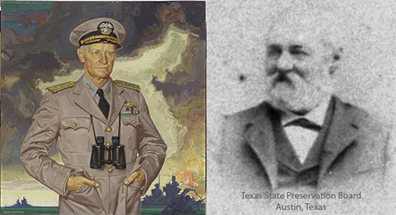
Admiral Chester W. Nimitz, a native of Fredericksburg, is one of the most famous names in modern American naval history.
Records in the GLO Archives help connect the history of one of America’s greatest naval heroes with the story of his ancestors in Texas. #SaveTexasHistory










![TracesofTexas's tweet photo. This is Don Enrique Esparza, the last surviving witness of the Battle of the Alamo, late in his life. In November, 1902, the San Antonio Light Newspaper published the following article about Enrique Esparza and it is fantastic. Here is the text, verbatim:
"Since the death of Senora Candelaria Villanueva, several years ago at the age of 112 there is but one person alive who claims to have been in the siege of the Alamo. That person is Enrique Esparza, now 74 years old, who, firm-stepped, clear-minded and clear-eyed, bids fair to live to the age of the woman who for so long shared honors with him.
Enrique Esparza, who tells one of the most interesting stories ever narrated, works a truck garden on Nogalitos street between the southern Pacific Railroad track and the San Pedro creek. Here he lives with the family of his son, Victor Esparza. Every morning he is up before daybreak and helps load the wagons with garden stuff that is to be taken up town to market.
He is a farmer of experience and contributes very materially to the success of the beautiful five acres garden, of which he is the joint proprietor.
While claims of Enrique Esparza have been known among those familiar with the historical work done by the Daughters of the Republic, an organization which has taken great interest in getting first-hand information of the period of Texas
Independence, the old man was not available up to about five years ago, for the reason that he resided on his farm in Atascosa county. This accounts for the fact that he is not well enough known to be included in the itinerary when San Antonians are proudly doing the town with their friends.
Esparza tells a straight story. Although he is a Mexican, his gentleness and unassuming frankness are like the typical old Texan. Every syllable he speaks to uttered with confidence and in his tale, he frequently makes digressions, going into details of relationship of early families of San Antonio and showing a tenacious memory. At the time of the fight of the Alamo he was 8 years old. His father was a defender, and his father's own brother an assailant of the Alamo. He was a witness of his mother's grief, and had his own grief, at the slaughter in which his father was included. As he narrated to a reporter the events in which he was so deeply concerned, his voice several times choked and he could not proceed for emotion. While he has a fair idea of English, he preferred to talk in Spanish.
"My father, Gregorio Esparza, belonged to Benavides' company, in the American army," said Esparza, "and I think it was in February, 1836, that the company was ordered to Goliad when my father was ordered back alone to San Antonio, for what I don't know. When he got here there were rumors that Santa Ana was on the way here, and many residents sent their families away. One of my father's friends told him that he could have a wagon and team and all necessary provisions for a trip, if he wanted to take his family away. There were six of us besides my father; my mother, whose name was Anita, my eldest sister, myself and three younger brothers, one a baby in arms. I was 8 years old.
"My father decided to take the offer and move the family to San Felipe. Everything was ready, when one morning, Mr. W. Smith, who was godfather to my youngest brother, came to our house on North Flores street, just above where the Presbyterian church now is, and told my mother to tell my father when he came in that Santa Ana had come. (Northeast corner of Houston and N. Flores Streets.)
"When my father came my mother asked him what he would do. You know the Americans had the Alamo, which had been fortified a few months before by General Cos.
"Well, I'm going to the fort" my father said.
"Well, if pop goes, I am going along, and the whole family too.
"It took the whole day to move and an hour before sundown we were inside the fort. Where was a bridge over the river about where Commerce street crosses it, and just as we got to it we could her Santa Anna's drums beating on Milam Square, and just as we were crossing the ditch going into the fort Santa Anna fired his salute on Milam Square.
"There were a few other families who had gone in. A Mrs. Cabury[?] and her sister, a Mrs. Victoriana, and a family of several girls, two of whom I knew afterwards, Mrs. Dickson, Mrs. Juana Melton, a Mexican woman who had married an American, also a woman named Concepcion Losoya and her son, Juan, who was a little older than I.
"The first thing I remember after getting inside the fort was seeing Mrs. Melton making circles on the ground with an umbrella. I had seen very few umbrellas. While I was walking around about dark I went near a man named Fuentes who was talking at a distance with a soldier. When the latter got near me he said to Fuentes:
"Did you know they had cut the water off?"
"The fort was built around a square. The present Hugo-Schmeltzer building is part of it. I remember the main entrance was on the south side of the large enclosure. The quarters were not in the church, but on the south side of the fort, on either side of the entrance, and were part of the convent. There was a ditch of running water back of the church and another along the west side of Alamo Plaza. We couldn't got to the latter ditch as it was under fire and it was the other one that Santa Anna cut off. The next morning after we had gotten in the fort I saw the men drawing water from a well that was in the convent yard. The well was located a little south of the center of the square. I don't know whether it is there now or not.
"On the first night a company of which my father was one went out and captured some prisoners. One of them was a Mexican soldier, and all through the siege, he interpreted the bugle calls on the Mexican side, and in this way the Americans know about the movements of the enemy.
"After the first day there was fighting. The Mexicans had a cannon somewhere near where Dwyer avenue now is, and every fifteen minutes they dropped a shot into the fort.
"The roof of the Alamo had been taken off and the south side filled up with dirt almost to the roof on that side so that there was a slanting embankment up which the Americans could run and take positions. During the fight I saw numbers who were shot in the head as soon as they exposed themselves from the roof. There were holes made in the walls of the fort and the Americans continually shot from these also. We also had two cannon, one at the main entrance and one at the northwest corner of the fort near the post office. The cannon were seldom fired.
"I remember Crockett. He was a tall, slim man, with black whiskers. He was always at the head. The Mexicans called him Don Benito. The Americans said he was Crockett. He would often come to the fire and warm his hands and say a few words to us in the Spanish language. I also remember hearing the names of Travis and Bowie mentioned, but I never saw either of them that I know of.
"After the first few days I remember that a messenger came from somewhere with word that help was coming. The Americans celebrated it by beating the drums and playing on the flute. But after about seven days fighting there was an armistice of three days and during this time Don Benito had conferences every day with Santa Anna. Badio, the interpreter, was a close friend of my father, and I heard him tell my father in the quarters that Santa Anna had offered to let the Americans go with their lives if they would surrender, but the Mexicans would be treated as rebels.
"During the armistice my father told my mother she had better take the children and go, while she could do so safely. But my mother said:
"No!, if you're going to stay, so am I. If they kill one they can kill us all.
"Only one person went out during the armistice, a woman named Trinidad Saucedo.
"Don Benito, or Crockett, as the Americans called him, assembled the men on the last day and told them Santa Anna's terms, but none of them believed that any one who surrendered would get out alive, so they all said as they would have to die any how they would fight it out.
"The fighting began again and continued every day, and nearly every night,. One night there was music in the Mexican camp and the Mexican prisoner said it meant that reinforcements had arrived.
"We then had another messenger who got through the lines, saying that communication had been cut off and the promised reinforcements could not be sent.
"On the last night my father was not out, but he and my mother were sleeping together in headquarters. About 2 o'clock in the morning there was a great shooting and firing at the northwest corner of the fort, and I heard my mother say:
"Gregorio, the soldiers have jumped the wall. The fight's begun.
"He got up and picked up his arms and went into the fight. I never saw him again. My uncle told me afterwards that Santa Anna gave him permission to get my father's body, and that he found it where the thick of the fight had been.
"We could hear the Mexican officers shouting to the men to jump over, and the men were fighting so close that we could hear them strike each other. It was so dark that we couldn't see anything, and the families that were in the quarters just huddled up in the corners. My mother's children were near her. Finally they began shooting through the dark into the room where we were. A boy who was wrapped in a blanket in one corer was hit and killed. The Mexicans fired into the room for at least fifteen minutes. It was a miracle, but none of us children were touched.
"By daybreak the firing had almost stopped, and through the window we could see shadows of men moving around inside the fort. The Mexicans went from room to room looking for an American to kill. While it was still dark a man stepped into the room and pointed his bayonet at my mother's breast, demanding:
"Where's the money the Americans had?"
"If they had any,' said my mother, "you may look for it.'
"Then an officer stepped in and said:
"What are you doing? The women and children are not to be hurt.
"The officer then told my mother to pick out her own family and get her belongings and the other women were given the same instructions. When it was broad day the Mexicans began to remove the dead. There were so many killed that it took several days to carry them away.
"The families, with their baggage, were then sent under guard to the house of Don Ramon Musquiz, which was located where Frank Brothers store now is, on Main Plaza.(Southeast corner of Soledad and Commerce Streets, now a parking lot, 1991). Here we were given coffee and some food, and were told that we would go before the president at 2 o'clock.
On our way to the Musquiz house we passed up Commerce street, and it was crowded as far as Presa street with soldiers who did not fire a shot during the battle. Santa Anna had many times more troops than he could use.
"At 3 o'clock we went before Santa Anna. His quarters were in a house which stood where L. Wolfson's store now is.(Middle of Commerce Street, north side, between Main Avenue and Soledad Street). He had a great stack of silver money on a table before him, and a pile of blankets. One by one the women were sent into a side room to make their declaration, and on coming out were given $2 and a blanket. While my mother was waiting her turn Mrs. Melton, who had never recognized my mother as an acquaintance, and who was considered an aristocrat, sent her brother, Juan Losoya, across the room to my mother to ask the favor that nothing be said to the president about her marriage with an American.
"My mother told Juan to tell her not to be afraid.
"Mrs. Dickson was there, also several other woman. After the president had given my mother her $2 and blanket, he told her she was free to go where she liked. We gathered what belongings we could together and went to our cousin's place on North Flores street, where we remained several months."
Doesn't Don Enrique Esparza have a truly magnificent face? The photo is courtesy the Dolph Briscoe Center for American History at UT-Austin, which is a wonderful place for Texas history buffs to visit. Among their holdings is the first photo of the Alamo.](https://pbs.twimg.com/media/HCvnerCXUAEDj38.jpg)