Empirical B2B marketing for industrial & high with a German foundation (Grundlegend) / B2B, Email Marketing, Cold Outreach, CRM, AI, marketing automation
В B2B с высоким чеком лиды дорогие и редкие? Сочетайте холодный outreach с многоканальным ремаркетингом: email, LinkedIn, WhatsApp, Meta и YouTube. Получите синергию - конверсия вырастет в 2-4 раза, стоимость лида упадет на 20-35%. https://t.co/FfaUX2PpBj
- Speed of feedback. A LinkedIn post lives for 3 to 5 days, but reach is heavily throttled and the crowd is boxed into corporate politeness. X runs on fast, unfiltered debate: you drop a hypothesis or case study and within an hour get feedback from people managing multi-million-dollar budgets.
- Cost and limits. LinkedIn Sales Navigator costs around $100 a month while strictly capping your invites and messages, and any automation gets your account banned. On X, for $30 a month, you get legitimate algorithmic reach to cold audiences without juggling proxies and antidetect browsers.
How the sales funnel works with Grok and chatbots
The X algorithm aggressively throttles posts containing external links (visibility drops by up to 90% because the platform wants to keep users on-site). Nobody drops raw links in their main posts anymore. Instead, operators run a two-step funnel using DM auto-responders.
One important note on the rules: business bots via API have existed on the platform since 2016, but after Musk took over, API access became paid, and in late 2023 the platform integrated Grok AI. By 2025-2026, automation rules drew a hard line: mass cold DM spam and automated commenting on other people's posts are banned on sight, whereas inbound opt-in triggers are completely legitimate.
A typical working funnel looks like this:
1. You write an expert long-form post breaking down a specific pain point (for example, how you cut B2B cost-per-lead by 3x using an AI and cold email workflow).
2. At the end of the post, you add a call to action: "I put together the step-by-step workflow template and unit economics sheet. Reply SYSTEM below and I will send it to your DMs."
3. A user leaves a comment. That immediately boosts your post in the feed (remember the reply weighting in the algorithm).
4. A connected tool (like Hypefury, Typefully, or a https://t.co/mqV5cRu2fT workflow wired to an AI agent) spots the keyword instantly and sends a DM with the lead magnet link.
5. Next, an AI chatbot (powered by Grok, Claude, or GPT) picks up the conversation, asks 2 to 3 qualifying questions about their business, and if the lead fits, drops a calendar booking link. Conversion from comment to qualified conversation in these funnels runs between 15% and 30%.
X vs. Reddit
It makes sense to compare X and Reddit directly, because for a long time Reddit was my go-to place for sharp marketing communities. I used to think that if you wanted to break into the Western market, Reddit was the immediate starting point. In reality, the two platforms solve very different problems:
1. Cost and time. Reddit is completely free with no subscriptions required. Spending 15 to 20 minutes a day answering questions in niche subreddits is plenty. On X, you need to pay $30 a month for Premium and put in at least an hour every single day, or your reach drops off a cliff.
2. Trust mechanics and content lifespan. On X, you build a personal brand. A post lives for 6 to 12 hours before fading from the feed, yet people buy specifically from you because they know your face and track record. Reddit is anonymous, and any direct pitch or self-promotion triggers instant pushback and moderator bans. On the flip side, one solid expert comment on Reddit gets indexed by Google and AI search engines, bringing in free, high-intent traffic for years.
3. Choosing based on your goal. If you want to capture high-intent traffic fast (people actively searching for a vendor or software right now) without putting your face on camera, go with Reddit. If your goal is to build a strong personal brand in the West, get into founder circles, sell high-ticket technical consulting, and build direct relationships with decision-makers, X is the clear winner.
Ideally, these two channels do not compete at all; they complement each other. You capture hot search demand on Reddit, while building authority, trust, and closing high-ticket deals via DMs on X.
The best social network for B2B marketers that everyone ignores. Pay-to-play entry, but a massive sales funnel
Today I want to point fellow marketers toward a distribution channel in the English-speaking market that you are overlooking for some reason. A few of my recent posts about the digital marketing crisis in the Russian-speaking space and specialist unemployment hit a nerve. Quite a few people slid into my DMs offering to work for me on LinkedIn and outbound outreach.
But I want to spotlight a different angle. I have been watching what Elon Musk is building for a long time. Love him or hate him, the guy is sharp and clearly understands how to build a multi-brand ecosystem. Lately, I have been studying how personal marketing blogs grow on X (formerly Twitter).
I will be blunt: in English-speaking X, there is actually plenty to read and people worth following. The platform is alive, the momentum is strong, and people share real case studies with hard numbers. Meanwhile, in the Russian-speaking space, I do not know a single social network right now with a critical mass of strong marketing pros worth debating or learning from. Facebook used to be that place, with active groups, sharp writers, and constructive debates. That market has dried up. In the English-speaking world, I used to enjoy Reddit, but right now I spend way more time reading X.
Here is my take: if you are a marketer or agency owner looking to break into the Western English-speaking market, X is the shortest path today. Let's break down in detail how this machine works, how much money and time you need to put in, and how it pays off.
How the feed and algorithms changed after paid accounts rolled out
After Musk bought the platform, X shifted to a strict pay-to-play model. Many people were skeptical at first, yet in practice, the paywall radically cleaned up the feed:
1. Mass bot spam and cheap engagement farming got wiped out. Once visibility requires real money tied to a credit card, flooding the feed with garbage stops making financial sense for free bot farms.
2. The recommendation logic itself changed. In late 2025 and early 2026, X completely rebuilt the "For You" feed engine on top of its own Grok AI. The algorithm no longer relies solely on follower count. It literally reads every post, understands the context, and matches it with a relevant audience, even if you have zero followers. Around 50% of any user's feed now comes from accounts they do not follow.
3. The tone of discussions shifted. The updated algorithm started downranking toxic outrage bait and pushing constructive threads with deep discussions to the top. A huge chunk of noise vanished from the feed, while the concentration of founders, investors, and operators went way up.
At the same time, free accounts are practically dead. According to analyst benchmarks, the median reach of a post without a paid subscription does not even hit 100 impressions, and half of all posts get zero engagement.
A paid subscription, on the other hand, gives an organic reach boost hardcoded directly into the algorithm:
- A subscription multiplies the visibility of your own posts by 4x among your followers and 2x for cold audiences in the recommendation feed. Research shows median post reach for paid accounts is 6x to 15x higher than for free ones.
- Beyond boosting your posts, the subscription pins your replies right to the top of threads under major creators.
The engagement weighting works roughly like this: a standard like gives 0.5 points, a repost gives 1 point, a reply from someone else gives 13.5 points, and a reply that the original author responds to gives 75 points (150 times more valuable than a like). The primary growth driver is dwell time. That is why short one-liners lose out to dense long-form posts with number breakdowns, dashboard screenshots, and build-in-public case studies.
How much money and time you need to invest ⬇️
X pricing is a bit confusing right now because in October 2026 the platform overhauled its subscription tiers and bundled the social network with Grok AI and the Cursor code editor:
1. The Plus tier at $8 a month. This is the minimum viable entry: you get the blue checkmark, a basic reach and reply boost, the ability to publish long-form posts, and a basic Grok usage limit.
2. The Premium tier at $30 a month. That $30 price tag is what pops up at checkout now because you can no longer buy "pure X" without AI add-ons. This tier packs the maximum algorithmic boost, top placement for your replies under big accounts, an ad-free feed, the X Pro analytics dashboard, plus expanded access to SuperGrok and Cursor.
For business, you specifically need Premium at $30 a month.
In terms of time and early growth mechanics (the first 2 to 3 months), the playbook relies on commenting under niche leaders (the so-called Reply Guy strategy). You pick 20 to 30 top marketers or founders with audiences over 50k, turn on notifications for them, and drop a thoughtful, expert reply within the first 15 minutes after they post. Because of your feed priority, your comment sits right at the top, funneling targeted traffic back to your profile.
Cadence: 2 to 4 posts a day plus 15 to 20 targeted replies daily. That takes roughly 45 to 60 minutes a day.
Payback timeline and what marketers actually say
Western operators agree on one thing: X is not an instant cash button on day one, it is a compounding asset. For the first 60 to 90 days, you build reputation and gather your first 1,500 to 3,000 targeted followers. Qualified inbound DMs start trickling in around month two or three of consistent work.
According to agencies and B2B consultants, ROI here does not come from mass traffic, it comes from high average deal sizes. Spending $30 a month on a subscription plus your own time, closing just one consulting or lead-gen architecture deal worth $5,000 to $30,000 pays for your costs years in advance. The biggest headache marketers complain about is messy attribution. A prospect might silently read your X threads for two months, then search your name on Google or send an email directly.
Which niches and offers perform best on X
X is useless for local businesses, low-ticket mass market offers, and Russian-speaking B2B (the audience simply is not there).
Remember when I mentioned that technical marketing specialists are in especially high demand in the Western market? The tool stack over there is massive, and every company has its own custom technical marketing architecture. Eastern European marketers (Russian- and Ukrainian-speaking) usually bring a strong engineering background and genuinely understand how to wire these systems together, unlike many Western European peers who stick to rigid templates. That creates a wide-open market and real demand for our specialists.
In the English-speaking segment, X works remarkably well for:
- Complex technical B2B marketing, CRM architecture, automation workflows, outbound outreach, and lead generation systems.
- SaaS products, AI tools, and developer software.
- Consulting, product analytics, fintech, and venture-backed startups.
- High-LTV offers ($20,000 and up) where a founder or C-level executive makes the buying decision personally.
Why X beats LinkedIn today
Most people default to LinkedIn out of habit, yet when you weigh all the factors, X currently gives an expert a serious edge:
- Direct access to decision-makers without gatekeepers. On LinkedIn, founders' and executives' inboxes are flooded with spam, filtered by assistants or HR. On X, company founders run their own accounts and actually read DMs from people with a credible profile. ⬇️
Then comes the sales side. And here, pharmaceuticals are a 100% female product.
It isn't just that women statistically pay far more attention to their health, or that governments allocate multiples more in subsidies for women's health than men's (there is zero equality there).
It is about the emotional core of the product. What feelings is medicine supposed to trigger? Care, gentleness, safety, tenderness, purity. Those are pure feminine emotions. And the entire sales machine is built on them.
Look at how it plays out on the ground. A mom brings her kid to the clinic. Sitting there is a caring general practitioner, a woman in her fifties: "Oh, what a sweet boy, let's take a listen, everything will be just fine." The mom instantly trusts her. When that doctor says, "Your boy needs this medication and this procedure," the mom runs straight to the pharmacy and buys it.
Today, an ordinary doctor is essentially a dealer for pharmaceutical corporations. The entire healthcare system is engineered to move pills.
The main challenge for a pharma business today is no longer just inventing a formula. It is rolling it out and distributing it. Building a massive client network. Getting tens of thousands of doctors around the world to like you, so people in white coats trust what you are pushing.
And who inspires the most trust? Women. That is just cold statistics.
Professional con artists know this mechanic inside and out. Look through criminal case files, and you will see that the most sophisticated scams almost always involve women. As collective hairless apes, we subconsciously trust women more.
From a marketing standpoint, pharma is one of the most aggressive, sophisticated, and adaptable industries in existence. The only thing comparable in terms of sheer marketing rigor is Big Tobacco. When a million people around you say a drug works, you involuntarily think: a million people can't all be wrong. They can, and they often are. Still, the mechanism of social trust works every time.
So here is my takeaway:
Yes, in pharmaceuticals, feminization does not destroy the business. On the contrary, it helps it grow. Once the technical foundation and the formulas are already built, what matters most is marketing, interpersonal relationships, empathy, adaptability, and finding ways around obstacles.
In that kind of environment, a female perspective and female communication skills are simply the most effective tools for the job.
Comments like this are the exact reason I love running a blog.
I recently made a pretty blunt claim that feminization destroys industries. In response, someone hit me with a solid, well-argued counterexample: pharmaceuticals. The industry is heavily feminized, with women everywhere from marketing and R&D to manufacturing. Yet there is zero esoteric nonsense at pharma conferences. It is all hard statistics, clinical trials, and hospital data. And the market is doing more than fine.
I will admit, it made me stop and think. I definitely swung too hard on that one.
If you look at the numbers, the counterexample looks bulletproof.
Over the last 10 years, the global pharmaceutical market grew from $1.05 trillion to $1.7 trillion. Annual growth sits at 5 to 7%, and analysts expect it to hit $2.4 trillion by 2029.
In Russia, the market climbed from 1.25 trillion rubles in 2015 to 2.9 trillion in 2025 (up 17% year-over-year), crossing the 3 trillion ruble mark in 2026.
The CIS region is moving even faster. Kazakhstan is at $2.46 billion (+12%), Uzbekistan at $2.03 billion (+28%), Belarus at $1.39 billion (+22%), and both Armenia and Kyrgyzstan are up 15% for the year.
The money in this industry is heavily concentrated. Just three areas, oncology (over $252 billion), immunology, and diabetes, account for 43% of all global revenue. Together with weight-loss drugs, they drove 89% of the market's total absolute growth.
But once you start digging into WHY this giant is growing and how it actually works under the hood, two very interesting stories emerge.
Story one: gender marketing.
The market is only just starting to really wrap its head around this, but the premise is simple. Products can be male or female. If your core audience is women, you sell to them based on their gender-specific psychology. It works the exact same way in reverse.
That entire wave of aggressive, toxic feminization and blatant anti-male messaging in big-brand advertising over the last few years wasn't even about ideology. Corporations just realized that women drive the lion's share of consumer spending, so they clumsily tried to pander to them using trendy narratives. It was a grab for market share. Plain and simple, it was all about the money.
Story two: the real mechanics of pharma.
Big Pharma consists of massive corporations tightly fused with governments and state subsidies in most countries around the world.
Why is the market growing? There are several drivers:
- Government procurement and subsidies (COVID gave this a massive push).
- An aging population and a rise in chronic illnesses.
- Breakthroughs in molecular biology and biotech, allowing drugs to be tailored to specific groups or even individual patients.
- The boom in obesity and diabetes treatments (GLP-1 drugs like Ozempic), which sent corporate revenues through the roof.
- The adoption of artificial intelligence.
That last point is critical. Pharma used to have two main bottlenecks.
The first was inventing a chemical formula. Specifically, a formula you could patent and milk for the next few decades. Developing a single drug took 10 to 12 years and billions of dollars.
The second was getting to market. Healthcare is one of the most heavily regulated sectors on earth. Governments put up strict filters, and you have to pass them all over again in every single country. Wherever government officials sit, lobbying and corruption follow. One bureaucrat deciding whether to put your drug on the subsidized list for retirees can mean a few billion dollars more or less for the corporation.
AI just solved the first bottleneck. The cycle for creating new formulas dropped from 10 years to 1 or 2 years. That is a genuine technological breakthrough.
Let me put it bluntly: in terms of technology and core growth drivers, men pulled pharma forward. Men invented the new technology behind AI and drove the breakthroughs in genetics and biotech.
"LinkedIn leads are stale. Dead, zero conversions." That's what a client's sales rep told me recently.
I asked him: what's a good lead then? Your list has a director at a European company with 5,000+ employees. They've been around for 30, 50, even 100 years, selling globally. Is a "live" lead someone who slides into your DMs saying, "Hey Mike, sell me your service right now"?
Use some logic. A company that's survived 30 years, grown, and scaled has already figured out how to solve its problems. That exec has been in their role for 5 to 10 years, built a career, and is doing just fine. You need to sell. They don't need to buy. That's your problem, not theirs.
So before you send another DM, ask yourself one question: why the f*** does he need you? He definitely has alternatives. He got along fine without you, and someone already sold him what he needed long before you showed up. Bring a better deal to the table, and then we can talk.
Over the last couple of years, several companies came to me wanting to expand from Russia into Europe. They're all scared, they're all lost, and they all have the exact same problem: they don't know how to sell themselves. They're used to sitting around waiting for the phone to ring, for someone to download a spec sheet from the website, fill it out, and email it over so a rep can send back a quote. Some of them are already on the brink of bankruptcy. The owners just shrug: "My reps don't know any other way. Where am I supposed to find new ones?"
LinkedIn outreach won't fix that. If you don't know how to sell yourself, it's not the leads that are stale.
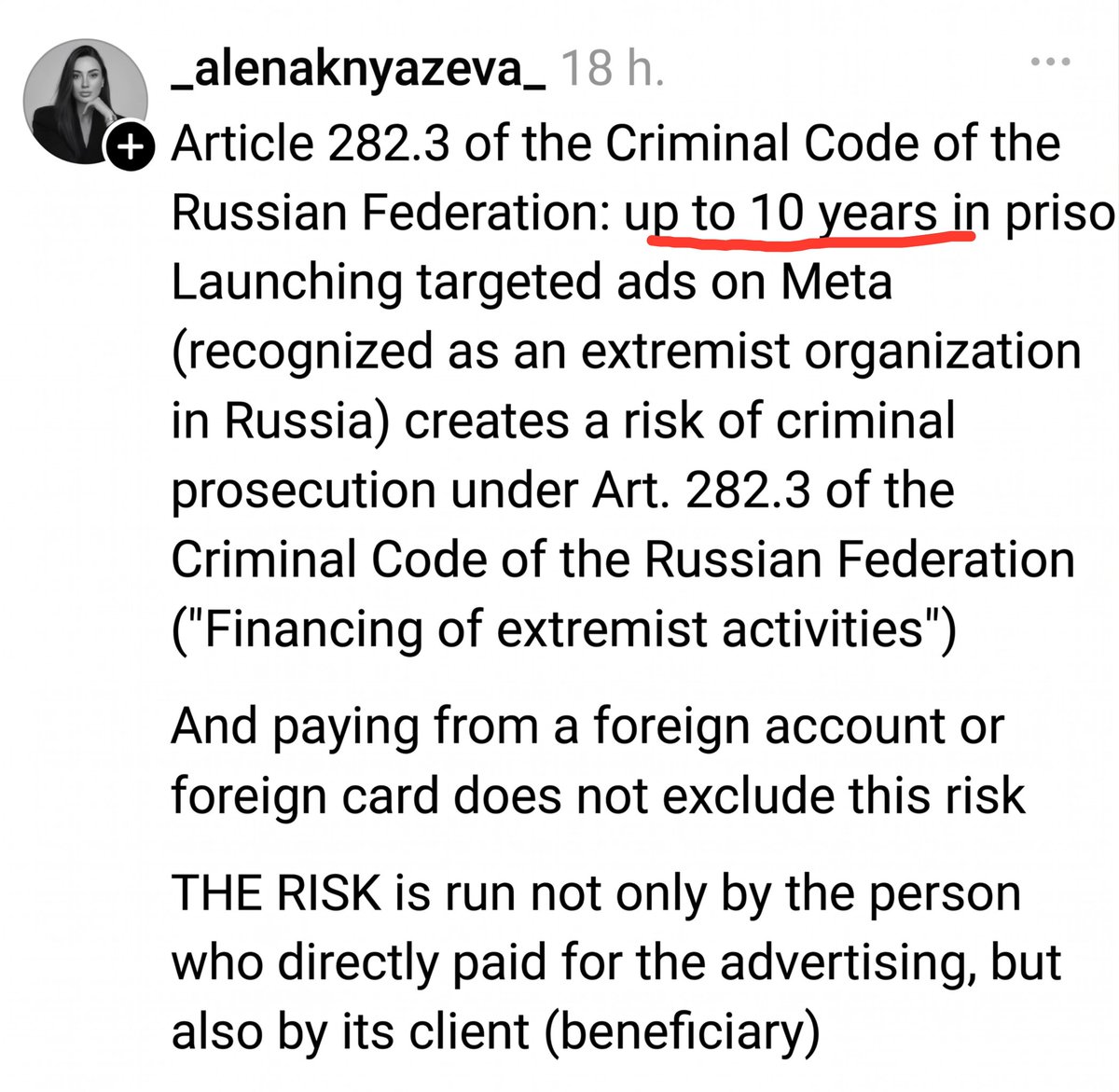
Congratulations, citizens of the Russian Federation.
Another step toward that "bright future" those patriotic blogging influencers were cheering for so fiercely back in 2022. Now, running targeted ads on Meta carries criminal charges and up to 10 years in prison. Paying with foreign cards won't save you anymore. Both the contractor and the client are on the hook.
I warned about this a long time ago. Scroll through my older posts or just Google my article, "Why Internet Marketing in Russia Is Over." I published it in 2024, though I should have written it back in 2022.
It's the end of 2026. Ahead of us is the prospect of another 10 to 15 years of this regime and endless tightening of the screws. The logic is obvious: the country is being methodically driven down to the level of North Korea.
It wouldn't be half as bad if it stopped at internet restrictions. Let's not kid ourselves, though. Next in line are currency controls, freedom of movement, and the basic right to breathe.
Another way to quickly find clients in the US or Europe. I have tested this method myself. It works specifically for small local businesses: restaurants, laundromats, service contractors, and anyone listed on Google Maps.
I didn't invent this approach. Below is an almost word-for-word breakdown of a real Reddit case study that describes the process accurately.
For two months, the author sent cold emails to local service companies (HVAC, contractors) and got a 1% reply rate. He tested subject lines, calls to action, and send times. Nothing changed.
The problem was at step one: he was scraping Google Maps and emailing generic info@ addresses. The owner of a three-person company doesn't sit in the general inbox. Once he switched to finding verified direct contacts for decision-makers, his reply rate jumped from 1% to 4-8%.
Here is the step-by-step workflow:
1. Scrape Google Maps. Search by niche and city. Use a simple filter: at least 10 reviews and a working website to filter out dead listings right away. One search usually yields 50-80 companies.
2. Check the website. Look for three things: whether the site is active, if the owner's name is listed anywhere (About page, footer, team page), and what corporate email format they use.
3. Find the owner if the site doesn't list them. Spend 2-3 minutes checking four sources: a Google search for "[company name] owner", industry directories and the Better Business Bureau, the company's LinkedIn page (in small businesses, the owner is often the only person listed), and public business registries. If nothing turns up in a couple of minutes, move on.
4. Guess and verify the email. Build standard patterns from the name (first@domain, firstname.lastname@domain, etc.) and run them through SMTP verifiers like NeverBounce or Bouncer. Don't skip this. One unverified send gave the author a 14% bounce rate and burned his domain reputation.
5. Personalize using reviews. Google Maps reviews are a goldmine. Customers mention response times, pricing, or specific technicians by name. A single line referencing a real detail from a review outperforms any generic icebreaker.
6. Clean the spreadsheet and send via Instantly to keep deliverability under control.
Manually, this whole cycle takes 5-6 hours per 100 contacts. With a stack like WebLeads or Outscraper plus Instantly, it drops to 20 minutes, leaving only personalization to be done by hand.
What matters in practice:
You can do all of this manually with zero tech stack. Or you can set up scripts and AI tools to run it semi-automatically or fully automatically.
Either way, it still comes down to three things:
1. The offer: what you actually write in that first email to make someone want to reply.
2. Segmentation: picking the exact companies that genuinely need what you are offering.
3. English: first comes the email thread, then the call. You either handle it yourself or put someone with solid spoken English on that step.
One important note from my own experience. When I sent emails to generic info@domain addresses myself, my reply rate reached 3%. So the problem isn't always the inbox. It all comes down to how you frame your offer.
A marketer who can show a real case study and make a strong promise is almost always in demand. For a business owner, marketing is always a direct question of how their revenue is going to change.
To junior specialists, I recommend studying hard, training your brain, and getting out of manual operational grunt work into marketing and sales architecture as fast as possible. And to experienced Russian-speaking marketers who are still trying to scrape together a living inside Russia: I strongly advise you to quit that and move into the international market. There is WAY more money out there.
Friends, if you are still sitting on your hands debating whether to enter the English-speaking market (and right now I am talking to Russian-speaking marketers who are still trying to make money inside the CIS and the former Soviet bloc), stop doing that. Touch a woman's boobs, not the market.
This post was triggered by another viral chart on X (formerly Twitter), where some influencer claimed an "insane surge" in marketing jobs: supposedly demand for Content Producers jumped by 1,261%, Content Creators by 410%, and GEO specialists by 340%.
At first glance, it looks like cheap Twitter clickbait and manipulation. So I dug into the original sources and fresh 2026 labor market reports for the US and Europe (data from Semrush, the US Bureau of Labor Statistics, Indeed, and AMA). Here is what I actually found.
There is no explosive growth in total headcount globally. The overall market in the US is growing by just 7% over a multi-year horizon, while in Europe and the UK it has even dipped slightly. Yet inside the profession itself, a brutal restructuring is underway, and the numbers from that chart are partially real.
Here is what is actually happening with jobs in the English-speaking market:
1. Classic content marketing is dead.
In that exact Semrush study where the blogger pulled the +1,261% figure for content producers, there is a second half of the table he conveniently left out. Openings for traditional Content Marketing Managers crashed by 73%, and Content Marketing Specialists dropped by 74%. Companies have stopped hiring people who just write articles and manage social feeds. AI has completely absorbed that busywork.
2. The barbell effect: hollowing out the middle and juniors.
Entry-level roles in the US fell by 8.6% over the past year. The market has split into two poles. On one end are expensive strategists at the Director and VP level (in the UK, demand for senior leaders earning over £80,000 rose by 143%). On the other end are versatile doers capable of shipping video, UGC, and multi-format content turnkey.
3. Demand has shifted to technical and revenue skills.
Nobody needs people who just brainstorm creatives and chase reach anymore. According to recent data, "writing skills" as a requirement in Western job postings dropped by 28%, while analytics requirements skyrocketed by 369% to 818% depending on seniority.
Who companies are actually hiring and paying for in Western markets:
- GTM Engineer and RevOps (demand up 205%). These are no longer liberal arts types, but sales and marketing engineers. People who build automated funnels powered by AI agents, data scraping, CRMs, and multichannel outreach, directly driving revenue and pipeline.
- GEO / AEO Specialist (up 340%). Optimizing content and brand visibility for AI search engines (ChatGPT, Perplexity, Gemini) rather than just classic Google. In the US, this already accounts for 20% of all content-related openings.
- Video production, AI Video Editor, and creator management (up 72% to 329%). Brands are pouring budgets into real influencers, TikTok Shop, and rapid AI-assisted video editing.
What is the takeaway from all of this? If you know how to think, analyze, gather data, and connect those dots into a logical system, you are at the top. Boring copywriting routines and primitive tasks are handled by AI today. But building a working sales architecture still requires a human.
Right now, creativity shows up primarily in the kind of sales architecture you design. That takes a live human brain. This is exactly why we are seeing such heavy demand for heads and directors who know how to engineer these systems.
The insane growth of marketing jobs right now:
Content Producer/Creative Director +1,261%
Content Creator +410%
Head of Content +376%
GEO / AEO Specialist +340%
AI Video Editor +329%
VP of Content +308%
GTM Engineer +205%
Creator Talent Manager +93%
Video Editor +59%
Social Media Strategist +36%
Social Media Manager +33%
Brand Strategist +26%
Growth Marketer +20%
Creator Partnerships Manager +20%
UGC Creator +20%
Influencer Marketing Manager +18%
Product Marketing Manager +18%
Short-form Video Producer +14%
Marketing Automation Manager +10%
Community Manager +5%
Gold rush.
Friends, let me jump into the discussion around Nvidia founder Jensen Huang and his resignation over romantic and sexual affairs.
First, the hypocritical sympathy for his wife. This woman is likely going to land in the top 10 richest women in the world. I am pretty confident a billion women on this planet would gladly trade places with her. So any pity directed her way is nothing more than pure hypocrisy.
Second, the exact same hypocrisy applies to Huang's resignation itself, supposedly over sexual relationships with female employees. Millions of women would have loved to be his mistress. A man's personal life is strictly his own business and has zero bearing on his professionalism. History is full of brilliant, smart, and successful men who were womanizers: DiCaprio, Clint Eastwood, Kennedy. Some had plenty of women, some had kids with different mothers, and none of it stopped them from being great actors, directors, or politicians. Looking at Russian history, Pushkin comes to mind. His intense love life actually fueled his greatness as a poet. Where is the link between the quality of Huang's work and his sex life? I just don't see it.
We shouldn't drag ethics into this either. Capitalism is about making money. It is not a religion and it is not a church. The main commandment is to generate profit. Without profit, nobody cares about your moral standing.
And finally, the most important part. Experience teaches us to follow the money if we want to get to the truth. Who benefits from everything happening right now? This looks like an orchestrated hit job. The story blew up way too fast. Some alleged connection to a potential Chinese spy, yet where is the trial? Where is the investigation? Where are the arrests? None of that exists. It is a blatant media fabrication, likely designed to tank Nvidia's stock so someone can cash in. Somebody heavily shorted those shares and manufactured all this noise. Just think of Soros and his favorite tactic: stepping into situations like this when prices drop and profiting off the crash.
In my view, what we are witnessing right now is one of the loudest and dirtiest plays to make money by tearing down a powerhouse tech company. A talented man who built a phenomenal business is losing his career just so some parasite can profit off it. And that is bad news for both the US and the entire world.
Continuing the topic of price versus value from my previous post, let's look at the problem from a different angle: the Russian-speaking marketing community itself.
Throughout my career, I have written several high-profile pieces that hit the top of search rankings and drew hundreds of comments.
The first was a breakdown of a popular CMS. The engine itself wasn't bad, and my tech lead pushed it heavily, but for real business needs, it turned out to be a nightmare to maintain. I laid out that pain point honestly. The article shot up in search results, and the developers behind the platform took serious offense.
The second was a case study on advertising in 2GIS. I tested the platform, tracked the funnel, and published the cold, hard numbers: what the sales reps promised, what I actually got, and the real cost per lead. The piece was brutal. My DMs flooded with thanks from fellow marketers, while reps from 2GIS reached out asking to talk, and their lawyers even tried to threaten me.
Many of you probably remember the third one: my teardown of content marketing using the agency TexTerra as an example, which blew up into a public clash with its then-director, Denis Savelyev.
Why did I do this? Did anyone pay me for it? No. These weren't paid hit pieces. I simply took a specific tool or service, popped the hood, broke the processes down to the molecular level, and showed the real unit economics. Sure, people could nitpick my methodology or argue over the details.
What shocked me was something else. None of my peers saw this as an attempt to clear the market of deadweight, lift the fog of war, and show clients how to tell a working tool apart from a cash incinerator.
I have one question for the market: why aren't you doing this?
Imagine if tomorrow, 100 marketers each published one honest breakdown. Say they took that notorious 60,000-ruble SEO package from a regional agency and mapped it out by billable hours. Even if you calculated the specialist's hourly rate at minimum-wage fast-food pay, the required workload physically wouldn't fit into that budget. Any competent agency could put together that math in an hour and prove with hard numbers what real SEO actually costs.
Yet they stay silent. Why?
Because 90% of agencies chose to bend to the market rather than change it. They see what a client is willing to pay and simply lower their quality to match that price tag. Nobody wants to educate the buyer, justify an estimate, or prove real value. It is easier to play along: "You want to pay pennies for the illusion of work? Great, we will deliver garbage for pennies."
Look at the media landscape. Everyone knows Elena Torshina. Even though she is genuinely sharp with certain tools, the broader public knows her strictly for scandals and public brawls with fake gurus. How many of her deep industry studies can you actually name?
Name a single active Russian-speaking marketing community where practitioners gather to dissect complex case studies, unit economics, and workflows at a high level. It simply does not exist.
In my article "Why Internet Marketing in Russia Is Over," I wrote about how economics, politics, and culture formed a snowball rolling straight toward declining competence. Small businesses in survival mode aren't ready to pay for sophisticated marketing, and frankly, they often don't need it.
Still, the overall state of the industry doesn't stop any individual specialist from doing honest work. Nobody is stopping us from sharing real experience, dissecting our own mistakes, publishing uncompromising analytics, and keeping things clean within at least the four square meters around our own desk.
That kind of open expertise and honest stance is the only way you eventually attract clients who don't pay "the market average," but what your work is actually worth.
A few days ago, a sharp thought popped up in my comments that stuck with me: "Looking for a correlation between price and quality is just as silly as telling others how much to charge for their services."
I remember the first time I ran into this years ago. I showed a client an estimate for 200,000 rubles, and he looked at me and said, "Listen, you're asking for 200k, while those guys over there do the exact same thing for 70k. Basically, it's the same service, just a different price tag."
That was the moment I realized the client genuinely couldn't see the difference.
In his logic, everything is simple. It's like shopping for jeans. On the corner, you have cheap Chinese ones for 1,500 rubles. A bit further down at a chain store, they're 4,000, a decent everyday option. And in the boutique next door, jeans hang for 15,000. A tenfold difference, even though at the end of the day, they're all just denim pants.
If you have a trained eye and some experience, you can walk in, feel the fabric, check the stitching, and see how they fit. It might even turn out that the 1,500-ruble pair holds up just as well as the designer ones. But the real question is: do you actually have the expertise to evaluate that before buying?
The problem with marketing is that it's an intellectual service. You can't touch it with your hands or inspect the stitching up front.
It's just like painters. Thousands of people graduate from art academies and paint pictures. Some artists have their work gathering dust in studios for pennies, others sell for high prices, and a few suddenly go for millions of dollars after they die. What makes one brushstroke fundamentally different from another? To an outsider, it's impossible to tell. It's the exact same story with illustrators, musicians, or marketers. Judging quality comes down to subjectivity.
It seems like you could solve this problem in marketing through billable hours. Take SEO. Here is an estimate for 200k: it includes X hours of work from specific specialists. And here is an estimate for 60k: a different set of people and fewer hours. Seems logical enough.
Except three massive holes immediately show up:
1. Who actually decides what an hour of some random guy's time is worth?
2. Who tracks how many hours he actually spent working on the task versus drinking coffee?
3. The work is still intellectual. Even a top-tier specialist can switch into low-power mode, phone it in, and put on a great show of looking busy.
So the client arrives at what feels like a rock-solid conclusion: there's no point in overpaying. Why spend 200k or 300k on marketing when you can get it for 60k? Either one could rip you off, slack off, or burn your budget. And since there are no guarantees, it makes more sense to risk the smaller amount.
And right here lies the main philosophical catch.
Being convinced that services only differ by price and that everyone around you is a hack isn't shrewdness. It's a specific person's worldview. If you already believe everyone is a con artist just waiting to cut corners and screw you over, then paying fair money really does seem stupid.
The whole question is why you are so sure of that. As the old, blunt saying goes: "If everyone around you smells like shit, maybe it's time to check your own shoes."
That is precisely why there is no point in trying to save the businesses of chronic cheapskates. They will always find a way to shoot themselves in the foot, penny-pinch themselves into failure, and then blame the entire market for being incompetent. If a client doesn't grasp that different levels of expertise and commitment produce different financial returns, explaining it to them is a waste of breath.
Of course, nobody has the right to dictate to the market what to charge or what to pay. Everyone sets their own price.
But for any business owner or specialist, there is always a much more important question to ask yourself: which world do you actually want to work in? The one where everyone is trying to rip each other off for pennies, or the one where people stand behind their quality and get paid what they're worth?
A few days ago, a sharp thought popped up in my comments that stuck with me: "Looking for a correlation between price and quality is just as silly as telling others how much to charge for their services."
I remember the first time I ran into this years ago. I showed a client an estimate for 200,000 rubles, and he looked at me and said, "Listen, you're asking for 200k, while those guys over there do the exact same thing for 70k. Basically, it's the same service, just a different price tag."
That was the moment I realized the client genuinely couldn't see the difference.
In his logic, everything is simple. It's like shopping for jeans. On the corner, you have cheap Chinese ones for 1,500 rubles. A bit further down at a chain store, they're 4,000, a decent everyday option. And in the boutique next door, jeans hang for 15,000. A tenfold difference, even though at the end of the day, they're all just denim pants.
If you have a trained eye and some experience, you can walk in, feel the fabric, check the stitching, and see how they fit. It might even turn out that the 1,500-ruble pair holds up just as well as the designer ones. But the real question is: do you actually have the expertise to evaluate that before buying?
The problem with marketing is that it's an intellectual service. You can't touch it with your hands or inspect the stitching up front.
It's just like painters. Thousands of people graduate from art academies and paint pictures. Some artists have their work gathering dust in studios for pennies, others sell for high prices, and a few suddenly go for millions of dollars after they die. What makes one brushstroke fundamentally different from another? To an outsider, it's impossible to tell. It's the exact same story with illustrators, musicians, or marketers. Judging quality comes down to subjectivity.
It seems like you could solve this problem in marketing through billable hours. Take SEO. Here is an estimate for 200k: it includes X hours of work from specific specialists. And here is an estimate for 60k: a different set of people and fewer hours. Seems logical enough.
Except three massive holes immediately show up:
1. Who actually decides what an hour of some random guy's time is worth?
2. Who tracks how many hours he actually spent working on the task versus drinking coffee?
3. The work is still intellectual. Even a top-tier specialist can switch into low-power mode, phone it in, and put on a great show of looking busy.
So the client arrives at what feels like a rock-solid conclusion: there's no point in overpaying. Why spend 200k or 300k on marketing when you can get it for 60k? Either one could rip you off, slack off, or burn your budget. And since there are no guarantees, it makes more sense to risk the smaller amount.
And right here lies the main philosophical catch.
Being convinced that services only differ by price and that everyone around you is a hack isn't shrewdness. It's a specific person's worldview. If you already believe everyone is a con artist just waiting to cut corners and screw you over, then paying fair money really does seem stupid.
The whole question is why you are so sure of that. As the old, blunt saying goes: "If everyone around you smells like shit, maybe it's time to check your own shoes."
That is precisely why there is no point in trying to save the businesses of chronic cheapskates. They will always find a way to shoot themselves in the foot, penny-pinch themselves into failure, and then blame the entire market for being incompetent. If a client doesn't grasp that different levels of expertise and commitment produce different financial returns, explaining it to them is a waste of breath.
Of course, nobody has the right to dictate to the market what to charge or what to pay. Everyone sets their own price.
Remember that snake-oil pitch from the pre-war days, when every guru on the internet was selling you the idea of "exponential business growth"? Today, it almost sounds like a bad joke. Companies in Russia and Kazakhstan aren't thinking about growing 10x right now. They're just trying to stay afloat. And with a global downturn right around the corner, it won't just be the CIS crying soon. Europe will feel it too.
Still, when it comes to real scaling in Western markets, say through outbound outreach, exponential growth looks nothing like a magic bullet.
Usually, a company comes to me and says, "We just want to run a quick test on the European market." Fine, we launch it. On the output, we get a pool of decision-makers from major European enterprises who are actually interested in talking about the product. And that's where reality hits and shatters any fantasies about fast money.
Even before the test begins, it turns out the company doesn't have a coherent presentation tailored for the West. Then, once the first leads come in, the main question pops up: how many of these contacts closed into a deal, and how fast? Almost always, the answer is zero.
The reason is simple: your sales team doesn't know how to sell to Western companies. Your rep doesn't know how to find a direct WhatsApp number alongside LinkedIn, how to make a cold call, or how to run a proper Zoom call. I'm not even talking about English fluency. I mean basic negotiation skills and delivering a short, sharp pitch that actually hooks a buyer.
Okay, let's say you hire the right person and train them. They learn how to turn calls into requests for a commercial proposal. What does that proposal look like? The templates you use back home simply don't work in Europe.
Say you fix that too and make it to your first deal. Now you hit the contract wall. European jurisdiction and the attitude toward legal paperwork are fundamentally different from what we're used to. Get ready for a non-trivial, 100-page contract.
Finally, after a long grind, the contract is signed, the money hits the account, and the unit economics check out. The hyped-up founder says, "Great, now let's do exponential growth!"
So we scale up the LinkedIn database, expand the infrastructure, increase throughput, and double or triple the incoming lead flow. And the entire cycle breaks all over again, only this time at the operational level:
- One sales rep gets buried. You need a second one, then a third, and every single one has to be trained.
- The team starts losing track of contacts. Now you need a proper CRM, strict SOPs, and a transparent pipeline so you can see where every lead sits and where the current bottleneck is.
- You get three reps running smoothly, and you hit the next ceiling. Now you need outsourced operators, deep database-to-CRM integrations, and AI tools to analyze and score incoming leads.
- One channel isn't enough anymore. You have to layer on automated remarketing, niche communities like Reddit, and trade shows in Europe, which work remarkably well for industrial B2B.
Here is the truth: exponential growth isn't hidden behind one clever hack or ad setup. It is the sequential, cyclical unblocking of bottlenecks across lead generation, sales, legal, production, and analytics.
So when someone tries to sell you "exponential growth," what they should really be selling you is systematic marketing. Long-term, grind-it-out marketing for at least three years straight. That is the exact pitch I give my clients: we are going to rebuild your system step by step over the next three years, and every stage is going to cost you more than the last.
I recently looked into a project with huge ambitions: expanding into Europe and closing industrial heavyweights with multi-billion-euro turnovers. The ambition is solid, and they are ready to invest real money into lead generation and outbound.
Then we get to the funnel, and I ask to see their commercial proposal. The actual document that gets sent over right after the initial Zoom call or meeting.
They send me three paragraphs directly in the body of an email.
These people are planning to close seven-figure deals, yet their proposal looks like a greasy receipt from a corner discount shop.
In the enterprise space, I live by a simple rule: 20/100.
A 20-page proposal. A 100-page contract.
The exact page count is arbitrary, but the philosophy behind it is fundamental. A proposal is not an administrative formality with a price tag. It is your primary sales engine. It is the document that gets printed out, placed on an executive's desk, and sits there for six months. And they will come back to it because it is impossible to ignore.
A proper proposal teaches the client more about their own business and operational bottlenecks than they knew before opening it. None of your competitors will ever offer that level of detail, that high resolution, or that depth of understanding of their industry and local landscape.
A real enterprise proposal has schematics, charts, calculations, a breakdown of existing bottlenecks, and a clear methodology to fix them. The entire document speaks the client's language and focuses on the client's problems. The actual price only shows up in three paragraphs at the very end.
If you want to sell a one-million-euro solution, package it like a three-million-euro project. The buyer needs to see an overwhelming volume of value so that the final price tag feels completely logical and well worth it.
The exact same logic applies to the contract. Legal documentation is just an extension of the sales process. It immediately signals your operational maturity, accountability, and depth of expertise.
If you are too lazy to put together a 20-page document backing up a six-figure or seven-figure check, you have zero business entering the European market. Corporate capitalism there has run for two centuries. You are dealing with multi-generational family businesses where partnerships last 15, 20, even 50 years.
Europe is not a place where you can just walk in off the street and flog raw, half-baked products in thirty minutes. Deals at this level are not a one-night stand at a local bar. It is a long, deliberate process built with marriage in mind.
Train your sales team to package complex proposals properly. Otherwise, no amount of outbound, LinkedIn messaging, or cold email campaigns will ever save your numbers.
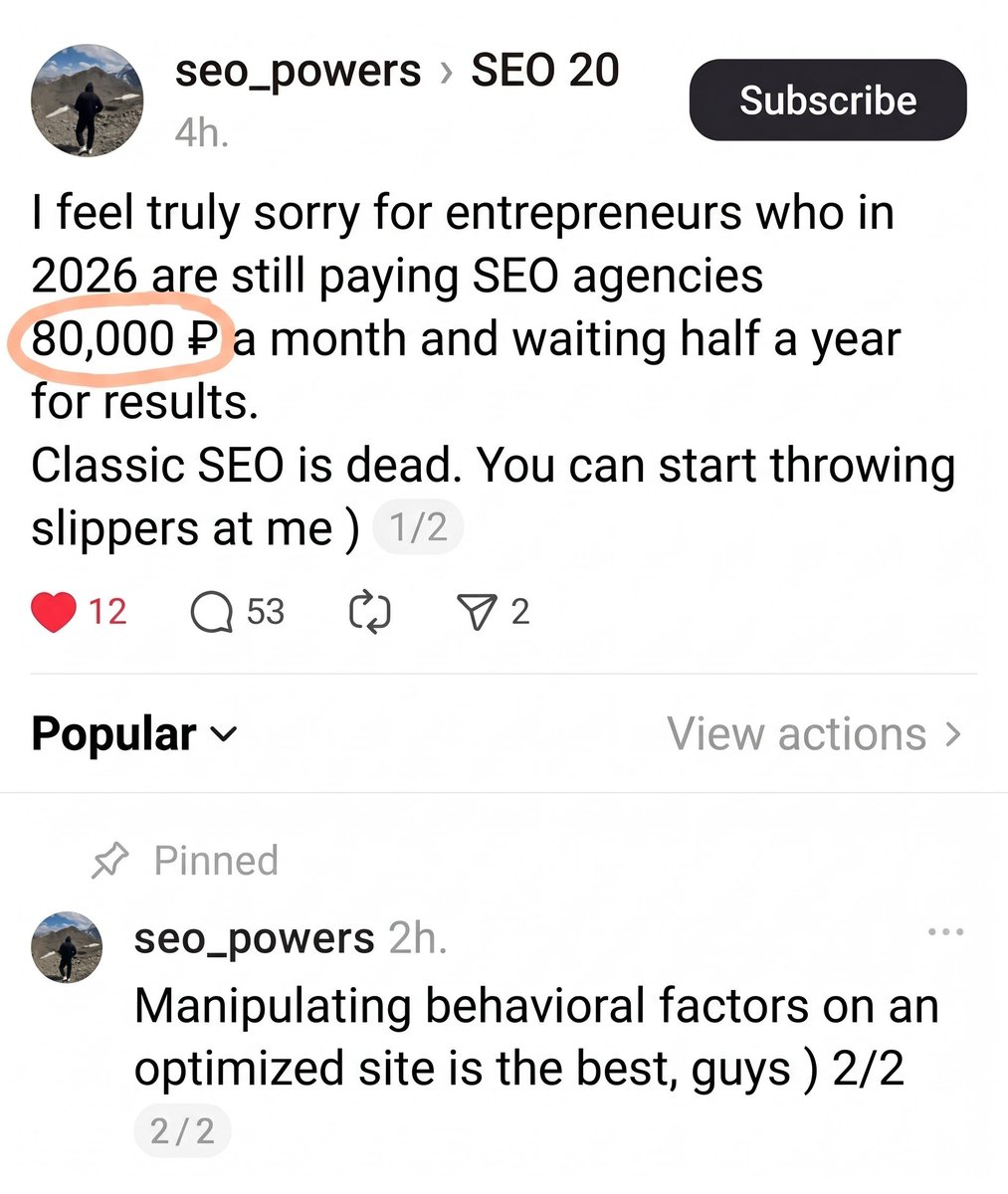
What is the key word here? "SEO"? "Behavioral factors"?
No. The key word is 80,000 rubles (around $850).
If an agency pitches end-to-end turnkey SEO for that kind of money, you are almost certainly paying for busywork theater. In any competitive niche, baseline competent work starts well above that mark, and a serious monthly retainer runs anywhere from 200,000 to 300,000 rubles ($2,000 to $3,000).
Yet the market plays by its own rules.
Recently, a longtime client came to me for advice. He runs an industrial manufacturing plant. The broader crunch hit hard, pipeline volume dried up, and sales stalled. Panicking, he rushed to fix it and found a well-known agency out in Siberia. They pitched him the dream offer: "pay for performance." You only pay when your website hits the top search rankings for target keywords. In Moscow.
In Moscow, of all places. The most overheated, cutthroat regional market where brands burn massive ad budgets just to defend single clicks.
He slides the contract across the table for my take.
Looking at him, I already knew: there was zero chance he would ever pay 200,000 or 300,000 for proper SEO. It is purely psychological. Regional manufacturing owners will never swallow real marketing retainers unless their backs are completely against the wall. To him, 80,000 was the absolute ceiling. Add the magic words "guaranteed results" and "top rankings in Moscow," and he was sold. Anyone who actually works in search knows nobody legitimately ranks in the capital for pennies anymore.
Technically, there was nothing to object to. The agency has a brand name, and nobody prints "we cheat the algorithms" on their contracts. There was no conflict of interest either, as they planned to test this on a separate secondary domain. Still, any decent SEO specialist will tell you the truth: fast, dirt-cheap rankings in Moscow come from manipulating user behavior metrics with bots. And running click fraud schemes on search engines invariably leads to a permanent domain ban.
I just shrugged: "If you want to roll the dice, go ahead."
This is how classic marketing still operates across local markets. Founders do not buy viable unit economics. They buy a cheap invoice and the illusion of safety.
A guarantee of what, exactly? That a couple of vanity keywords linger on page one for a few weeks? Who promised that ranking number one translates to closed deals? Industrial equipment does not sell on impulse just because someone found a landing page on an organic search query.
More importantly: what happens next? The site sits at the top for a month, two months, maybe half a year. Then the search engine penalty hits, and the domain drops completely out of the index. How much will it cost to salvage the domain? How many months will it take to build, rank, and warm up a fresh domain while the plant sits idle with zero incoming RFQs?
Buying the fantasy of guaranteed rankings for pocket change is easy. Doing the actual work, assessing operational risk, building a real pipeline, and tracking revenue is hard.
The hardest step for any founder is hiring an in-house Head of Marketing who actually has the competence and drive to grow the enterprise instead of burning ad spend.
When you have a strategic lead in your corner, tactics like SEO, paid search, and cold channels become straightforward operational tools. Without one, you will keep paying algorithmic manipulators and wondering why the pipeline is dead.
How to burn your marketing budget, sales salaries, and European contracts over bad mailbox settings.
We are on a routine sync with a client's sales team. Cold outreach campaign targeting the European market: going over lead volume, response times, and funnel bottlenecks.
Mid-conversation, one of the reps casually drops: "Whenever I follow up on LinkedIn, I ask the prospect to check their spam folder. Our emails end up there all the time."
I stop the call right there. "Spam? Since when?"
The rep shrugs. "It happens. I send an offer or a follow-up, the prospect goes dark, and later turns out it landed in spam."
Context: we run outbound from separate, warmed-up secondary domains. Nobody touched the main corporate domain for cold outreach, so I hadn't audited it yet. The reps were just using their standard company mailboxes for day-to-day follow-ups once a contact engaged.
Right after the call, I check their mail server settings. And there it is: basic DMARC records for the corporate inboxes are completely missing. Zero.
I run a deliverability check on their main corporate domain. At least 80% of emails sent to European prospects simply never arrive. Realistically, closer to 100%. European mail providers reject incoming mail with missing authentication straight out of the gate.
Think about this: the company hires me, pays an outreach team, pays sales salaries, and pays system administrators. All of that money goes straight down the drain because email is the primary business channel in Europe, and the company's messages cannot even reach an inbox.
Here is another example, simpler, but from the exact same playbook.
Another client, local market. I get an automated alert from a Telegram bot: form submission failed to send email.
I check the server logs. The website has a lead form. A prospect fills it out, hits "Submit", and the inquiry is supposed to route to the company inbox.
Except it never does. The company's mail server flags notifications from its own website as spam and drops them at the door. Leads were just vanishing into thin air.
They also have a full-time system administrator. They also have an active mail server. Yet incoming leads went straight to the trash for months without anyone noticing.
Marketing is not about flashy creatives, clever copy, or high-level scaling strategies. Marketing is operational hygiene, and the devil is in the details.
You can build the cleanest lead generation machine, hire top closers, and throw serious cash at the project. But if your mail server lacks basic DMARC settings, or your own system kills inbound leads, you will burn 50% to 80% of your revenue on pure carelessness. And you will still be sitting there wondering why no one is writing back.
I get a call from a client in manufacturing. He vents: our pipeline is flooded with low-ticket requests. Routine maintenance, replacing consumables, fixing a few mechanical parts. It is a massive operational headache, the checks are pocket change, and the margin is basically zero. His conclusion is straightforward: "Why bother? We are cutting these out."
Around the same time, I talk to another client. He is aiming for the European market with heavy industrial machinery, where average deal sizes hover around $500,000. His game plan makes sense on paper: land three deals a year, skip the daily chaos, and make solid money.
The desire of small B2B operations to chase only whale contracts is completely understandable. Landing three half-million-dollar deals is objectively more appealing than drowning in 300 orders worth $250 each, where operations eat every dollar of profit.
Yet this exposes a classic trap I see all the time: completely ignoring the product matrix and the customer journey.
When you try to sell an ultra-expensive solution cold, the sales cycle stretches out indefinitely. That is especially true when entering a new territory where nobody knows who you are.
Industrial B2B runs on pure conservatism. It is an old-school environment where mistakes cost millions. Plant downtime and equipment failures trigger endless finger-pointing, contractual penalties, and messy insurance claims. Because of that, plant managers prize stability and reliability above all else. No chief engineer or technical director in their right mind signs a $500k deal with a random supplier who just walked in off the street.
The upside is that this conservatism cuts both ways. Breaking in is painful, but once you deliver without screwing up, they stick with you for decades. It is like finding a reliable pair of boots: a guy finds the right fit and buys the exact same brand for the next 15 years.
How do you break through that wall? By lowering the barrier to entry.
Your product tiers have to connect logically:
1. Renting instead of an immediate capex purchase. Dropping half a million on day one is terrifying. Renting gear for a specific pilot or a temporary project feels manageable. The client runs the numbers on their own floor, sees the ROI, and naturally realizes that buying the equipment outright makes far more financial sense.
2. Service and minor repairs as foot-in-the-door offers. Swapping out a couple of bolts or repairing an industrial cooler will never generate real revenue by itself. What it does give you is site access, direct face time with engineers, and vetted vendor status.
Once you handle regular maintenance and solve an immediate bottleneck on schedule, you are inside the trust circle. From there, the real business starts: auditing an adjacent workshop, upgrading power infrastructure, or replacing an entire aging line. You are no longer selling cold.
Yes, low-ticket orders are annoying. They demand ruthless operational rigor: Standard Operating Procedures, process routing cards, standardized workflows, and assembly-line precision. Most small companies drop the ball here because building reliable operations for minor service jobs is harder than waiting around for a big contract every six months.
Yet it is precisely this balance of high-volume base services and high-ticket capital sales that makes an industrial business resilient. If your roadmap includes scaling or expanding internationally, get comfortable managing both ends of that spectrum. Treating low-risk entry points as stepping stones toward massive customer lifetime value is not busywork. It is how you survive.
@aj_geo_analysis Это тупой пиздеж. Описанная схема была распространена по всему миру в эпоху родоплеменного строя. Арабы культурно отсталые. Для них закон - пустой звук. Важна только твоя племя.