A Harvard psychiatrist said one sentence about why ambitious people are self sabotage. It made his colleagues stop talking mid conversations.
The sentence was this:
"The body doesn't distinguish between a real threat and a memory of one."
His colleagues sat in silence because they knew what it meant. Every ambitious person in their practice was reacting to dangers that no longer existed.
A criticism from 10 years ago still triggered fight-or-flight. A failure from their 20s still lived in their chest. A voice from childhood still told them they weren't safe.
The body doesn't update the calendar. It just keeps protecting.
So when a promotion gets close, the body says "danger." When visibility increases, the body says "threat." When success is finally possible, the body says "stop."
That's what self-sabotage actually is. Not a character flaw. Not a secret fear of success. Just a nervous system stuck in an old timeline.
The psychiatrist noticed something else. The ones who broke the pattern weren't the ones who tried harder. They were the ones who learned to show their body a new timeline.
A 60-Second Practice When You Feel Self-Sabotage Rising
Pause. Place one hand on your chest. Whisper to yourself: "That was then. This is now." Take three slow breaths. Let the body catch up to the present.
This turtle behavior, often called “claw fluttering,” is a courtship ritual where a male rapidly vibrates or waves his long front claws near a female’s face to attract her
🚨BREAKING: Ghana becomes the first African country to integrate payment into its Citizens' Identity Card, ditching US-based payment giants Visa and Mastercard in Africa
The card is now widely accepted in over 200 countries for online, in-store, and ATM use. It allows for secure purchases, international payments, and offers perks like insurance and emergency assistance.
Ghana Card holders can activate their card using the MyCitizens App or by dialling *402#
People who moved abroad alone in their 20s, handled all docs, bank account, visa, tax, jobs, accomadation, and culture difference
These people fear nothing anymore
A HARVARD psychologist says: “if you’ve achieved nothing by 25, you’ve avoided the most destructive illusion of youth”
> In 2021, a Harvard psychologist surprised a lecture hall with an unexpected statement:
“If you haven’t accomplished much by 25, you may have escaped one of youth’s biggest illusions.”
At first, the room laughed.
She wasn’t kidding.
> The illusion of early success.
In your early 20s, the brain seeks quick proof of worth ~status, attention, rapid achievements.
But psychologists warn that chasing recognition too soon can lock people into roles or paths they never consciously chose.
They decide too early… and spend years trying to undo it.
> The exploration phase.
Research on career development suggests that people who explore more before 30 often build stronger long-term directions.
Testing ideas.
Making mistakes in public.
Changing course.
At 25 it looks like confusion ….but by 35 it often turns into clarity.
People who feel “behind” in their mid-20s frequently gain something others miss:
Perspective.
Patience.
And a clearer sense of what truly matters to them.
That foundation often leads to better decisions later on.
At the end of the lecture, the psychologist left the students with one final thought:
“You’re not meant to have life fully figured out at 25.”
“You’re meant to discover who you’re not.”
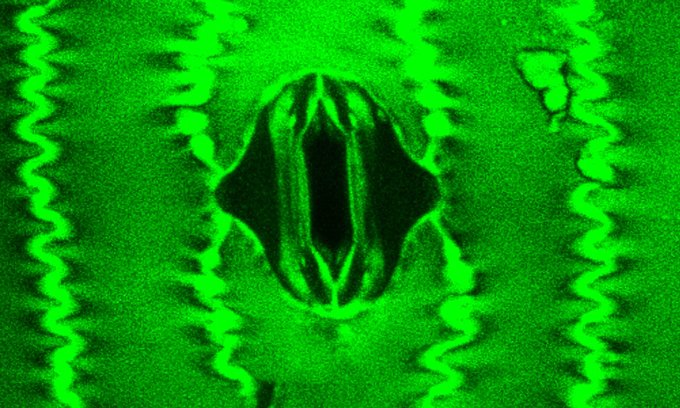
🚨: For the first time, we're watching plants breathe in real time. 😮
Plants "breathe" through minuscule openings on their leaves known as stomata—a term derived from the Greek word for "mouths." These tiny pores perform a critical balancing act: they open to allow carbon dioxide (CO₂) to enter for photosynthesis, while simultaneously permitting water vapor to escape into the atmosphere through transpiration.
This ongoing compromise influences a plant's growth rate, water requirements, and overall resilience, especially in challenging environments.
Historically, scientists faced significant limitations in studying this dynamic process directly.
Tomás Vega invented a MouthPad, a groundbreaking device that enables people with paralysis to control digital devices using tongue, mouth, and head gestures.
In the city of Shenyang, China, a very unusual method is being used to treat insomnia: people are hanging from their necks with a belt and gently swinging for a few minutes.
Those who try it claim their sleep problems have significantly improved.