Goldmine for AI Engineers! 📌
If you're learning AI, ML, LLMs, or AI agents, don't waste hours jumping between random tutorials.
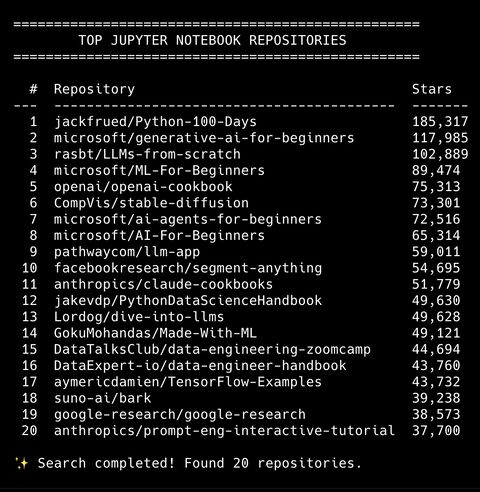
These are 10 repositories I'd actually keep bookmarked - from Python fundamentals to ML, LLMs, agents, and production AI.
1. Python - 100 Days
jackfrued/Python-100-Days
A 100-day Python learning path covering fundamentals, data analysis, web development, and more.
GitHub:
https://t.co/ED5Fm7Ei3Q
2. Generative AI for Beginners
microsoft/generative-ai-for-beginners
A practical introduction to building Generative AI applications.
Covers:
• LLM fundamentals
• Prompt engineering
• RAG
• AI agents
• Fine-tuning
• AI application development
GitHub:
https://t.co/kdQ2b6jBYB
3. LLMs From Scratch
rasbt/LLMs-from-scratch
Want to understand what's actually happening inside an LLM?
Build one step by step.
Covers:
• Tokenization
• Embeddings
• Attention
• Transformers
• Training
• Fine-tuning
GitHub:
https://t.co/lzCKdk7kl1
4. Machine Learning for Beginners
microsoft/ML-For-Beginners
A structured 12-week, 26-lesson curriculum covering classical machine learning.
A good starting point if you want ML fundamentals before jumping into LLMs.
GitHub:
https://t.co/AlXqh5KO9b
5. OpenAI Cookbook
openai/openai-cookbook
A collection of practical examples and guides for building applications with OpenAI models.
Useful when you want to move from:
Learning → Building
GitHub:
https://t.co/FrBiKTbIS6
6. Stable Diffusion
CompVis/stable-diffusion
Interested in generative image models?
This repository contains the original Stable Diffusion implementation and research code.
GitHub:
https://t.co/25e7FVkHIf
7. AI Agents for Beginners
microsoft/ai-agents-for-beginners
A practical course for understanding and building AI agents.
Covers:
• Agentic AI
• RAG
• Agent frameworks
• Tool use
• Multi-agent systems
GitHub:
https://t.co/oAn2ptn2T5
8. AI for Beginners
microsoft/AI-For-Beginners
A structured 12-week, 24-lesson introduction to AI.
Covers:
• Neural networks
• Computer vision
• NLP
• Deep learning
• Classical AI
GitHub:
https://t.co/p4PdLnL89o
9. LLM App
pathwaycom/llm-app
Focused on building practical LLM applications.
Explore:
• RAG
• AI pipelines
• Enterprise search
• Real-time data
• Vector search
GitHub:
https://t.co/LYMOE4PgWj
10. Segment Anything
facebookresearch/segment-anything
A foundation model for promptable image segmentation.
Worth exploring if you're interested in computer vision and multimodal AI.
GitHub:
https://t.co/j0mPn2or2V
Don't bookmark all 10 and forget about them.
Pick based on where you are:
Python → Python-100-Days
ML → ML-For-Beginners
AI Fundamentals → AI-For-Beginners
LLMs → LLMs-from-scratch
Generative AI → Generative-AI-for-Beginners
Agents → AI-Agents-for-Beginners
Building → OpenAI Cookbook / LLM App
Computer Vision → Segment Anything
Pick one.
Build something.
Then move to the next.
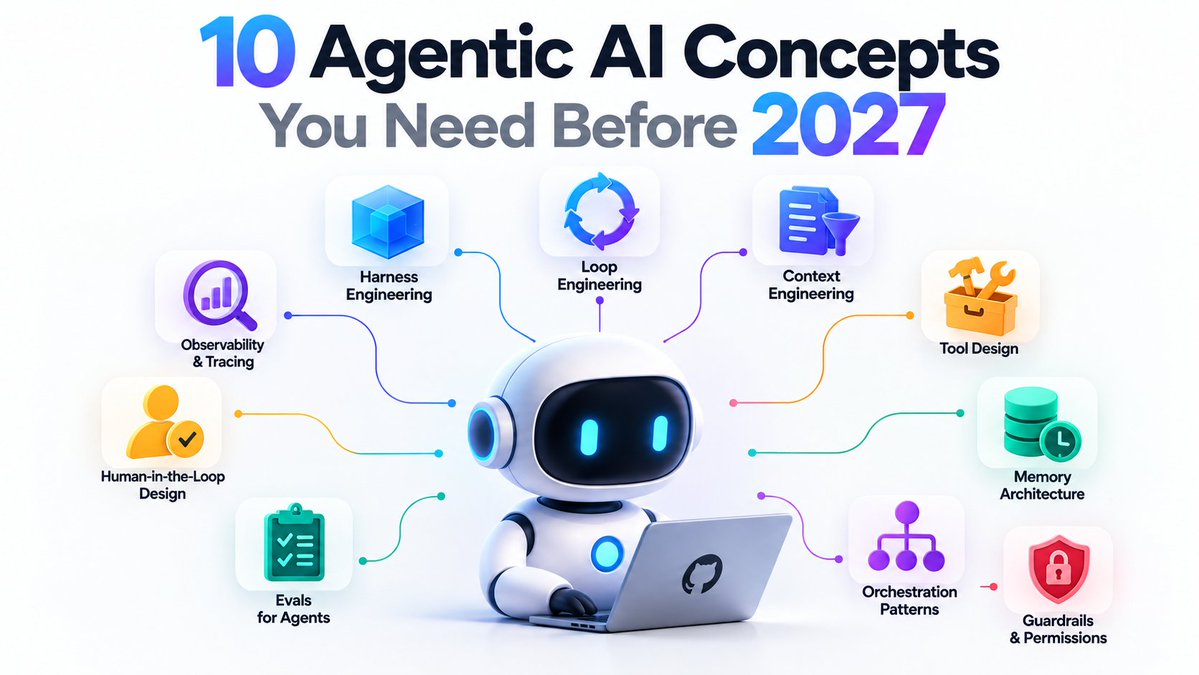
10 GitHub repositories to learn the Agentic AI concepts you need before 2027 👇
1- Harness Engineering
https://t.co/GaBptbI9Li
2- Loop Engineering
https://t.co/vntHvqr5Z8
3- Context Engineering
https://t.co/WMSnpLWLCb
4- Tool Design & MCP
https://t.co/2BBQPGEIB9
5- Agent Memory
https://t.co/u1khzk1ShW
6- Agent Orchestration
https://t.co/UHrE2bTLmy
7- AI Guardrails
https://t.co/bPDcwGrxlK
8- Agent Evals
https://t.co/lZdNMrxYXQ
9- Human-in-the-Loop
https://t.co/A8oCRldLlx
10- Agent Observability
https://t.co/BmnkE0mxy9
These cover the production side of agentic AI:
→ Harness
→ Loops
→ Context
→ Tools
→ Memory
→ Orchestration
→ Guardrails
→ Evals
→ Human oversight
→ Observability
✅ Save this for your Agentic AI learning journey.
Join the tech community for more resources:
https://t.co/GXwVvESAPV
Follow for more developer resources, AI tools, interview prep, jobs & opportunities.
SSH Tunnels Cheat Sheet 🧐
- Local port forwarding: Access private endpoints, potentially through a bastion host, as if they were locally opened ports
- Remote port forwarding: Expose local ports or private network addresses publicly via an exit node
Both with good old SSH 👇
@MichaelVerstrae@narendramodi Indian leadership has independent decision makers. Not like puppet leadership like in Ukraine.. it's because of poor leadership Ukraine is in this mess
@bigbasket_com Number of items available has drastically reduced.. most of the items are not available now a days. Before @TataCompanies merger BB was very good. Fresh vegetables and organic items list was high. Bb needs backward upgrade to survive now
@sagar_lele Shame on people who give importance to the quantity of hours rather than quality.. I strongly believe person who spend more than expected hours in office regularly is incompetent in his role.
Operating System resources that helped me in clearing interviews at top MNCs.
It includes videos, blogs, resources & notes for revision.
A thread 🧵
(1/n)
If you want to learn system design and Kubernetes, read these famous engineering blog posts from top companies (OpenAI, Airbnb, Netflix, Stripe, etc)
I spent hours digging for them so you don't have to:
10 of the Best Company Engineering Blogs I read this year:
1) How Discord stores trillions of messages: https://t.co/5YRnNKTMXh
2) Real time messaging at Slack: https://t.co/5i8oC5GlHV
3) How Canva scaled Media uploads from Zero to 50 Million per Day: https://t.co/44O5lxb76u
4) How Facebook uses AI to power it’s Marketplace: https://t.co/Fr9wJCIWj7
5) How Pinterest built a real-time user action counting system for ads: https://t.co/Ko4hzrvngI
6) How Airbnb avoids double payments: https://t.co/jMUACVjafB
7) How Uber optimizes the Timing of Push Notifications using ML: https://t.co/1IbWgMs2qP
8) Capturing a billion emojis at Hotstar: https://t.co/ODM25yYVwo
9) Stripe’s payments APIs - The first 10 years: https://t.co/ek5bcVDhbH
10) Building Faster Indexing at DoorDash: https://t.co/5wOk1j67Al
IBM MQ -> RabbitMQ -> Kafka ->Pulsar, How do message queue architectures evolve?
🔹 IBM MQ
IBM MQ was launched in 1993. It was originally called MQSeries and was renamed WebSphere MQ in 2002. It was renamed to IBM MQ in 2014. IBM MQ is a very successful product widely used in the financial sector. Its revenue still reached 1 billion dollars in 2020.
🔹 RabbitMQ
RabbitMQ architecture differs from IBM MQ and is more similar to Kafka concepts. The producer publishes a message to an exchange with a specified exchange type. It can be direct, topic, or fanout. The exchange then routes the message into the queues based on different message attributes and the exchange type. The consumers pick up the message accordingly.
🔹 Kafka
In early 2011, LinkedIn open sourced Kafka, which is a distributed event streaming platform. It was named after Franz Kafka. As the name suggested, Kafka is optimized for writing. It offers a high-throughput, low-latency platform for handling real-time data feeds. It provides a unified event log to enable event streaming and is widely used in internet companies.
Kafka defines producer, broker, topic, partition, and consumer. Its simplicity and fault tolerance allow it to replace previous products like AMQP-based message queues.
🔹 Pulsar
Pulsar, developed originally by Yahoo, is an all-in-one messaging and streaming platform. Compared with Kafka, Pulsar incorporates many useful features from other products and supports a wide range of capabilities. Also, Pulsar architecture is more cloud-native, providing better support for cluster scaling and partition migration, etc.
There are two layers in Pulsar architecture: the serving layer and the persistent layer. Pulsar natively supports tiered storage, where we can leverage cheaper object storage like AWS S3 to persist messages for a longer term.
Over to you: which message queues have you used?
–
Subscribe to our weekly newsletter to get a Free System Design PDF (158 pages): https://t.co/uc5M7CdXXC