@simplydt great question, stability with pages is achieved thanks to the hybrid approach. tokio's async loop handles the waits with DOM, and if the page becomes too chaotic, the interactive proxy allows you to intervene manually instead of crashing the script.
That’s honestly incredible and a brilliant take.
"Memory is structured, not a transcript" is definitely something worth digging deeper into.
Shifting away from chat blobs to an explicit, typed state changes everything for agent reasoning, and it's a great rabbit hole to keep exploring.
Generating images with GPT Image 2, writing from scratch every time or copying and pasting prompts, wanting a specific style but not knowing how to describe it, and trying over and over again, is a considerable waste of time.
On GitHub I saw the project GPT Image 2 Skill, which offers a complete library of curated prompts for generating images, and can also be invoked directly as a skill for Claude Code and Codex.
With a single command you can generate images, and it comes with a complete guide for writing prompts and parameter explanations, covering everything from text-to-image to image editing.
The prompts are divided by styles into 28 categories, including anime, video game screenshots, cyberpunk, illustrations for academic papers, product posters, UI design mockups, tattoo designs, etc.; each one comes with an example image of the result and the complete parameters.
If you use GPT Image 2 frequently but struggle to write good prompts, this library can serve as a reference manual to consult at any time; it is worth saving.
REPOO
Raw text RAG is definitely hitting a wall with complex codebases. Brute-force context dumping just introduces too much noise and burns tokens for nothing. Moving towards multi-agent pipelines that actually compile code intent into a structured knowledge base is the only scalable way forward.
Spot on, Manuel.
Indexing fixes structural search, but hidden product constraints will still break the agent's loop.
A clean fix is pairing local .md files with custom skills right inside the repo.
Mapping out product rules via in-repo markdown and open skills completely stops the context leak.
What do you think?
Are you still manually stitching together LLM scripts, generated images, and TTS audio just to build a basic AI video pipeline?
The story-flicks repository unifies these fragmented multi-modal tasks into a single automated Python pipeline. It uses an LLM to generate structured scene scripts, parallelizes requests to diffusion and text-to-speech models, and relies on MoviePy to sync audio timestamps with subtitles and stitch image frames.
✅ Vendor-agnostic model inference with native support for OpenAI, DeepSeek, and local LLMs via Ollama
✅ Parallelized generation of image assets and synthesized audio tracks per narrative scene
✅ Automated subtitle synchronization using explicit audio timestamps during the assembly phase
✅ Modularity designed around the adapter pattern to swap underlying AI providers seamlessly
This architecture serves as a production-ready scaffolding for asynchronous programmatic video generation, though developers should note that MoviePy relies on CPU-bound rendering which can bottleneck heavy high-definition media processing.
This open-source engine has already earned over 2,345 stars on GitHub, demonstrating why it is a compelling modern alternative for developers looking to completely bypass the paywalls and token limits of closed SaaS solutions.
REPOOO 👇
Why burn thousands on enterprise API tiers or run complex scraping clusters just to build a custom RAG dataset from your X bookmarks?
The twitter-web-exporter project offers a client-side architecture that bypasses the restrictive official X API paywalls entirely, enabling the local extraction of your complete account data and bookmarks directly inside your browser.
✅ Injects a local userscript to intercept native fetch requests and GraphQL network responses seamlessly
✅ Flattens deeply nested internal JSON entities from private endpoints directly into clean data structures
✅ Bypasses official rate-limits completely without needing API keys, developer tokens, or OAuth configs
✅ Supports bulk downloading of media and full metadata exports into raw JSON, CSV, and HTML formats
This architecture functions as a client-side network interceptor that relies on the user's active session, allowing for the quick accumulation of structured, local context datasets for LLM fine-tuning or personal knowledge bases without triggering infrastructure costs.
This open-source architecture has already earned over 2417 stars on GitHub, showing why it has become the standard modern alternative for this exact developer pain point.
REPOOO 👇
Google just launched Gemini 3.5 Flash.
And we’re much closer to the first real digital employees.
✅ plans complex tasks for hours
✅ divides the work among sub-agents
✅ works on huge codebases
✅ uses tools and executes actions
✅ maintains massive context without losing consistency
Google is no longer competing to make the best chatbot.
It’s competing to build agents capable of working on their own.
And the craziest part:
Gemini 3.5 Flash already rivals top models in agentic tasks and coding, at a fraction of the price.
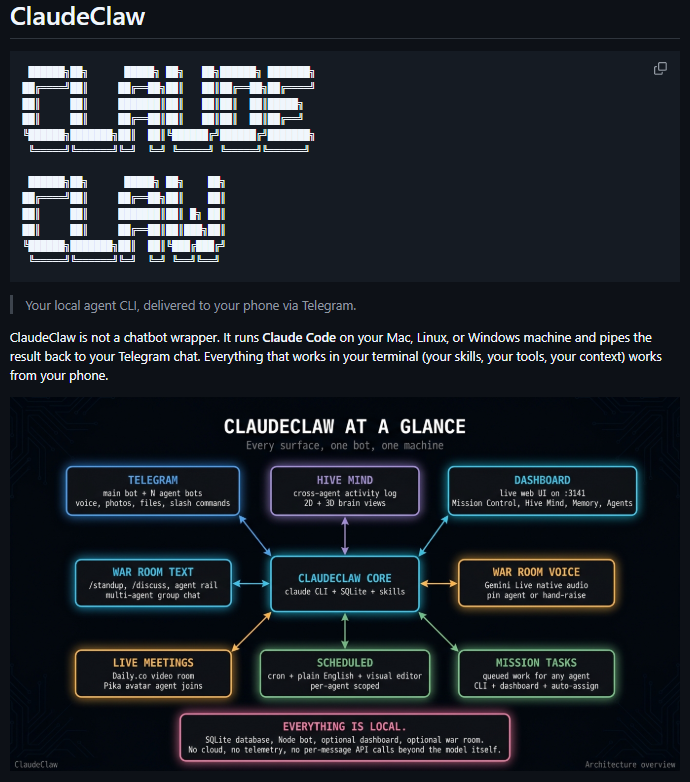
Is granting a Telegram bot full execution access to your local filesystem the ultimate AI workflow hack, or a critical security disaster waiting to happen?
ClaudeClaw OS acts as a Node.js middleware that orchestrates requests from Telegram directly to local instances of the Claude Code CLI. It eliminates the need for complex SSH tunnels or VPNs by running your local development environment as a remote-controlled, multi-agent cluster.
✅ Persists state natively across OS reboots using launchd, systemd, or pm2 background daemons
✅ Synchronizes shared multi-agent memory using a high-concurrency SQLite database running in WAL mode
✅ Injects local context dynamically by parsing open tasks directly from your local Obsidian markdown vaults
✅ Routes media payloads through Groq for audio transcription and Gemini for vision before passing text metadata to Claude
This architecture introduces a natural language cron engine that schedules periodic tasks for specific specialized agents, allowing developers to automate and monitor heavy local scraping or repository analysis while entirely away from the keyboard.
This experimental open-source project, ClaudeClaw OS, has quickly gathered 136 stars on GitHub, highlighting a growing developer demand for ubiquitous remote access to powerful local AI environments without relying on ephemeral cloud containers.
REPOO 👇
@JimGate55333273 That’s a really interesting point.
Thanks for sharing this, honestly such a high-value recommendation.
Def gonna give Claudx a try and see how it fits into the workflow. 🫡🫡
Why tie your AI coding agents to a monolithic IDE or a blind CLI when you can run them as a decoupled local daemon with built-in visual diffs and live previews?
Mainframe is an open-source orchestration environment that solves the fragmented workflow of managing autonomous coding agents.
✅ Runs an agnostic local Node.js daemon via HTTP and WebSockets
✅ Injects dynamic context via local RAG based on your working tree
✅ Manages persistent multi-session state without terminal clutter
✅ Supports custom LLM adapters through an extensible plugin system
By decoupling the orchestration engine from the user interface, this client-server approach eliminates the context fragmentation typical of CLI tools while bypassing the restrictions of editor-bound integrations.
Mainframe has already earned 26 stars on GitHub, showing early but clear validation from developers seeking a highly customizable, modern alternative for orchestrating heavy vibe-coding sessions.
REPOOO 👇
Why pay $100/mo for a legacy CRUD scheduler when you can run a self-hosted Electron + Docker stack that uses local agents to reverse-engineer social APIs, orchestrate multimodal LLMs, and reply to buyers autonomously?
AiToEarn replaces static scheduling by wrapping headless browser automation and generative AI endpoints into a unified, MIT-licensed pipeline.
✅ Orchestrates local LLMs and multimodal APIs like Sora and Flux to generate trend-based assets
✅ Manages cookie rotation and session states across 14 platforms via headless automation
✅ Processes incoming comments using zero-shot routing to detect and reply to buyer intent
✅ Operates natively as an Electron thick client or a containerized Docker backend
This architecture replaces traditional third-party API dependency with an autonomous RPA workflow, though running it at scale requires robust proxy management to handle the inherent brittleness of reverse-engineered DOM scraping.
The AiToEarn repository has already earned 15,524 stars on GitHub, demonstrating exactly why open-source builders are abandoning expensive, rigid social tools for self-hosted agentic alternatives.
REPOO 👇