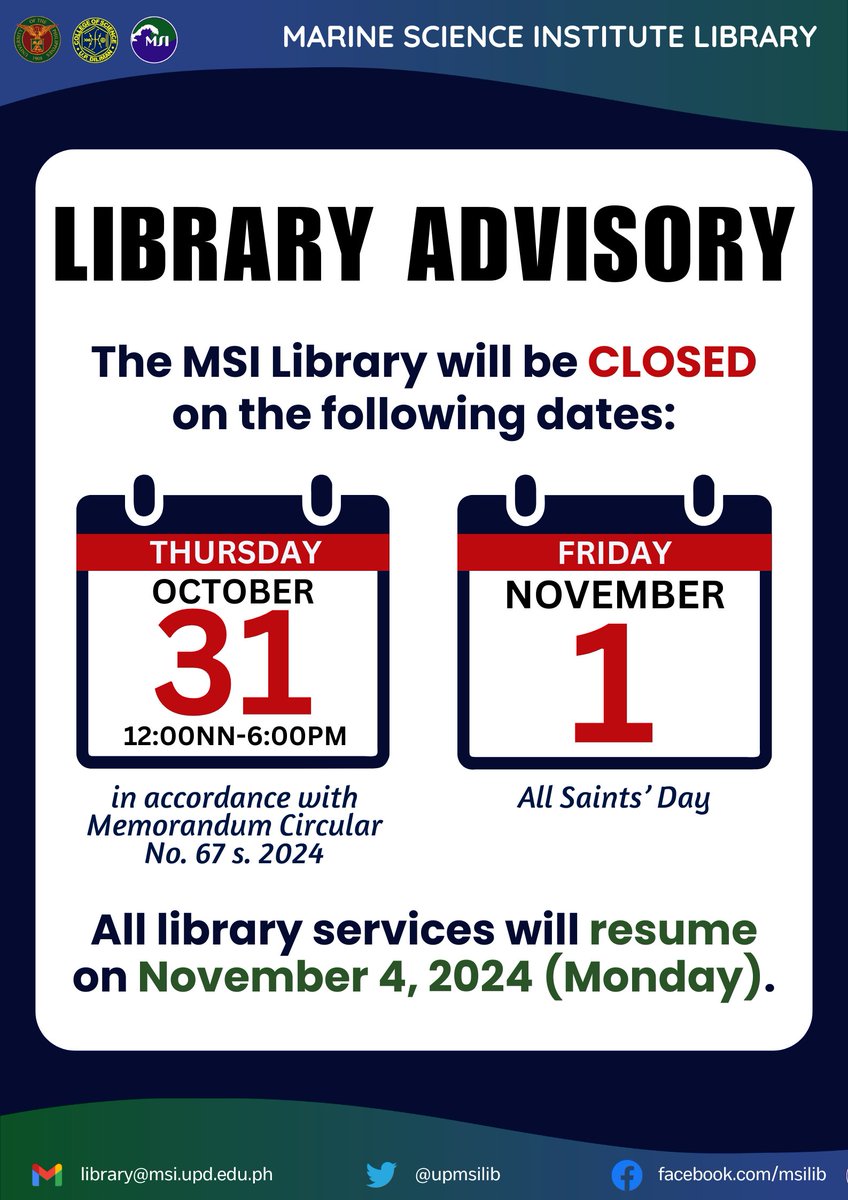
📌 Library Advisory
The MSI Library will be closed on the following dates and will resume its services on Monday, November 4, 2024. Please be guided accordingly.
Thank you!
A documentary featuring the Microbial Oceanography Laboratory's plastic work received a trophy at the Department of Science and Technology’s 2024 Bantog Awards for Science Communication.
Read more here: https://t.co/9ou1AevtTd
A new Marine Heatwave Tracker which provides daily updates on marine heatwave events across the Philippine seas was developed at the Physical Oceanography and Observation Laboratory and is already live and accessible to the public.
Read more here: https://t.co/HHn0QE8jU0
“New study documents a severe coral bleaching event occurring in a deep coral reef that resulted in high rates of coral mortality. Unlike many bleaching events, this was driven by the presence of extremely cold water.”
Read more here: https://t.co/halHR1BSfS
“Territorial wrangling over who owns the South China Sea has strangled local marine life, say scientists, urging China and the Philippines to set aside political differences and work to save the fish, coral and plants that live border-free.”
Read here: https://t.co/jFrlWBEoS3
Scientists in Australia are now employing sea lions as videographers to help explore previously unmapped underwater habitats.
Read more here:
https://t.co/FluKVco3H9
📢 NEW AREA ALERT!
You may now use our new napping/studying area at the 2nd floor! Kindly help us keep this area clean by putting your shoes on the rack found around the area 🫶
Marine scientists of UP recalled the harassment they experienced from the Chinese Coast Guard during a recent marine scientific survey in the Sabina Shoal, also known as Escoda Shoal in the West Philippine Sea.
Read more here: https://t.co/01dmtMeXwZ
"Research led by the University of Hawaii at Manoa Hawaii Institute of Marine Biology (HIMB) has led to a new tool for forecasting coral disease that could help conservationists step in at the right times with key interventions."
Read more here:
https://t.co/T82kJlgHAD
“Researchers reporting in the journal Current Biology on May 23 show that sexual parasitism arose during a time of major global warming and rapid transition for anglerfishes from the ocean floor to the deep, open sea.”
Read more here:
https://t.co/1WlyFHbnth
Long-term and systematic monitoring is needed to ensure the survival of marine resources in the West Philippine Sea, scientists said in a forum last May 13.
Read more here: https://t.co/vybnBN0o4l
“A marine biologist who led the recent marine scientific research (MSR) in Pag-asa (Thitu) Island estimated that the damage on coral reefs in the isolated cays may have been going on for “several years already”.”
Read more here: https://t.co/4etSBuKp4H
The Philippine government is currently in talks with OceanX, a US-based exploration startup, to conduct marine research in its waters.
Read more here: https://t.co/wMwpNk4ZbC
"The University of the Philippines lashed out at the Chinese Coast Guard for harassing its scientists conducting marine scientific research in the West Philippine Sea."
Read more here: https://t.co/1MfZFwILvo
The Philippines has started marine research in Sandy Cay over the West Philippine Sea intending to record its biodiversity and help ensure food security.
Read more here: https://t.co/k1bKyhk8Ez
A marine research station is set to be established in Sta. Ana, Cagayan by the Department of Environment and Natural Resources (DENR) along with the Biodiversity Management Bureau.
Read more here:
https://t.co/i4LEUfGZmr
UP MSI hosted a workshop for the sustainability of the National Academic Research Fleet (NARFleet) this January 17-18 with partner universities UP Visayas, Bicol University, and Mindanao State University - Iligan Institute of Technology.
https://t.co/3qvdgUGlvU
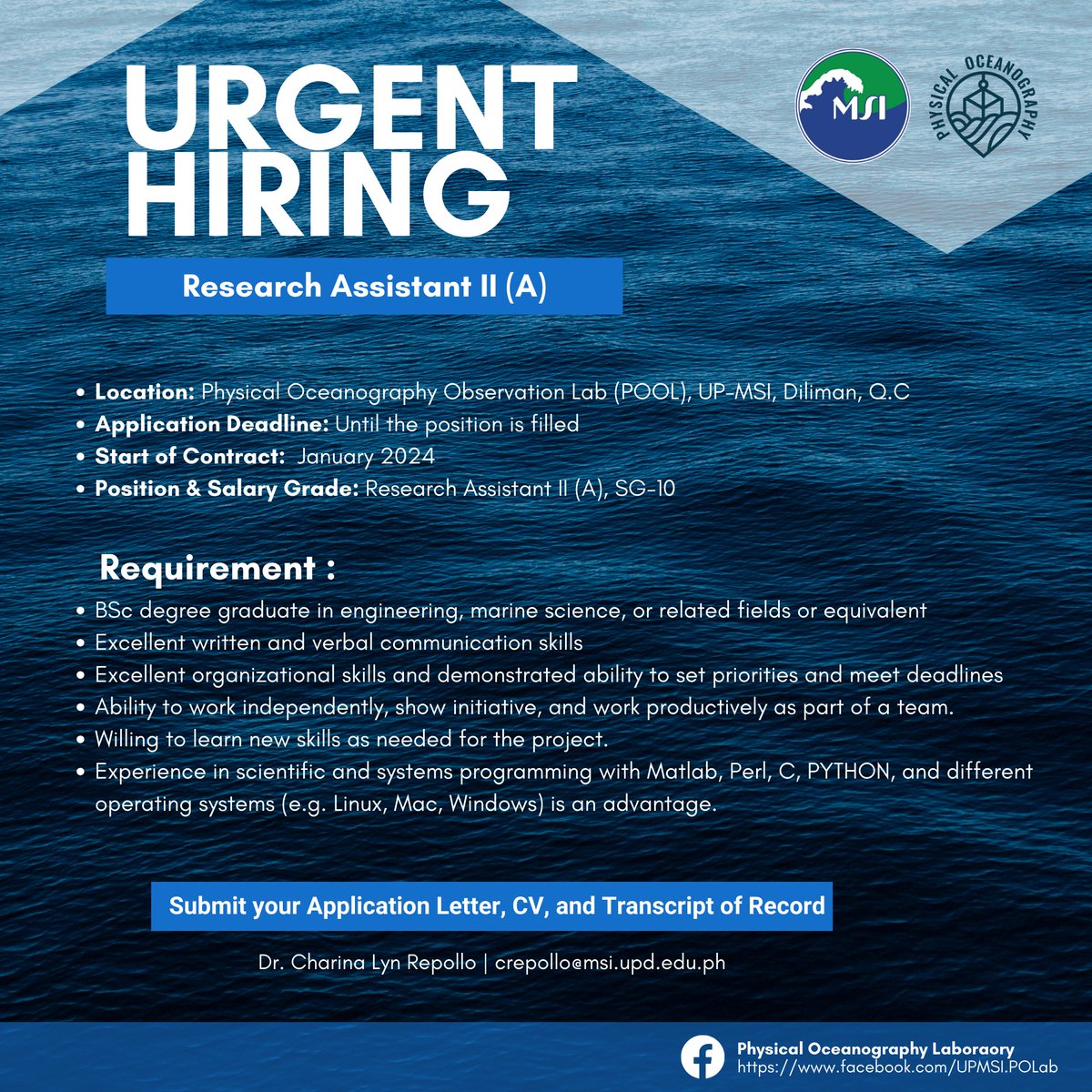
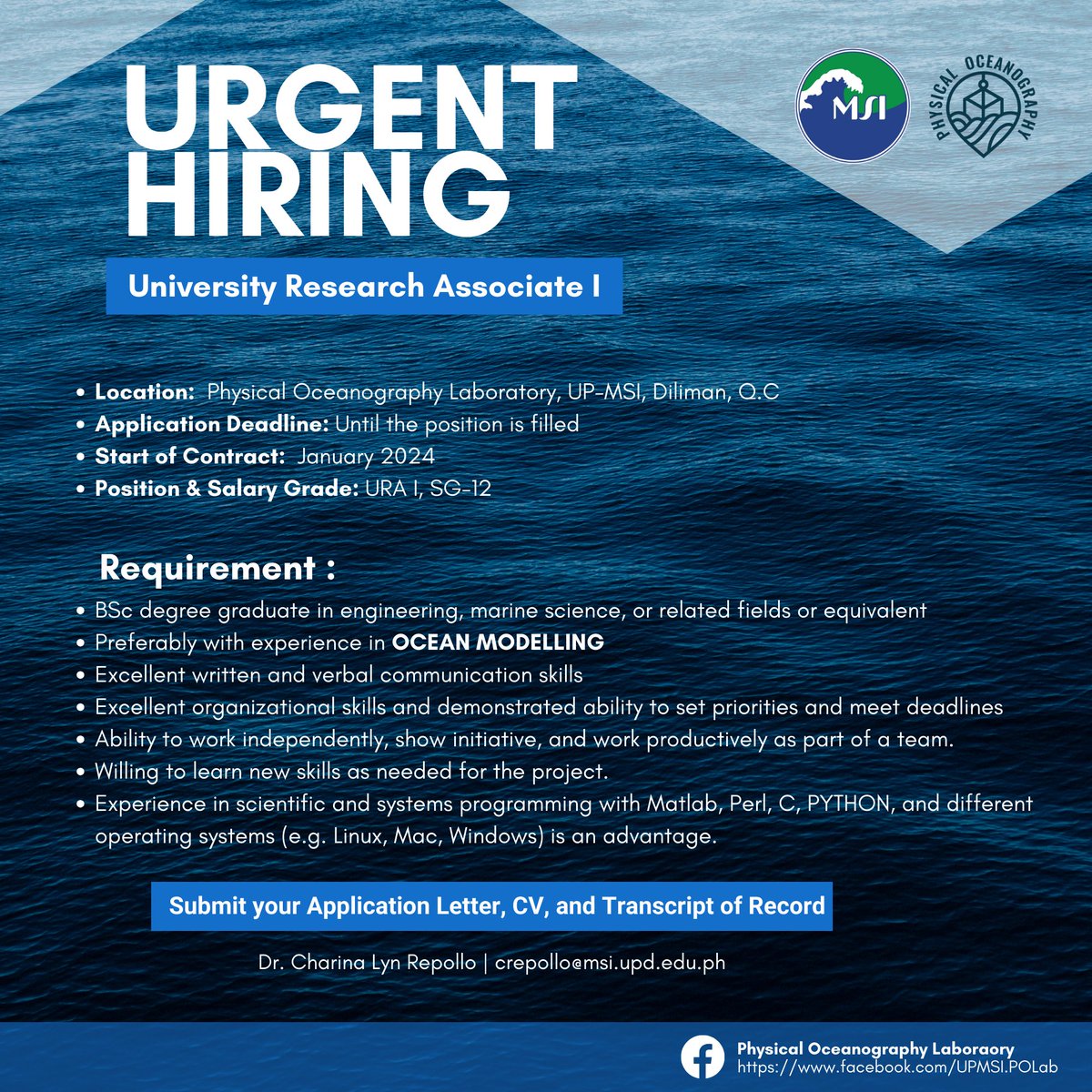
URGENT HIRING: The Physical Oceanography Laboratory and Physical Oceanography Observation Laboratory are looking to fill the following positions. Kindly send your applications to Dr. Charina Lyn Repollo at [email protected].
“Recent research has identified a key evolutionary event that has enabled the widespread impact of invasive mussels in North America. This discovery also paves the way for the development of sustainable materials inspired by mussel fibers”
https://t.co/sbrfVX5ATy