Two economists just published a mathematical proof that AI will destroy the economy.
Not might. Not could. Will — if nothing changes.
The paper is called "The AI Layoff Trap." Published March 2, 2026. Wharton School, University of Pennsylvania. Boston University. Peer reviewed. Mathematically modeled.
The conclusion is one sentence.
"At the limit, firms automate their way to boundless productivity and zero demand."
An economy that produces everything. And sells it to nobody.
Here is how you get there.
A company fires 500 workers and replaces them with AI. A competitor fires 700 to keep up. Another fires 1,000. Every company is behaving rationally. Every company is following the incentives correctly. And every company is building a trap for itself.
Because the workers who were fired were also customers.
When they lose their jobs faster than the economy can absorb them, they stop spending. Consumer demand falls. Companies respond by cutting costs — which means automating more workers — which means less spending — which means more falling demand — which means more automation.
The loop has no natural exit.
The researchers tested every proposed solution. Universal basic income. Capital income taxes. Worker equity participation. Upskilling programs. Corporate coordination agreements.
Every single one failed in the model.
The only intervention that worked: a Pigouvian automation tax — a per-task levy charged every time a company replaces a human with AI, forcing them to price in the demand they are destroying before they pull the trigger.
No government has implemented this. No major economy is seriously discussing it.
Meanwhile the numbers are already tracking the curve. 100,000 tech workers laid off in 2025. 92,000 more in the first months of 2026. Jack Dorsey fired half of Block's workforce and said publicly: "Within the next year, the majority of companies will reach the same conclusion."
Nobody is doing anything wrong. Companies are following their incentives perfectly. That is exactly the problem.
Rational behavior. At scale. Simultaneously. With no mechanism to stop it.
Two economists built the math. The math leads to one place.
Source: Falk & Tsoukalas · Wharton School + Boston University ·
Meta等のレイオフ、卒業式でのAIブーイングなど、AIが仕事を奪う論が本格化しており、海外では
「年配層が好意的で、若い人が反発する最新技術は史上初では?」
と言われ始めています。
実は「AIで若い人は仕事が減り、年配者は逆に仕事が増えている」とする研究が存在し、今週のBSフジ出演時にも取り上げました。
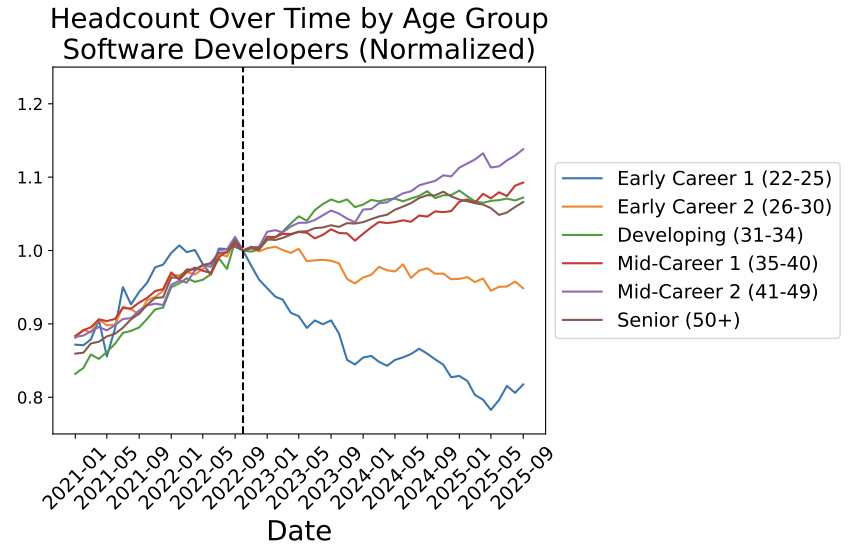
スタンフォード大学から出た"Canaries in the Coal Mine? Six Facts about the Recent Employment Effects of Artificial Intelligence"という論文では、生成AI普及と共に労働市場がどうなったか実際のデータを用いて分析しているのですが、まず「AIによって仕事が奪われやすい」とされていた職種については、実際に雇用の減少が見られました。
ただ、画像の図を見てもわかるように、確かに雇用の減少傾向が見られるものの、年齢別に見てみると、むしろ雇用が増えている層がいます。
「Early Career」とされている20代〜30代の雇用は減少しているものの、Seniorとされてい50代くらい層を中心に、年配者は雇用が伸びています。
元々、AIによって仕事が奪われる論は、職種ごとに「奪われる/奪われない」を見ていたのですが、この研究によると、さらに年齢という軸が重要だったことがわかります。
この辺の研究を踏まえると、特に若い人ほどAIに反発し、大学の卒業式でブーイングが起きるような事態になるのはわかる気がします。