🚨FIIs Are Loading Heavily‼️
🗽FIIs Just Increased Stake by Up to 8.66% in These 10 Stocks ⚠️
💰Foreign Money Is Pouring In♨️
Save It for Later 🔖
A MEGA 🧵 Thread 🧵👇👇👇
1 . HFCL Ltd 🔖
#hfcl
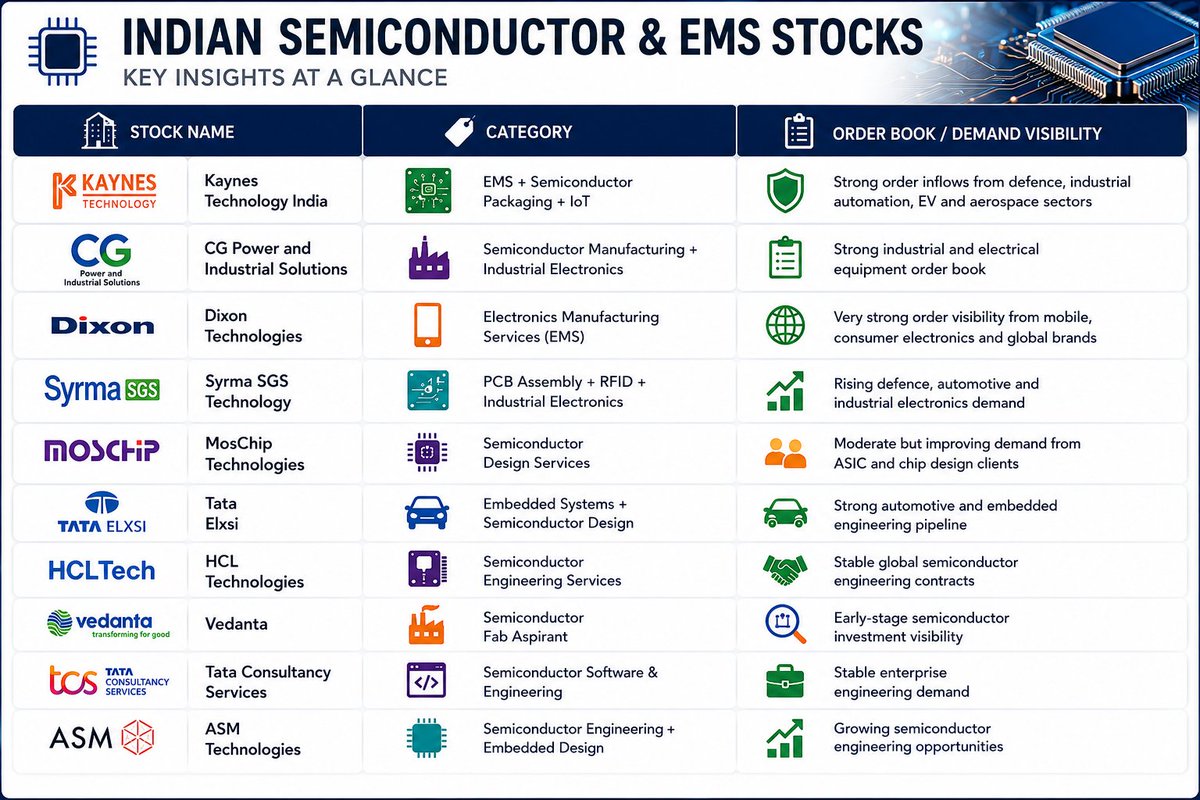
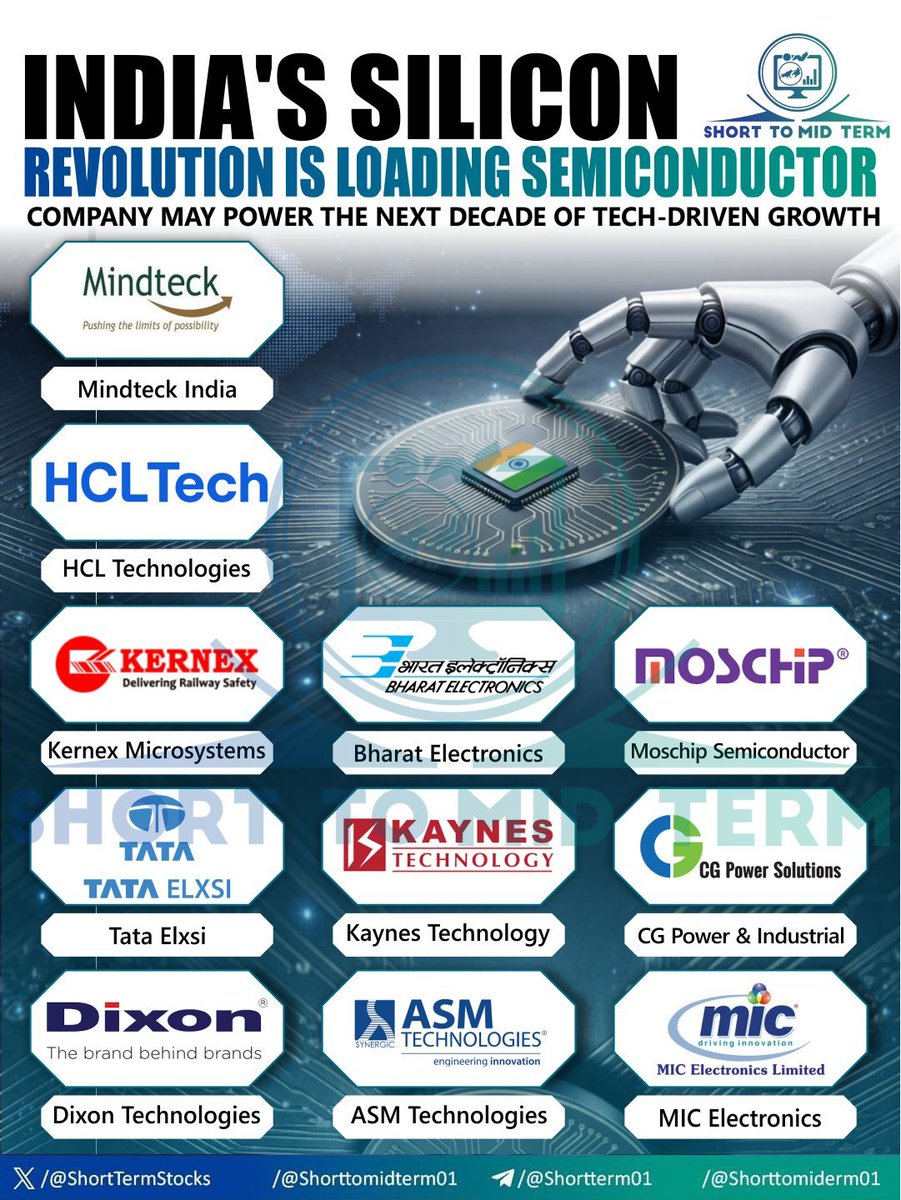
🇮🇳 India’s Semiconductor Story is just getting started 🚨
Top themes to watch 👇
⚡ EMS & Packaging – #Kaynes, #Dixon
⚡ Chip Design – #MosChip, #TataElxsi
⚡ Semiconductor Manufacturing – #CGPower, #Vedanta, #SyrmaSGS
⚡ Engineering Services – #HCLTech, #TCS, #ASM
India could create the next wave of multibagger tech stocks ??
Comment - which is your favourite stock 💖!!
If you found Helpful - ♻️Repost | 📩 Share
#Semiconductor #IndianStocks #StockMarketIndia #EMS #AI #Investing #MakeInIndia #SemiconductorStocks #Nifty #Multibagger
“Indian Express’s Udit Misra just filed the autopsy report:
🔴 Rupee: ₹86 → ₹96 in ONE year. Quietly.
🔴 Net FDI gone NEGATIVE; Indians building factories abroad because they don’t trust this government’s economy
🔴 BOTH current account AND capital account in deficit; simultaneously. First time. Ever.
🔴 Per capita income = ₹20,000/month. MOST Indians earn below even that.
🔴 Exports? Almost stagnant and flat; after 12 years of “make in India”,
And Misra confirmed, the government KNEW this for 2 years. They hid it during elections. The call only came once votes were counted.”
India's defence budget crossed ₹7.85 lakh crore this year. 75% of capital acquisition is locked for domestic companies only.
But most investors stop at HAL, BEL, Mazagon Dock. These are assemblers. The missile itself is built by a completely different set of companies.
A quick breakdown of who actually builds India's missiles:
BrahMos went from 15% Indian-made components in 2015 to 70% today. Target is 85% by end of 2026. New Lucknow plant takes annual production from 100 to 300 units. Export pipeline is building towards ₹5 lakh crore by 2030. $450 million in export orders already signed.
Every one of those 300 missiles needs seekers, boosters, titanium forgings, guidance electronics.
Here's who supplies what:
Bharat Dynamics (BDL): India's sole missile manufacturer. Akash, Astra, MPATGM. Order book ₹26,000 crore. Two new plants coming in Telangana and UP.
Data Patterns: Developed the Fire Control System for BrahMos. Testing seekers. All-time high order book at ₹1,868 crore. EBITDA margins 35-40%. Revenue growth guidance 20-25% CAGR.
Astra Microwave Products: Builds RF and infrared seekers. Executing 70% of the QRSAM missile programme. Order book ₹2,226 crore. Q3 FY26 EBITDA margin hit 31.7%, highest in 8 quarters. 95% of new orders from defence.
Solar Industries: Made the transition from mining explosives to missile propulsion. Supplies solid propellant boosters for BrahMos via DRDO tech transfer. Also making Pinaka rockets and 155mm ammunition. Defence order book alone is ₹16,600 crore.
MTAR Technologies: Precision components for liquid propulsion engines and Agni missile programme. Q3 FY26 revenue up 59% YoY. Profit up 117%. Order book ₹2,395 crore.
PTC Industries: Titanium and superalloy castings for BrahMos, Pralay missiles, and now Blue Origin and Honeywell Aerospace. 9-month FY26 revenue up 95%. Building titanium capacity to 6,000 TPA. Management targeting 10-15x revenue growth over 5-7 years.
Premier Explosives: Akash missile propellants. Long-term contract with BDL. Quiet but locked in.
Goodluck India: Steel and alloy forgings for Pinaka rockets and BrahMos components.
DRDO conducted the first salvo launch of the NASM-SR anti-ship missile this month. Goldman Sachs projects the Indian defence market to grow 6x to ₹10 lakh crore over 20 years.
The assemblers get the headlines. The supply chain gets the orders.
Educational only, not a recommendation.
A community college professor taught the same study skills lecture for 30 years, and the video quietly became one of the most watched educational recordings on the internet.
His name is Marty Lobdell. He spent his career as a psychology professor watching students fail not because they were lazy, but because nobody had ever taught them how their brain actually works under the pressure of learning something hard.
The lecture is called "Study Less Study Smart." Over 10 million views. Passed around in Reddit threads, Discord servers, and university study groups for over a decade. And the core insight buried inside it has been sitting in cognitive psychology research for years, waiting for someone to explain it in plain language.
Here is the framework that completely changed how I think about effort.
Your brain does not sustain focus the way you think it does. Studies tracking real students found that the average learner hits a wall somewhere between 25 and 30 minutes.
After that, efficiency doesn't just decline. It collapses. You're still sitting at your desk, still looking at the page, but almost nothing is going in.
Lobdell illustrated this with a student he knew personally. She set a goal of studying 6 hours a night, 5 nights a week, to pull herself out of academic probation. Thirty hours of studying per week. She failed every single class that quarter.
She wasn't failing because she lacked effort. She was failing because she had confused time spent near books with time spent actually learning. The 25-minute crash hit her at 6:30pm every night. She spent the next five and a half hours sitting in the wreckage of her own focus and calling it studying.
The fix sounds almost too simple. The moment you feel the slide, stop. Take five minutes. Do something that actually gives you a small reward. Then go back. That five-minute reset returns you to near full efficiency. Across a six-hour window, the difference is not marginal. It is the difference between thirty minutes of real learning and five and a half hours of it.
The second thing he taught destroyed something I had believed about how memory actually works.
Highlighting feels productive. Going back over your notes and recognizing everything feels like knowing. But recognition and recollection are two completely different cognitive processes, and your brain is very good at making you confuse them.
You can see something you've read before and feel completely certain you understand it, even when you couldn't reconstruct a single sentence from memory if the page were blank.
He proved this live in the room. He read 13 random letters to his audience. Almost nobody could recall them. Then he rearranged the same 13 letters into two words: Happy Thursday. The whole room got all 13 without effort.
Same letters. Same count. The only thing that changed was meaning.
The brain stores meaning. Not repetition. The moment new information connects to something you already understand, the retention changes entirely.
This is what the cognitive psychology literature calls elaborative encoding, and it is the mechanism underneath every effective study technique.
The third principle was the one that hit me hardest, and the one almost nobody applies.
Lobdell cited research showing that 80 percent of your study time should be spent in active recitation, not passive reading. Close the material. Say it back in your own words.
Teach it to someone else, or to an empty chair if no one is around. The struggle of retrieval is where the actual learning happens. Reading your notes again is watching someone else do the work.
His parting line has stayed with me longer than almost anything else I have read about learning.
He told the room that if what he shared didn't change their behavior, they hadn't actually learned it. It would just live in their heads as something they had heard once and felt good about.
He was right. And most people leave every lecture exactly like that.
The students who remember everything aren't putting in more hours.
They stopped confusing the feeling of studying with the fact of it.
I wanted to check: did any ace investor spot India's nuclear theme BEFORE the Fast Breeder Reactor went critical?
So I went through the Dec 2025 shareholding data of every major portfolio. Here's what came up.
Mukul Agrawal quietly built a 4-stock nuclear basket without anyone noticing.
✍️ HCC (Hindustan Construction Company) This is the company that built 60% of India's nuclear power capacity. Tarapur, Kakrapar, Kudankulam. Every major reactor, HCC did the civil construction.
✍️ PTC Industries Specialised alloy castings for reactor internals. Precision components that go inside the core. Niche. Hard to replicate. Years of qualification needed.
✍️ WPIL Ltd Pumps for reactor cooling systems. NPCIL is a direct client.
✍️ KRN Heat Exchanger Heat exchangers are critical for reactor thermal management. Every new reactor needs them.
4 companies. All in the nuclear supply chain. All in one portfolio. All bought BEFORE the PFBR achieved criticality on April 6, 2026.
A ₹7,000 crore portfolio doesn't take 4 bets on one theme by accident.He saw the nuclear capex cycle coming before the headlines did.
Now here's the bigger picture of what's ahead:
🔸 8.18 GW installed today → 100 GW target by 2047
🔸 ₹20,000 Cr Nuclear Energy Mission
🔸 Atomic Energy Act amendments opening the sector to private players for the first time
🔸 3.8 GW of fast breeder capacity planned by BHAVINI
🔸 ₹18,000-20,000 Cr PLI scheme coming for nuclear component makers
Defence went 5-10x after the capex cycle began in 2020. The smart money is now front-running the same playbook in nuclear.