Heartbreaking news out of Orange County, Virginia. K9 Blek, a loyal partner with the Sheriff's Office, passed away while on duty this week. After eight solid years serving alongside Sgt. Justin Neal, he gave everything right up to the end from natural causes.
These dogs aren't just tools. They are true teammates who run toward danger without hesitation, protecting officers and the community day after day. Blek did that with honor and heart for nearly a decade.
The department put out a moving final call for him. It hits hard. Rest easy, Blek. You served well, and the watch continues without you. Thank you for your service, and deepest condolences to Sgt. Neal and the whole Orange County Sheriff's Office.
Our K9s deserve every bit of respect we can give them. They earn it every single shift.
There’s been a lot of talk in this race about what makes a "real man."
A man does what’s right when no one is watching. He upholds his commitments to his family and neighbors. He doesn’t lie, cheat, & steal his way through life.
Real men serve others. Weak men serve themselves.
Saddened to hear the news of the passing of my dear friend @EricGuillot14, but a blessing that he no longer has to suffer. Miisunderstood by some, and despite our differences at times, I will forever cherish the memories we spent together with those special moments at the racetrack, in the Winners’ Circle, and in our personal lives, simply priceless! They broke the mold when they made ‘da Jenius’, and frankly, there will never be another. With love and sympathies to Anna, his daughter, Olivia, sons Rhett, Carter, and Eric Jr., I will miss our talks. Thank you for all that you did for me and my family, I am grateful. Until we meet again my brother, and may God rest your crazy soul. 🙏💔🏇🇺🇸 #Greatest
Andy Beshear: “Let’s overturn ‘Citizens United’ we can get corporate money out of these elections, while we’re at it let’s have term limits for everybody including the Supreme Court”
“No more games of trying to put someone on for 40 years”
Janitor almost got fired after CCTV caught him sneaking into a gorilla enclosure.
The gorilla had been brought in after poachers raided her home, leaving her injured and unconscious before locals found her and helped send her to a sanctuary to recover.
For weeks, she didn’t trust anyone.
She would take her food, go straight to the corner, and eat alone like every person near her was another threat.
But security cameras had been catching something for days.
The janitor had been going inside her enclosure, sitting with her, talking softly, and showing her kindness through small gestures. He wasn’t forcing anything. He was just trying to let her know not every human was there to hurt her.
Nobody really noticed until the board reviewed the surveillance footage to check on her progress.
That’s when they caught him.
At first, they were ready to fire him for breaking the rules. But as they kept watching the footage, they realized something.
The gorilla wasn’t healing because of the enclosure.
She wasn’t healing because of the food. She was healing because she had finally built a bond with someone.
And for now, that was all that mattered.
BREAKING: Constitution loophole Found that guarantees Democrats the White House for decades
Trump could be the LAST Republican President to ever hold the White House
She walked three miles to the vet at 2 a.m. — barefoot, in her nightgown. She had just twenty-three dollars to her name. She placed it on the counter and whispered, “This is everything I have. Please don’t let him die.”
On a freezing Tuesday night in January 2023, an emergency veterinary clinic in a small city in central Ohio received an unusual walk-in at 2:14 a.m.
Not by car. Not by ambulance. A woman. Alone. On foot. In twenty-eight-degree weather, moving through the dark with nothing but urgency to guide her.
She was sixty-one years old. A thin bathrobe hung loosely over a worn nightgown. No shoes covered her feet. They were raw — cracked, reddened, and bleeding from miles of frozen pavement. She hadn’t stopped to find anything warmer.
Hadn’t searched for shoes. There was no time. She didn’t call a cab because she didn’t own a phone. She didn’t call anyone because there was no one left to call.
In her arms, she carried a dog.
A large, aging mixed-breed — something close to a retriever — around twelve years old. Wrapped tightly in a small towel. His body hung limp. His breathing came fast and shallow, the kind that signals something is terribly wrong. His gums had gone pale. His eyes barely opened.
She reached the front desk and carefully placed a small stack of money on the counter.
Twenty-three dollars. Everything she had.
Beside it, she laid a handwritten note, torn unevenly from a notebook. It read:
“His name is Arthur. He is 12. He stopped eating 3 days ago. Tonight he collapsed and couldn’t stand. I don’t have insurance. I don’t have a car. I walked. This is all the money I have. I will pay the rest. I will do anything. Please help him. He is all I have.”
The receptionist looked down at the money.
Then at the woman’s bare, injured feet.
Then at the dog in her arms.
She turned away for a moment, covering her mouth as the weight of it settled in.
The veterinarian on duty examined Arthur immediately. He was in acute kidney failure — a condition that can be treated if caught in time, but only with urgent care. He needed IV fluids, medication, constant monitoring.
The estimate came to $1,400.
The woman had $23.
The vet didn’t hesitate.
“Start treatment,” she said. “We’ll take care of the rest.”
They admitted him as an emergency case. Paperwork could wait. Time could not.
The woman refused to take her money back. She left it on the counter and sat quietly in the waiting room — barefoot, wrapped in her robe, holding the now-empty towel Arthur had been wrapped in.
She didn’t ask for anything.
Not water.
Not coffee.
Nothing.
She just sat there. Waiting.
At 3 a.m., a technician brought her a pair of slippers and a warm blanket. She accepted the slippers without a word.
But when offered the blanket, she gently shook her head.
“Give it to him,” she said softly.
By morning, the entire day staff had heard her story.
Arthur stabilized slowly over the next three days. The fluids began to work. His levels improved. On the second day, he managed a few bites of food. By the third, he stood. By the fourth, his tail wagged again.
And every single day, she returned.
Walking the same three miles. Each way.
Six miles total.
Through the cold.
On the second day, someone from a nearby church gave her a pair of shoes. She wore them without socks, the fabric rubbing against healing skin.
She sat in the same chair each visit, holding that towel, waiting with quiet patience.
On the fourth day, they brought Arthur out to her.
She held him exactly the way she had when she arrived — wrapped close, her chin resting gently on his head. He pressed his face into her neck. She closed her eyes, as if finally allowing herself to breathe again.
The veterinarian told her there would be no bill.
She shook her head and placed the twenty-three dollars back on the counter.
“I owe you,” she said. “This is what I have. I’ll bring more when I can.”
The vet slid the money back toward her.
“You walked three miles barefoot in the middle of the night to save him,” she said gently. “You don’t owe us anything. You already paid.”
Quietly, the staff pooled their own money. They sent her home with medication, special food, and a follow-up visit already covered.
One of the technicians drove them home — the first car ride either of them had taken in over a year.
Her home was small. Just a single room tucked behind another house. One bed. One chair. A hot plate. A worn dog bed in the corner. A ceramic bowl with “Arthur” written across it in chipped paint.
Two photographs hung on the wall. One of a man — likely her late husband. The other of Arthur as a young dog.
Arthur recovered.
He’s older now, slower, but still by her side.
She learned how to give him fluids herself — something that once frightened her. But she learned anyway. For him.
And the twenty-three dollars?
She still keeps it. Folded neatly inside her nightstand.
She never spent it.
Because in her mind, it still belongs to him — waiting, just in case he ever needs it again.
The receptionist who read that note still has a photo of it saved on her phone. She’s never shared it publicly.
She just looks at it sometimes.
Because out of every emergency she’s witnessed — every client with insurance cards, payment plans, and resources —
No one ever gave more to walk through that door than a woman who had nothing…
…and still gave everything.
And Arthur?
Every night, he sleeps safely under a roof.
Curled beside the person who walked through darkness, through cold, through pain — just to make sure he lived.
And now, he never has to wonder again if he’s loved.
John Roberts’ Supreme Court has perverted justice and corrupted the nation from the top down.
Let’s make him the first US Chief Justice to be impeached.
Tell Congress to rally behind this and get it done! https://t.co/TVKgC1ilEm
BREAKING: Leader Hakeem Jeffries just announced that Democrats will support legislation that permanently bans Donald Trump's taxpayer funded slush fund for January 6th Insurrectionists. Let's go.
Albanians aren't just protesting. They burned down the house of their president who approved the sale of the national park to the Kushners.
This is the wayyyy
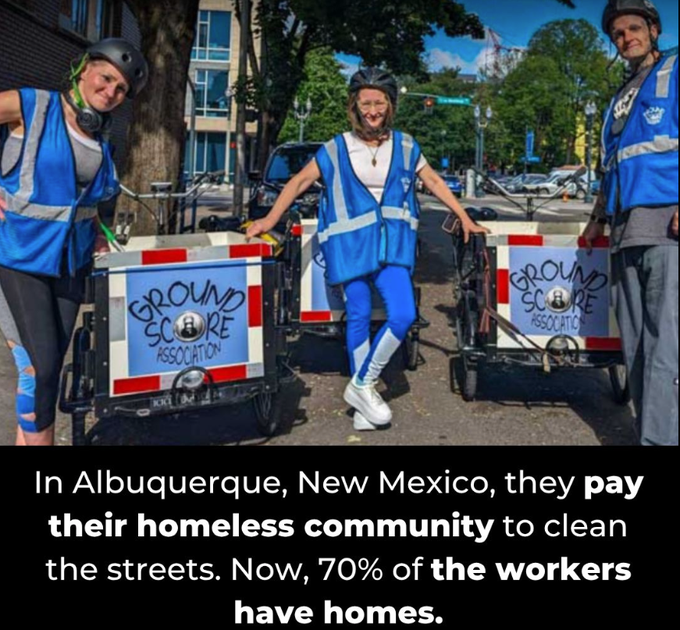
In a groundbreaking social initiative, Albuquerque, New Mexico launched a program that pays homeless individuals to clean streets, parks, and public areas.
The idea was simple — offers work, dignity, and purpose instead of punishment or pity.
The results were remarkable: over 70% of participants have now secured permanent housing or full-time employment, transforming their lives and communities alike. The city’s “There’s a Better Way” program proves that compassion-driven policies can be more effective than traditional welfare systems.