When Insulin causing Hypokalemia is NOT the answer to the MCQ.
AIIMS/INICET Loves this
Everyone knows - Insulin pushes K+ inside the cell and causes Hypokalemia.
But there are two scenarios - where Hypokalemia is not the answer despite pathophysiology dictated by high insulin.
Both asked repeatedly in INI. Because examiner knows - you see Insulin, you pick K+.
A. Infant of diabetic Mother.
High RBS in mother - glucose goes inside fetus - caused fetal hyperinsulinemia.
This causes hypoglycemia in neonates born to diabetic mother - the most common metabolic abnormality.
However - the 2nd most common metabolic abnormality is HypoCalcemia - not HypoK+. This was asked in the exam I gave (May 2018). I picked K+
Don’t make the mistake like I did.
B. Refeeding syndrome.
A high calorie diet in first week to SAM results in sudden surge in insulin which causes K+ and PO4- to go inside cell.
HypoK+ and HypoPO4- occur.
But remember - the hallmark of Refeeding syndrome is Hypophosphatemia - not HypoK+
(why ? - because HypoK+ can occur due to SAM itself, hence not specific to Refeeding Syndrome - while hypophosphatemia only occurs when there is Refeeding syndrome)
Images from my offline class notes at DBMCI- will help.
A lot of people struggle with Biochem and trying to rote memorize in which state is enzyme activated and in which state is it deactivated.
There is simple way to remember.
As far as regulation is concerned - if you’re moving away from glucose - enzymes are active in dePO4rylated state and when you’re moving towards glucose - in phosphorylated state.
So Glycolysis - dePO4
Gluconeogenesis- PO4.
Glycogen synthesis - dePO4
Glycogenolysis - PO4
The logic is pretty neat.
When you’re doing Glycolysis - the goal is to make ATP. When the goal is to make ATP - why do you want to waste that ATP to phosphorylate the enzymes? So enzymes have to be activated in Dephosphorylated state.
Opposite for Gluconeogenesis/Glycogenolysis.
Cell has ATP. Now during fasting state - it’s using that ATP to make glucose. Hence enzymes are active in phosphorylated state.
Diseases which are severe and often fatal in the early years are usually autosomal recessive
(Classic MSUD, Tyrosinemia, Galactosemia,MMA,PA, SMA,GSDs, LSDs,Fatty acid oxidation defects, Mitochondrial complex/oxphos disorders)
Diseases that are moderate to mildly severe, life often sustains inspite of the diseases state are usually autosomal dominant
(Glut 1 def, Huntington, TSC, NF-1, Marfan , Ehler Danlos, most HMSNs, few LGMDs)
Fatal early in life - AR.
Less likely to be fatal in early life-AD
(Few exceptions exist.)
A lot of people preparing for NEET PG have issues remembering which disease is autosomal recessive, what is dominant.
While ofcourse - at the end of the day it is a little bit of rote memorisation - there is a certain logic to it.
Remember- enzymes- pretty much of all them in our body are more than what’s required.
So, even a 50% enzyme activity suffices for majority.
Hence, unless enzymes are fully zero - disease won’t manifest.
So, any enzyme deficiency- will be AR - both genes have to be mutated/absent.
PKU
Galactosemia
Glycogen storage disorders
Congenital adrenal hyperplasia
Alpha 1 anti trypsin
Wilson
Even 1/2 Hb causes mild anemia - so even That/Sickle cell are AR.
Contrast this with neuromuscular damage in general.
Anything that causes damage to nerves and Muscle- even 50% damage would result in disease.
If you look at AD diseases - most are have some issues either with nerves or muscles or cytoskeleton.
Huntington
Myotonic dystrophy
Achondroplasia
Marfan
Hypertrophic cardiomyopathy.
Most neurocutaneous syndromes. (tuberous sclerosis/neurofibromatosis)
Ofcourse this is not hard and fast.
But serves to improve your memory and understanding.
X linked is genuinely just rote memorization. Those genes just happened to be on X chromosome.
Ghanta farak nahi padta.
We Used to have FB groups.
Random question. Random scorings. People giving answers.
None of them got any ranks.
Just show off. Right @Rishabh2970 . No one was in top 100.
Stick to PYQs/PYTs and the most important last 7-10 day revision .
If you’re scoring 130-140 in GTs and do your last 10 day revision really well - you’ll push it to 150+ correct - you’re sorted.
So after marking an answer in MCQs, should you change it in NEET PG, INICET, FMGE?
Almost every student struggles with this.
Do you trust your first instinct, or go back and change it if something feels wrong?
We looked at data from Cerebellum’s INICET Mock-1.
Students changed their answers 35,966 times.
Out of these, 17,759 were changed to the correct option, and 18,207 to the wrong one.
So overall, more answers were changed to incorrect than correct.
But here’s where it gets interesting.
When we analysed the data rank-wise:
Top 100 students were right 66% of the time when they changed answers
Rank 101–200: 59%
Rank 201–500: 54%
Rank 501–1000: 52%
Rank 1001–2000: 46%
Rank >2000: only 31%
Which means, if you have been consistently scoring well, the chances of your second hunch being right actually improve.
We’ll soon start sharing detailed analytics of this parameter in our GTs and mocks for each student.
Managing disappointments is one of the most important components of entrance exam preparation.
Yes, backlogs will develop.
Yes, GTs will go wrong.
Yes, you will struggle to remember everything you read.
That happens!
What matters is telling yourself, even on bad days, that it is okay and that you will manage.
You can call this approach having 'Stupid faith' in yourself.
Stupid faith is precious. It is what carries you forward when going gets tough. It is what finally gets you across the finish line.
So keep the stupid faith.
Keep studying.
Take your preparation to the last day.
And remember it's never late to start!
NEET PG/INI CET 2026
Here’s how I analysed my Grand Tests.
A simple approach that helped me crack INICET on my first attempt (AIR 49).
Clean. Effective. Repeatable.
#inicet#NEETPG
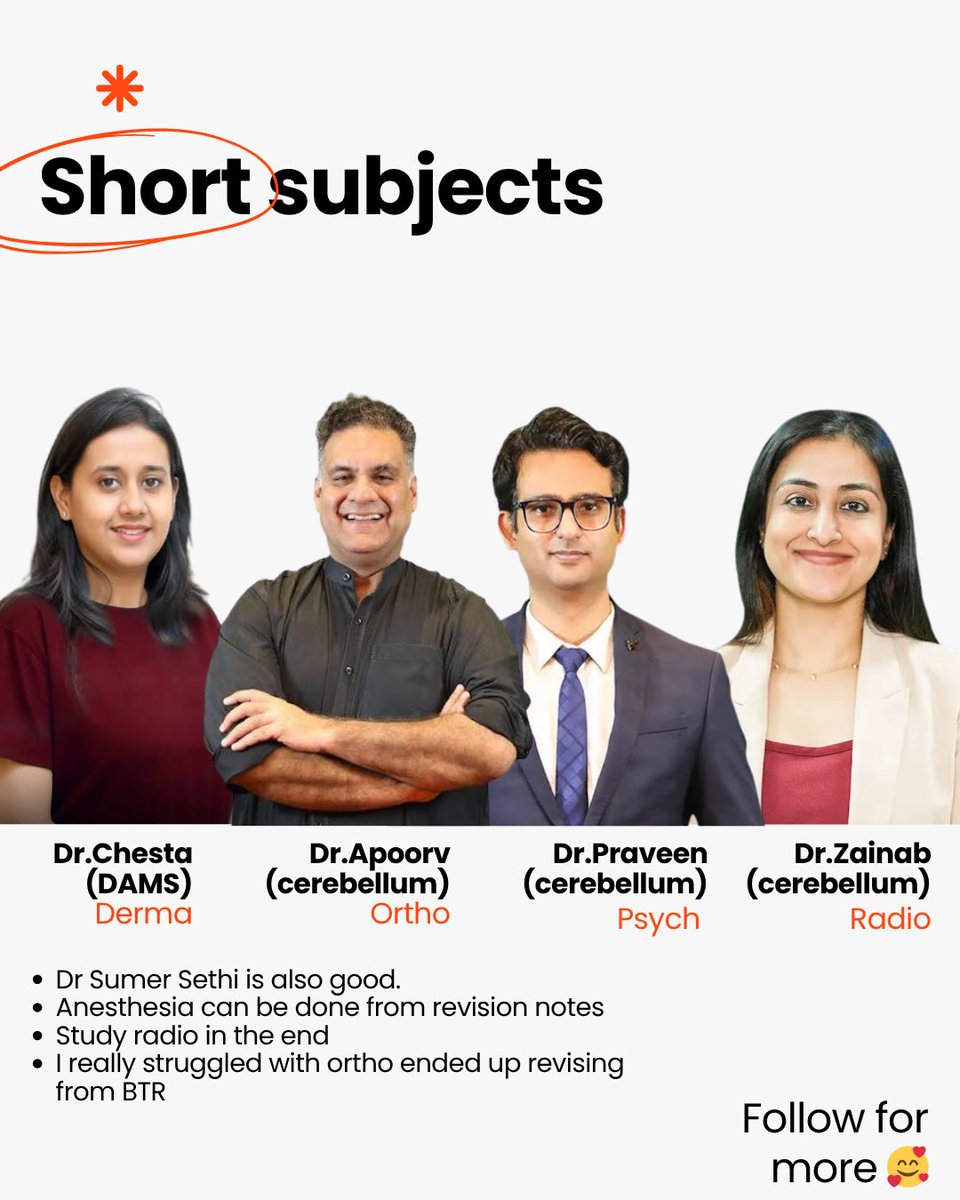
Now that Diwali is over, take a day off if you need & get back to prep mode. Don’t stay stuck in the festive hangover. Start with short, easy subjects that you can finish in a day.Each small win will rebuild your momentum and confidence.
#neetpg#INICET#MedX
I tried everything at some point
DAMS F2F (2nd year): few good teachers, but app interface is bad, QBank weak, offline model not for me. Rarely used it.
PrepLadder (3rd/Final year): Solid teachers
Marrow (Internship): The QBank + GT platform.
Anki: 75% of my prep