Chameleon is live.
Chameleon brings models from @OpenAI, @AnthropicAI, @GoogleDeepMind, @xai and @AskVenice into one chat. Each has different strengths. You should be able to use them without learning which model to pick for every task.
Powered by @typesafeai’s Jev, Chameleon reads each request in context and picks the model suited to the task. @orbiodotso provides access to those models through one API, while @AskVenice powers the private lane.
Go from researching the latest news → generating an image → writing code, and it switches models as the task changes. You stay in the same conversation, without moving between apps or copying context from one chat to another.
Hold $CHAM to access the models through one interface, with a daily usage budget funded by trading fees.
Robinhood Chain
CA: 0xb3fb23f47ee49a3becf322389f3dce679dc1caf4
Try it: https://t.co/mCjB8i0Wdv
We’re bringing deep research to Chameleon.
Using Jev’s rapid decision-making, it will assess findings along the way and decide where to dig deeper or change direction.
Coming soon.
Every $CHAM trade on Pons pays a 2% creator fee to Chameleon's treasury in robinhood:0xaa07a0e9209e16ac99708c3ec70159c6ef3128a3. That revenue funds the AI usage available to holders.
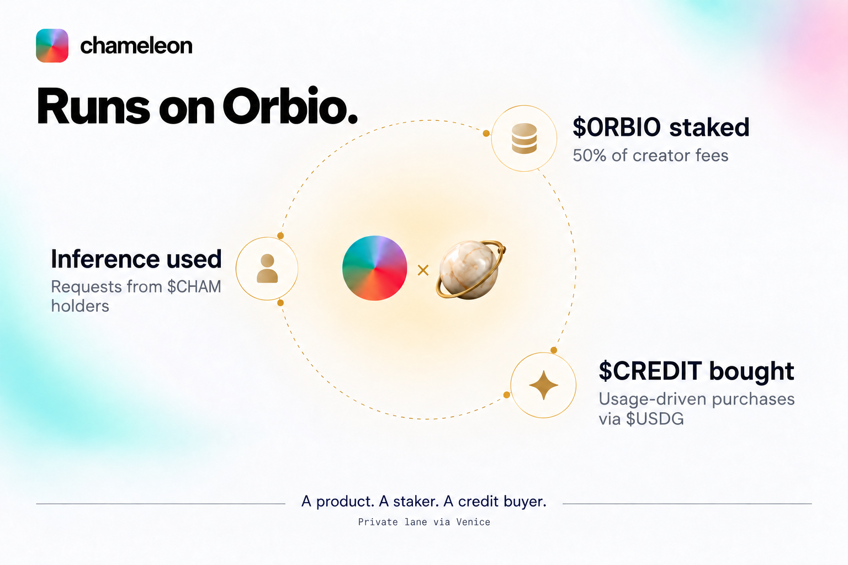
Half is staked with @orbiodotso to earn solana:As9FpeL4rnXYmmAn6ZqJpaFojdoW2yU9MfHUNfbupump, harvested hourly into the treasury's API key. The other half covers usage on demand: every three minutes, the treasury checks what holders have consumed, sells the corresponding amount of robinhood:0xaa07a0e9209e16ac99708c3ec70159c6ef3128a3 for $USDG on Uniswap, and buys credits on Orbio's order book to replenish the same key.
Your share of $CHAM held in wallets determines your share of the day's treasury-backed usage pool.
A 1% share gives access to 1% of that pool.
Requests are charged at the selected model's actual rate, so the same budget buys different amounts of work across models.
Trading fees fund the pool. Your holdings set your share. Your requests determine what you spend.
Quick update on Chameleon app usage since launch.
794K+ tokens processed across 6 models.
Jev, built by @typesafeai, reads each request in the context of the conversation and selects a model suited to the task.
Median routing decision: 326 ms in live usage.
It has already switched models mid-conversation on 9 requests - carrying the context forward without users opening another app or starting a new chat.
Average inference cost sits under $0.02 per completed request, with the usage pool funded by $CHAM trading fees.
More details on the next app updates coming soon.
Chameleon runs on @orbiodotso's inference infrastructure and turns $CHAM trading fees into demand for its credits.
The $CHAM/$ORBIO pair brings robinhood:0xaa07a0e9209e16ac99708c3ec70159c6ef3128a3 into the buying route: when someone buys $CHAM with another asset through that pair, the route first buys robinhood:0xaa07a0e9209e16ac99708c3ec70159c6ef3128a3. Creator fees then arrive in the treasury as robinhood:0xaa07a0e9209e16ac99708c3ec70159c6ef3128a3, with half staked to earn $CREDIT.
Holder usage drives the other half. As people use the app, the treasury sells robinhood:0xaa07a0e9209e16ac99708c3ec70159c6ef3128a3 for $USDG and buys solana:As9FpeL4rnXYmmAn6ZqJpaFojdoW2yU9MfHUNfbupump on Orbio's order book to replenish its API balance. That creates a recurring outlet for credits Orbio stakers want to sell.
For Orbio, the connection is concrete: an application using its infrastructure, a treasury staking robinhood:0xaa07a0e9209e16ac99708c3ec70159c6ef3128a3, and credit purchases tied to actual inference consumption.
Private chats run separately through @AskVenice. The treasury page shows the stake, credit balance and transaction history.