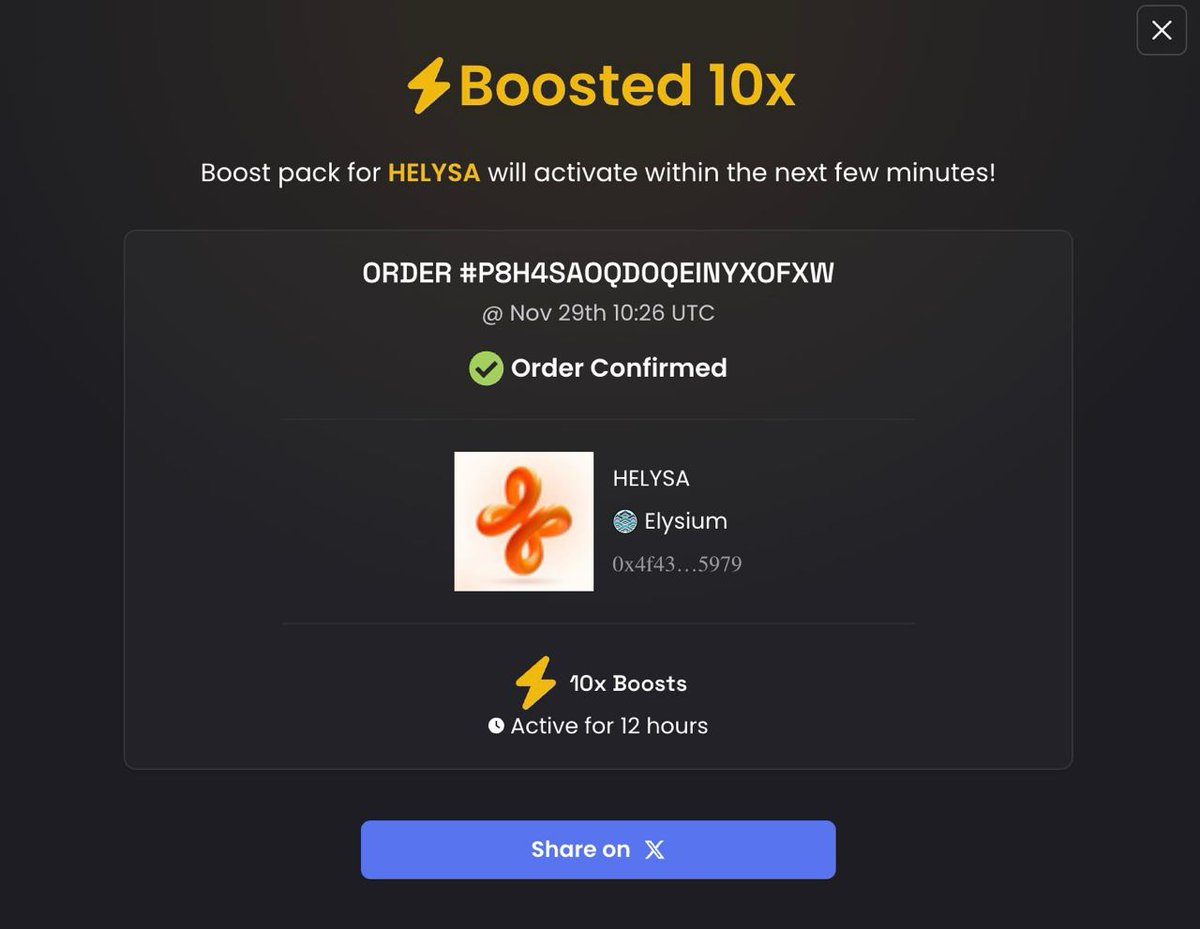
$HELYSA is live.
Helysa's native token has launched. We're building self-custody liquidity tools for Elysium: market making by policy, concentrated LP from your wallet, live chain research and hedge planning. Your wallet signs every action.
CA: 0x4f43ea606c18d33791988562d7e6e9758f7d5979
https://t.co/tmOAkGxdwT
Six rules we build Helysa by.
01 You sign everything. No hidden approvals and no background actions you didn't arm yourself.
02 Show, don't promise. Historical figures are labelled as historical. We never show projected APRs as fact.
03 Custody stays with you. Positions and treasuries live in your wallets, not ours.
04 Risk in plain words. Every guardrail explains what it does and what it doesn't.
05 Earn when you earn. Our fee applies only to realized earnings, never to principal.
06 Open by default. Public API, signed webhooks and a changelog that lists every release.
Four questions we get before people connect a wallet. Four honest no's.
Do I need an account? No. Connect a wallet. Signing in is a free message signature, not a transaction.
Can Helysa move my funds? No. Pools needs your signature for every action, and Forge's Quoter can't withdraw from your treasury.
Are there fees I'll only see later? No. Every fee shows in the transaction preview before you sign.
Are earnings guaranteed? No. LP and market making can lose money, and nothing on Helysa limits losses.
Non-custodial on Elysium and HyperEVM.
https://t.co/TgBt1avmAx
Closing the tab doesn't stop a Forge Quoter. That's on purpose.
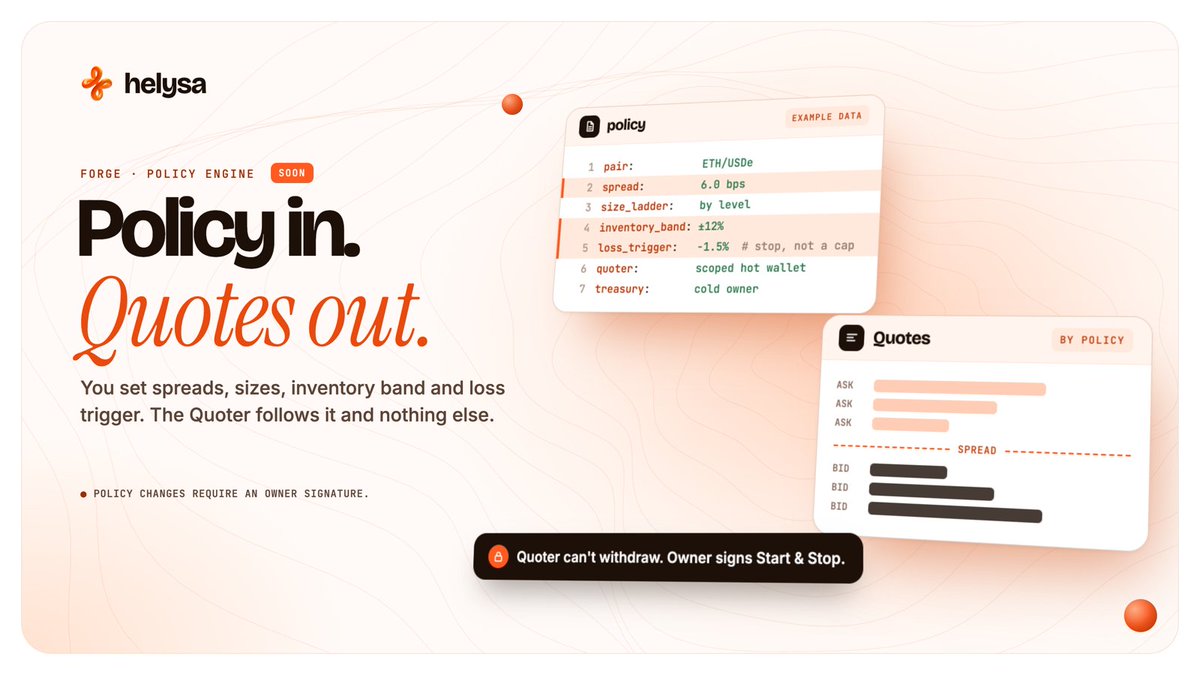
Forge, our PropAMM market-making tool (coming soon), runs on a simple lifecycle. Write a policy: pair, spread, sizes, inventory band and loss trigger. Fund the Quoter wallet from your Owner wallet. Sign Start with the Owner.
From then on, the Quoter keeps quoting inside your policy even after you log out. Closing the browser doesn't stop it. Only two things do: you sign Stop with the Owner, or the loss trigger you set kicks in.
Update on Helysa: Token Scanner.
Paste any Elysium token address and Helysa reads the chain to show you what you're buying into.
• Contract: owner, proxy or clone, and functions like mint, blacklist, tax, pause and upgrade
• Holders since launch: top 10 share, the biggest wallet, what the creator still holds
• Pools: liquidity pulled from its peak, buys vs sells, and what each Montra V4 hook is allowed to do
Scan before you trade: https://t.co/GikH8oLvpi
Helysa runs on two networks: Elysium and HyperEVM.
Different chains, same rules. Helysa never holds your keys, on either one. Every state-changing action shows a preview first, then asks your own wallet to sign. Each action leaves an onchain receipt tied to your signature and a block you can look up.
The fee rules don't change either. Deposits and withdrawing principal are 0%. Scope and Shield are free.
Use any EIP-1193 browser wallet, like MetaMask or Rabby. If your wallet doesn't have Elysium yet, Helysa adds it for you.
Two networks. Same rules.
https://t.co/xGK4zKYnAf
Begin in Scope. It's read-only research: pools, swaps, liquidity depth and positions, with watchlists and alerts. Then move to Shield and plan your hedge on paper across price scenarios. Neither one ever asks for a signature, and both are free.
When you're ready, Pools manages your Uniswap V3/V4 positions from your own wallet. Every action shows a preview first, and you sign each one. Forge, for operators, is coming next.
Each product works on its own. Non-custodial on Elysium and HyperEVM.
What happens to your LP if price drops 20%? Ask before the market answers for you.
Helysa Shield models your LP value and a perp hedge across price scenarios. Slide the price down, slide it up, and see how the position and the hedge move against each other, before you commit anything.
Shield is paper-only. Live order signing is not enabled, so there's nothing to sign and nothing gets placed. It's free, just like Scope.
Concentrated liquidity can underperform simply holding, and no tool can promise otherwise. Planning first just means fewer surprises.
When you plan a Uniswap V3/V4 position in Helysa Pools, Assist proposes a range from three inputs: recent realized volatility, liquidity depth and the pool's fee tier. Every suggestion lists the inputs behind it, so you can see why it looks the way it does.
Then it's your call. Keep the range, widen it, tighten it or ignore it completely. Nothing happens until you approve it.
Your liquidity doesn't move into anything when you use Helysa.
Your LP stays a standard Uniswap V3/V4 position NFT, in your own wallet. Pools reads every position NFT you hold on supported networks. Then it prepares actions: mint, add, remove, collect and rebalance. Each one goes through your wallet, and you sign it.
There's no vault to deposit into and no wrapper token. You're not locked in either. Prefer to collect directly on Uniswap? Go ahead. Actions you take outside Helysa are not charged.
Same position, same NFT, your keys. Helysa just helps you manage it better. Still yours. Still Uniswap.
Forge is a PropAMM market-making console for operators. You write one policy: pair, spread, size ladder, inventory band and loss trigger. A scoped Quoter wallet follows that policy and nothing else.
On Helysa, every mint, rebalance and collect is tied to a signature you made and a block you can look up. Each action shows a preview before you sign. Once confirmed, it leaves an onchain receipt: which wallet signed, which network, which block, which transaction.
Your position earns swap fees. You collect them through Pools, and your wallet signs that collect. Only earnings that are realized and verified count. Then the fee applies to those verified earnings, never to your principal.
A concentrated position only earns fees while price stays inside its range. The moment it drifts out, it stops earning. That's when timing matters.
Helysa Scope watches your positions read-only, with watchlists and alerts. When price leaves your range, the alert fires. Nothing is signed and nothing moves.
Then you decide. Rebalance with a preview first, collect, or withdraw, all signed in your own wallet. Assist can suggest a new range, and you can edit it freely. Withdrawing is one signature, and there's no fee on principal.
Stay in range, or leave on your terms.
https://t.co/5tvOnqaGDI
Not every wallet popup is the same. Know which one you're looking at. Signing in to Helysa is a free message signature. It isn't a transaction: it costs nothing and moves no funds. Your session lasts 30 days, and you can revoke it from settings at any time.
Actions that change state, like mint, add, remove, collect or rebalance, are different. Helysa shows you a preview first, and nothing happens until your wallet signs.
Helysa never holds your keys. Read every prompt before you approve it, on Helysa and everywhere else.
https://t.co/EMKfzl9m5J
All your Uniswap positions in one view, without handing over your keys. Helysa Pools reads every Uniswap V3/V4 position NFT in your wallet on supported networks, so you see each position and its range in one place.
Every action, whether mint, add, remove, collect or rebalance, goes through your own wallet. Nothing moves until you sign.
Building on Helysa ? The data is open.
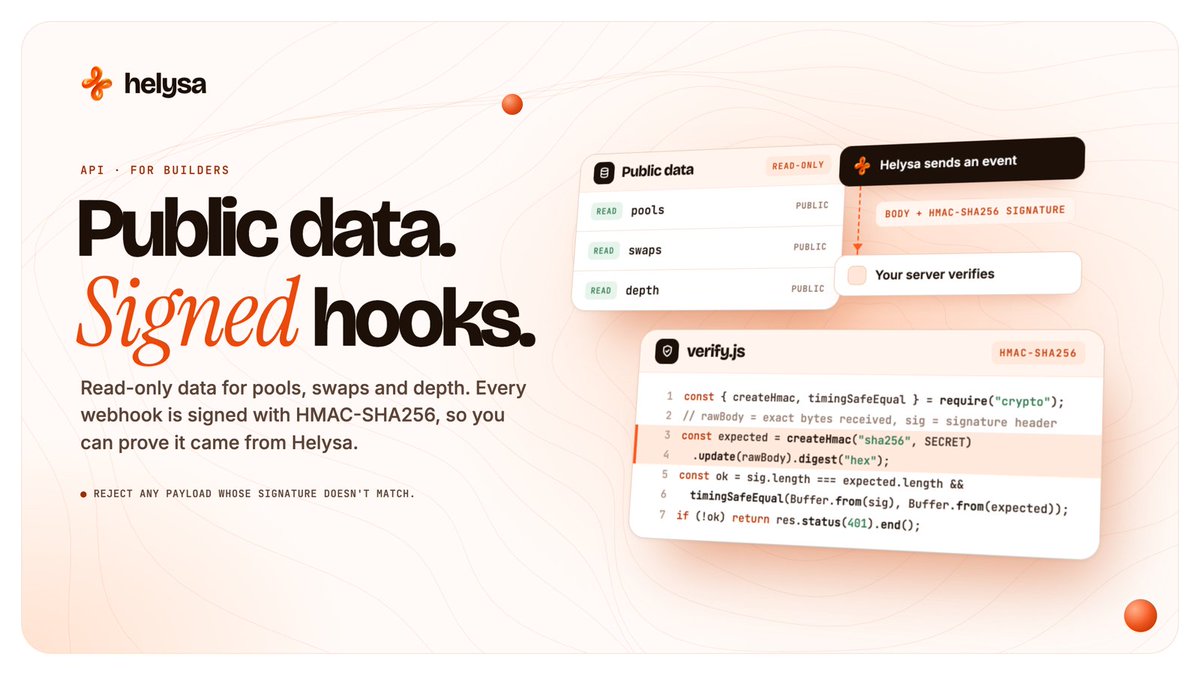
The Helysa API serves public, read-only data for pools, swaps and depth. Pull it into your dashboards, bots or research tools.
Every webhook payload is signed with HMAC-SHA256. On your server, recompute the HMAC over the exact raw body with your secret, then compare it to the signature you received using a constant-time check. If it doesn't match, reject it.
That's how you know an event really came from Helysa and wasn't changed on the way.
Docs: https://t.co/h1DyjzxlJG
Impermanent loss: a concentrated position can underperform simply holding the tokens. Out of range: when price leaves your range, the position stops earning fees.
Market-making loss: Forge loss triggers are stop triggers, not maximum-loss guarantees.
Smart contract risk: protocols and wallets can have bugs, so check the audit status first.
New feature update: Pool Explorer is live on https://t.co/5tvOnqaGDI.
Every active Montra V4 pool on Elysium, all in one live table:
→ Trades, volume, spot price and in-range liquidity for each pool, read from on-chain Swap events and refreshed every 20 seconds
→ Every pool key is verified: keccak256(PoolKey) must equal the pool ID, so nothing listed is a guess
→ Search by symbol, name or address. Sort by trades, volume, newest or last trade
→ Star pools to keep a watchlist on your device
Try it now: https://t.co/YbEtHLge7K