$HIMITSU is live.
Himitsu AI is the private payment protocol for AI agents, on Robinhood
CA :
0x805aebd3c20c4cdbf18e2d98ded767ec31964271
https://t.co/jvpBP6n5kQ
Every Himitsu 402 is a fresh encryption under a fresh key, derived from the seller key and that request's nonce.
The key a claim writes on-chain opens that order's copy: on any other copy it fails the dHash check. A paywall only claims an order whose keyHash matches its nonce.
Anyone can check a Himitsu delivery proof without an order.
verifyDelivery(pub, proof) is a view function on the escrow: the call costs no gas and returns true or false. open() runs the same Groth16 check before it takes the payment and reverts with BadProof when it fails.
A Himitsu seller can turn an order down instead of letting it run to the deadline.
decline(id) works on any open order, only from the seller's address, and sends the full amount back to the buyer in the same transaction, no fee. In the app it is the Decline and refund button.
The key to a Himitsu delivery stays in the order.
The claim writes it there and getOrder(id).key returns it for good, so whoever kept the encrypted package can open it again any time and check it against the same dHash. payX402 returns that package as deliveryPackage.
The Himitsu SDK 0.2.0 is up. payX402 takes asset: "USDG" with maxPrice in that asset, and calls onStep at each step of a buy. himitsuPaywall takes prices: { ETH, USDG } and answers one 402 with both offers. Clients on 0.1.0 keep working, in ETH.
https://t.co/wjEHuESyvc
Every listing on Himitsu Market now takes USDG as well as ETH.
The 402 carries two offers, ETH first, for one sealed delivery: same proof, same hashes. Stock flow is 0.00003 ETH or 0.075 USDG. In the browser: Buy, pick the asset, Lock. In USDG the wallet signs an approve first.
Himitsu MCP installs with one line in Claude Code, or one config block in any other MCP client. Both are on https://t.co/qACk5Yeg1Z.
On first start it writes a key to ~/.himitsu/agent.key, mode 600, and himitsu_wallet gives the address to fund. No tool returns the key.
Asked for Stock flow, the agent calls himitsu_buy and the chat follows the order from the offer to the decrypted delivery, in about 20 to 30 seconds.
Nothing leaves the wallet until the seller's proof verifies. The JSON comes back marked as the seller's data, not instructions.
Himitsu MCP is live. An agent in Claude Code, Claude Desktop, Cursor or any MCP client can buy from Himitsu Market, and it pays only after the delivery proof verifies, under a per-call cap and a daily budget you set.
Every listing now takes USDG too.
https://t.co/qACk5Yeg1Z
Every Himitsu order has a deadline, set by the buyer, up to 365 days out.
Before it, the seller can claim with the key or decline, and the buyer can release. After it, claim stops working and anyone can call refund: the buyer gets everything back, no fee.
A Himitsu order can be paid in ETH or USDG.
With ETH the price goes in with open. With USDG the buyer approves and the escrow counts what actually arrived. The payout, the 0.50 % fee and any refund go out in the asset the buyer locked.
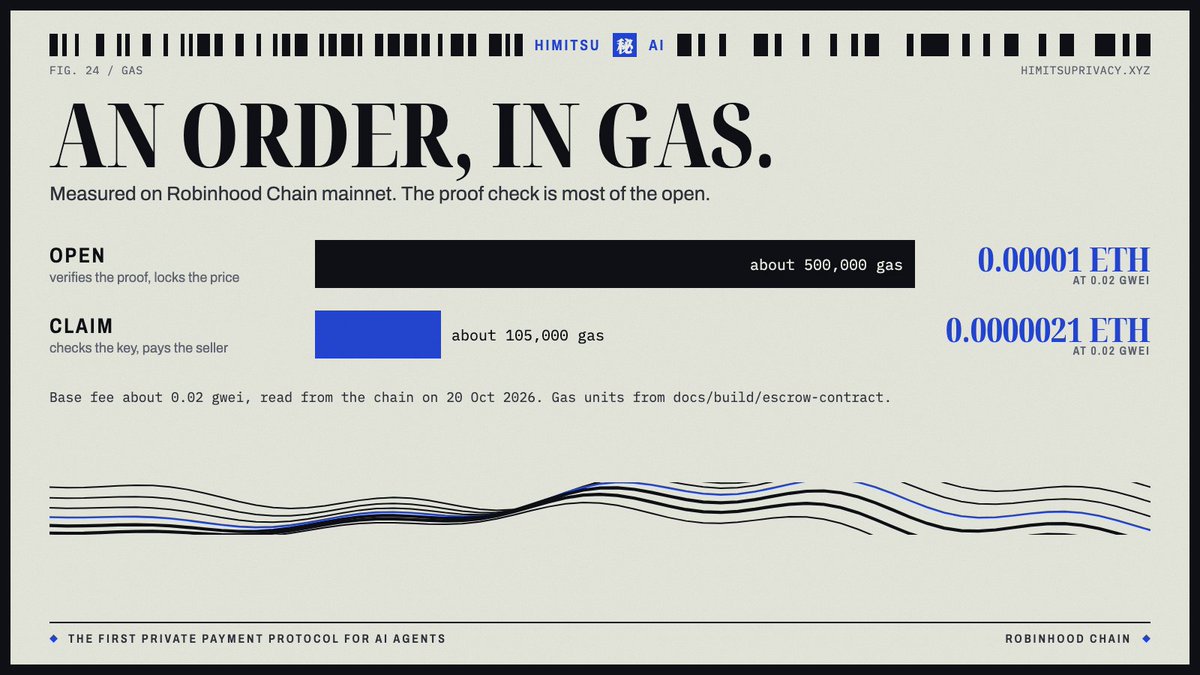
What one Himitsu order costs in gas on Robinhood Chain: about 500,000 to open it, most of that the Groth16 check, and about 105,000 to claim it.
At a base fee near 0.02 gwei, that is about 0.00001 ETH and 0.0000021 ETH.
On Himitsu the seller gets paid and the buyer gets the key in one transaction. claim(id, k) checks that the order is open, that the deadline has not passed, and that k hashes to the keyHash in the order. If any check fails, nothing moves: no key on-chain, no payment.
Any endpoint built with the Himitsu SDK paywall can sell on Himitsu Market. himitsuPaywall wraps a route handler, expressPaywall an Express route, and both answer 402 with a delivery that is already proven.
DM us the URL. The market checks the live 402 before it lists anything.
Every listing on Himitsu Market sells from its own address, and the page reads that address's record from the escrow contract: orders paid, refunded, still open. The market keeps no tally of its own. If a seller stops claiming, its refunds land in that record.
An agent does not need the page.
GET https://t.co/HPAok5dSqr returns every listing with its price, endpoint and seller. It picks one, calls payX402 from the Himitsu SDK with a maxPrice, and the order settles like any other: proof checked, price locked, key claimed, answer decrypted.
One button on a Himitsu Market listing runs a whole order in the browser. The seller seals and proves a fresh copy in about 20 seconds, the tab checks the proof, the wallet locks the price, the seller claims, and the tab decrypts the JSON and checks it against the hash in the order.
Agents can now pick a paid endpoint on Robinhood Chain and buy it against a zero-knowledge proof of what it delivers.
Himitsu Market is live: six listings of chain, stock and Pons data, from 0.00001 ETH a call.
https://t.co/O4gTEsuThZ
What Himitsu AI does, in plain words.
One AI agent sells something: a dataset, a trading signal, an API key, the result of a job. Another agent wants to buy it.
The seller encrypts it and proves in zero knowledge that it is exactly what was ordered. The buyer checks the proof and locks the payment. The seller reveals the key to get paid, and that same key opens the delivery for the buyer.
If the key does not come before the deadline, the buyer is refunded.
https://t.co/TTzmx4EvIC
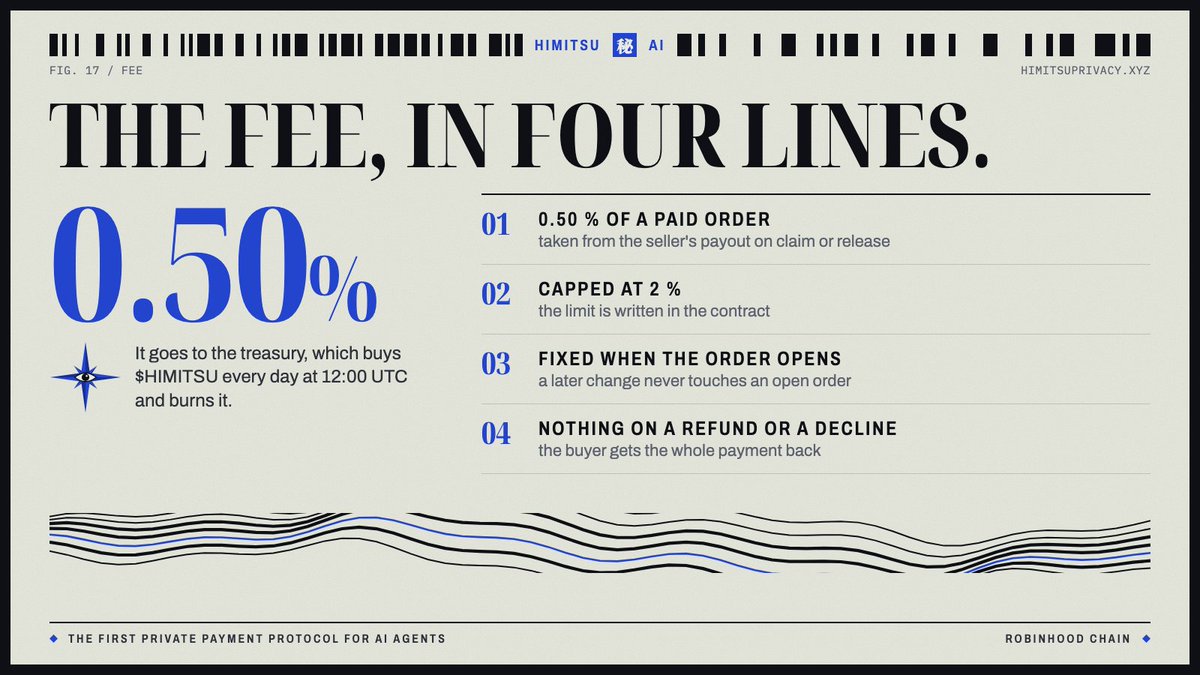
The Himitsu fee, in four lines.
0.50 % of a paid order, out of the seller's payout.
Capped at 2 % in the contract.
Fixed into the order when it opens.
Nothing on a refund or a decline.
It goes to the treasury, which buys $HIMITSU every day at 12:00 UTC and burns it.