$KEEL is officially live.
CA: 0x0a3d6e9bc9342900706d6fd7d75de661ea6d1e6b
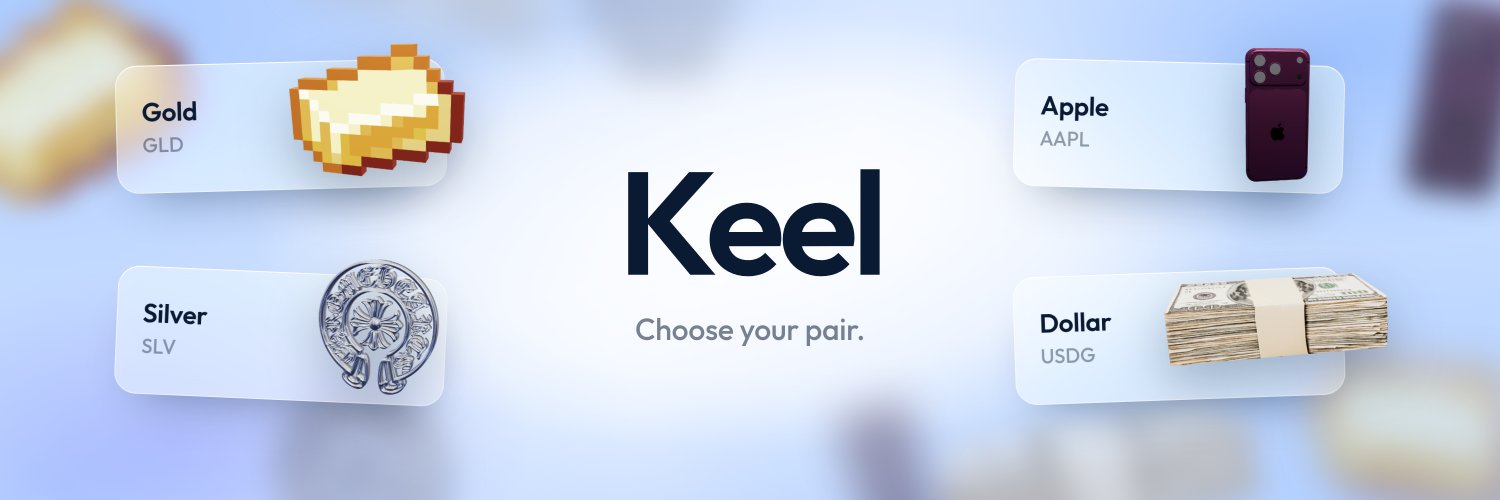
66 tokenised assets to choose from. Gold, silver, the S&P 500, Apple, the dollar, and more.
Launch a coin paired with a real tokenised asset through pons v2 on Robinhood Chain.
The pair is written into the curve at launch and never changes. Priced in the asset, not pegged to it.
https://t.co/qxwLrIWBgP
Shipped today: a price line on every coin, sorting and filtering on the register, launch notices, a creator page with your fees, a live trade feed, and a public review of our own code with the two bugs it found.
Also fixed: the page that was loading empty for some of you. That one was ours and we said so.
https://t.co/dhTmnB82VY
A bonding curve's fees do not land in your pocket by themselves. pons holds the launcher's share until somebody claims it into the vault, and the vault holds it until its owner withdraws.
Two steps, both public, neither of them ours to skip. Now both are one click from the same page.
Every buy and every sell on Keel, in one page, as it happens.
https://t.co/HedyXS2gJd
One query to the chain covers a whole day of it, which is why there is no database behind it and nothing left over when you close the tab.
We do not hold your coin. We do not hold your asset. We cannot change what your coin is priced in.
What we do is keep a register of which pair tokens pons approves, draw what the chain says, and tell you when we get something wrong. That is the whole job.
Launched a coin on Keel? Open https://t.co/dcw3Y12QxM and connect.
It shows what you launched, the fees waiting to be claimed, what is already in your vault, and what you have withdrawn. Two buttons, two signatures. Someone had 0.02 USO sitting there today without knowing it.
New on Keel: every trade on every coin, in one place.
https://t.co/WHC6PnOPvR shows buys and sells across the whole register as they happen, read straight from each curve's own events. New ones arrive while you watch.
One query to the chain covers the whole day of it, so it costs the node almost nothing and there is no database behind it. Close the page and there is no feed left anywhere.
New on Keel: your launches, in one page.
Connect your wallet at https://t.co/17ZW44hj2l and you see every coin you launched, the fees waiting to be claimed, what is already in your vault, and what you have withdrawn.
Two buttons, two signatures, and Keel holds none of it at any point.Someone launched a coin priced in oil today and had 0.0245 USO waiting without knowing it. Now they will.
Plenty in the pipeline, and it is all the same idea: more of what the chain already knows, and none of what it does not.
Shipped today alone: a price line on every coin built from its own trades, sorting and filtering on the register, launch notices, and a public review of our own code with two bugs we found and fixed.
Reminder for anyone arriving today: pick the pair carefully.
It is written into your coin's curve at launch and it cannot be changed afterwards. Not by you, not by us, not by pons. That is the point, and it is also the one decision you cannot walk back.
Two things we will never do.
Take a cut of a creator's fees. That one is a choice we could reverse and will not: 2% goes to the launcher's vault and we take none of it.
Change what a coin is priced in. That one we could not reverse if we wanted to. The pair is immutable on the curve and there is no setter for it anywhere.
There is no database behind Keel.
Every number on the site is a contract call made when the page opened, and made again while you watch. The market cap on a card is getReserves(). What a coin trades in is getLaunchedToken(token).pairToken. Whether pons still allows that asset is approvedPairTokens(asset).
You can run any of them yourself.
We do not have a token sale, a points programme, a referral tree or a private round.
We have a launchpad that takes 0% and a coin that launched the same way everyone else's does. If that ages badly, you will be able to see it on chain before we say anything.
A launchpad where the interesting number is not the market cap.
It is the reserve: how much of a real asset a coin's curve is actually holding right now. You can read it on every coin's page, and it is the thing that decides when the pool opens.
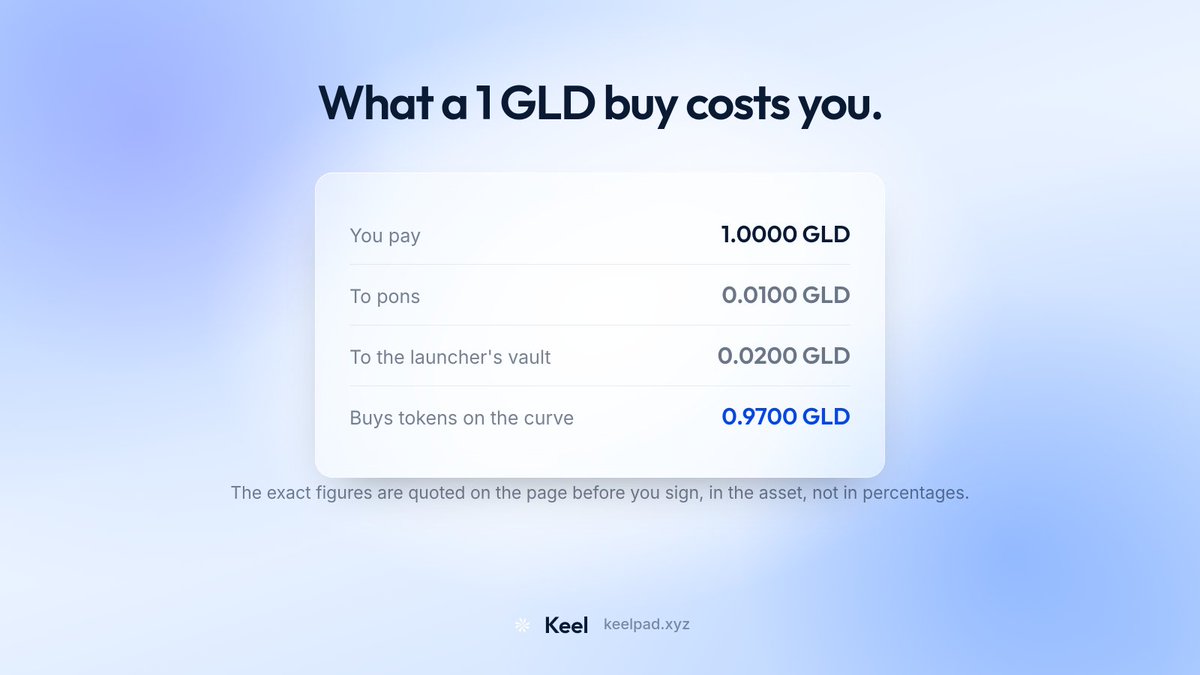
What a 1 GLD buy actually costs you, in gold, not in percentages.
0.01 to pons, 0.02 to the launcher's vault, and 0.97 buying tokens on the curve.
Those exact figures are quoted on the page before you sign, in the asset you are paying with.
Priced in gold is not backed by gold, and we would rather say it ourselves.
What it means: you pay GLD, you get GLD back, the fees and the reserve and the pool are all GLD. The unit of the whole market is gold.
What it does not mean: the coin is not a claim on gold and does not follow its price. GLD belongs to its issuer, not to us. It says so on every asset page, before you launch anything.
Three lists, read from the contracts.
What pons can do. What Keel can do, which is almost nothing. And what nobody can do, starting with changing what your coin is priced in.
https://t.co/j9M4bea3U9
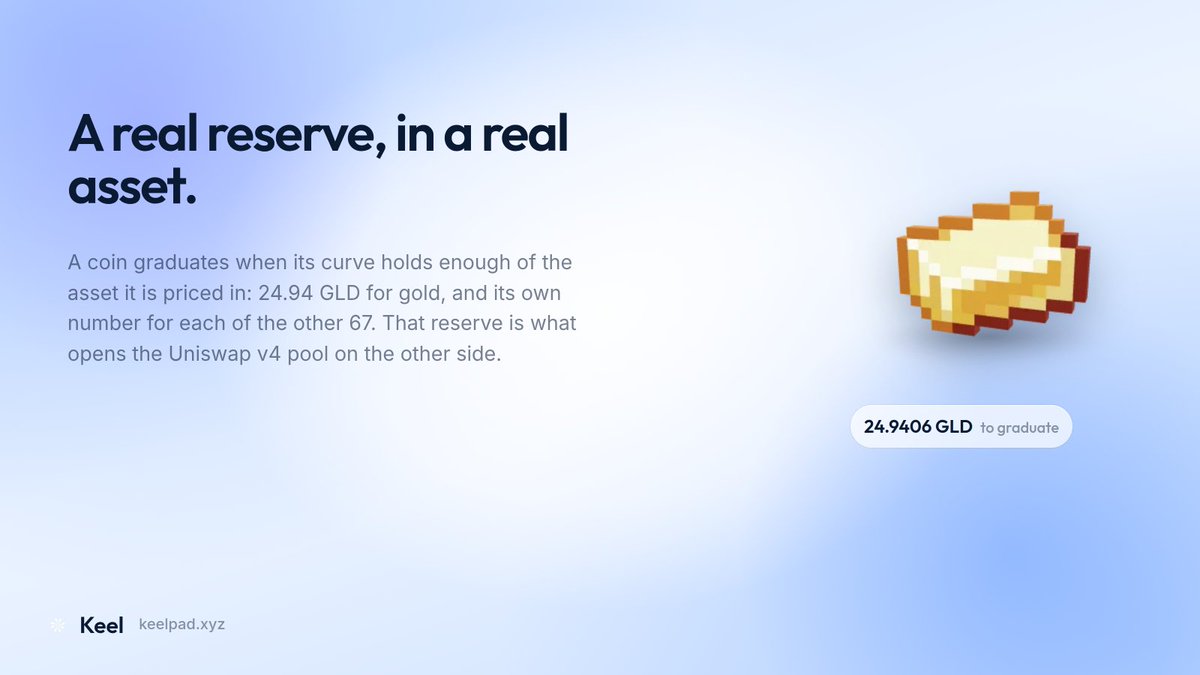
A coin on Keel graduates when its curve holds a real reserve of the asset it is priced in. 24.94 GLD for gold, its own number for each of the other 67.
That reserve is not a milestone on a marketing page. It is what opens the Uniswap v4 pool on the other side, with the same asset in it.
Launching on Keel is one signature, and it creates three things.
Your coin, an ERC-20 on Robinhood Chain with the name, ticker and picture you gave it. Its curve, priced in the pair you chose. And your vault, where 2% of every trade lands, owned by you and nobody else.
If pons does not record your exact pair on that curve, the whole transaction reverts. https://t.co/EBbzp9UaB2
The empty numbers are fixed. A refused read no longer takes the rest of the page with it, pages retry before giving up, and the register loads three times faster.
Anything else broken? Tell us the page and what you saw, we will fix it in public.
We hear you. Some pages were coming up without their numbers and we know why: the public RPC node has been refusing requests under load, and our own retry was not patient enough.
The fix is going out today: a failed read is retried instead of turning into a dead page, and one unlucky call no longer takes the rest of the page down with it.
If you hit something else, reply with what page and what you saw. We are on it.
We hear you. Some pages were coming up without their numbers and we know why: the public RPC node has been refusing requests under load, and our own retry was not patient enough.
The fix is going out today: a failed read is retried instead of turning into a dead page, and one unlucky call no longer takes the rest of the page down with it.
If you hit something else, reply with what page and what you saw. We are on it.