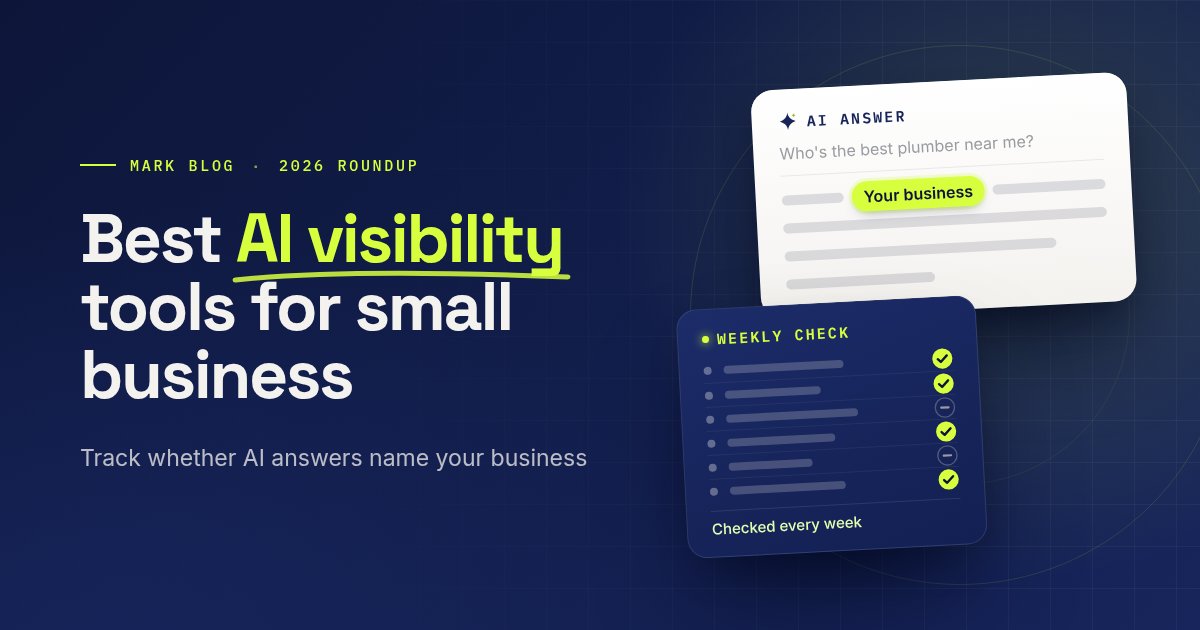
You don't need an enterprise contract to see what AI says about your business.
Small-business tools that track AI answers start at $29 a month. The first check is free: ask ChatGPT the questions your buyers ask, leave your name out, and see who it names.
One catch we hit: the check flags a phrase even when a draft quotes it to criticize it.
Start with three phrases you never want in a post. Decide if each one blocks a draft or only warns.
How we set up Mark's own rules: https://t.co/M5X56xEUHA
Brand rules for AI drafts are two lists.
Judgment calls, like "keep shipped and planned separate," go in the voice guide the model reads.
Exact phrases you never want published go on a list software checks on every draft. A model can slip. A string match doesn't.
AEO (answer engine optimization) and GEO (generative engine optimization) are mostly two names for the same work. Answer the buyer's question in the first two sentences, cite a source for every fact, and keep your business details identical everywhere. That covers both.
AEO grew out of featured snippets and voice search. GEO was named in a 2023 research paper (https://t.co/MkCEHKRK9k). Google's May 2026 guide calls both SEO: https://t.co/0XBxumaT36
Then the newer check: ask an AI tool where to go in that town and see who it names. More on location pages, reviews and AI answers: https://t.co/Qjt9t8nCwr
Quick check if you run more than one location: open each one's Google Business Profile, its page on your site, and its latest post. If the name and address don't match across all three, fix that first.
Google's guidelines ask for one profile per real-world location, under the name customers see on the sign. Duplicate or mismatched profiles can show conflicting info on Maps and Search.
Posting for several clients from one shared folder is how a caption meant for one brand lands on another brand's page.
Fix: one workspace per client. Its brand rules, posts and accounts live there, and a person approves the exact post before it's scheduled.
Each engine's score sits beside it, best first. Every buyer question gets its own score in the Questions table.
Cited pages and Wrong answers are tables you can search and sort.
Everything in this update:
https://t.co/Vfck5rp7bc
Mark's Calendar now has a Month view, next to Day, 3 days and Week.
Channel and pillar filters stay in the URL, so a shared link opens the same view.
How far ahead do you plan posts: a week or a month?
Published website posts in Mark now get a daily reading of pageviews and form submissions from your PostHog project. It's on each post's review page.
After a post goes live, do you check its traffic or move on to the next one?
That last gap is why Mark puts several tools in one. Starter is $79/mo: AI answer tracking on 6 engines weekly, content drafting, social scheduling and analytics, plus keyword rankings and Search Console.
All 7 tools compared:
https://t.co/2LLU8PGEVO
Our take after comparing 7 AI visibility tools: most small businesses shop for them the wrong way.
They line up monthly prices and pick the cheapest. But those prices cover very different amounts of work. The real question is what each price includes.
4 things to check first:
4. A report is not a fix.
Tracking shows which questions name a competitor instead of you. Someone still has to write the page or post that answers them.
If no one will, the dashboard turns into a tab you stop opening.