No black box.
Every check the scanner runs, the weight each one carries and where the numbers come from, written out on one page.
https://t.co/t2FHZyG3JY
Watchlist: pin it, pick a move, get pinged.
Pin tokens from a scan or by address. Prices refresh every 30 seconds while Nock is open.
Each token starts with a 10% ping. Set anything from 1% to 500%.
Radar shows what just opened on Robinhood Chain.
Four tabs.
Live
Read straight from the chain every second: Pons launches and new Uniswap V2, V3 and V4 pools, a few seconds after they are created.
Copycat names get flagged.
New
Fresh launchpad tokens from GMGN (Pons, Clanker, Flap, Long and more), with a meter for how full each bonding curve is.
Trending
Tokens GMGN ranks highest for trading in the last hour, tagged with the launchpad they came from.
Boosted
Tokens that paid DexScreener for a boost. Paid attention, not a quality signal.
Being on the radar is not a recommendation. Every row has a scan button. Scan before you buy.
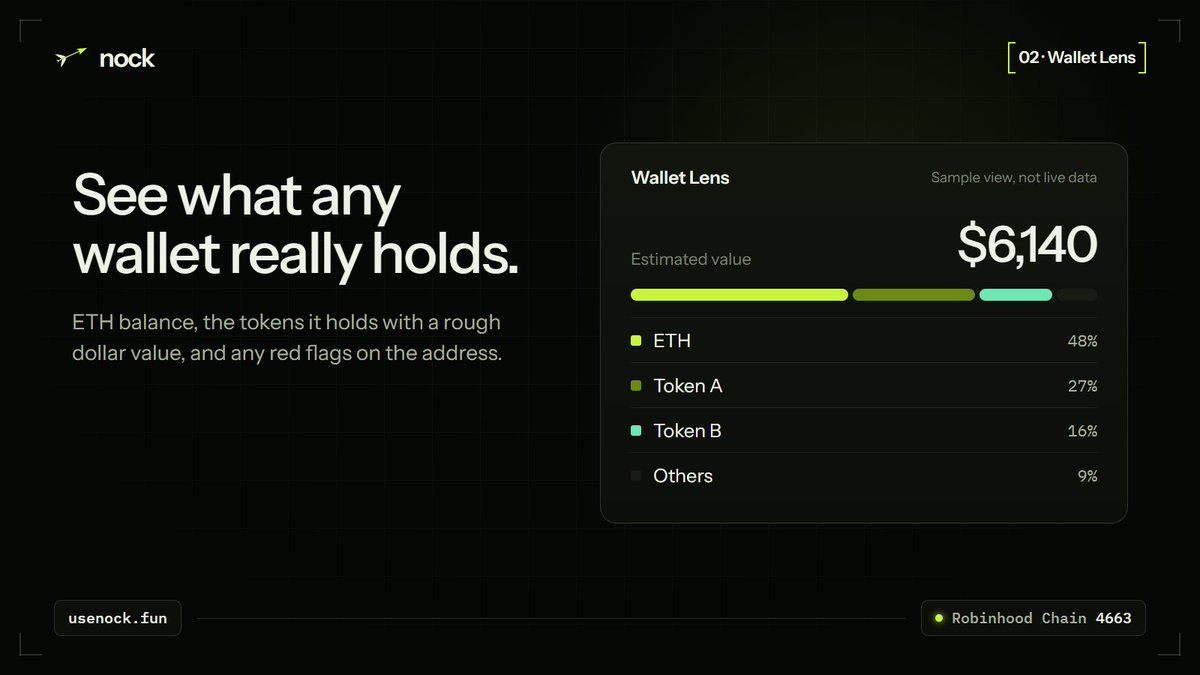
Wallet Lens: see what any wallet really holds.
Paste a Robinhood Chain wallet. Get its ETH balance, how many transactions it sent, its tokens with a rough dollar value, and any GoPlus red flags on the address.
A red Possible copycat badge means a much bigger token already uses the same ticker.
A copy passes contract checks by design. So Nock also compares the ticker with the busiest tokens on Robinhood Chain.
A Nock score can't be carried by one good number.
Four caps keep it honest.
1. A fail on can you sell, mint function, owner powers or buy and sell tax caps the score at 54.
That always reads as High risk.
2. Two or more failed checks of any kind cap it at 79.
So they can never read as Looks clean.
3. Tokens that started trading less than a day ago are capped at 79 too.
Most rug pulls happen in the first hours, so a tidy contract alone is not enough to call a brand-new token clean.
4. Copycats. If another token with the same ticker has 20 times the liquidity or more, the score is capped at 54. Between 3 and 20 times, at 79.
Either way the scan names the bigger token's address.
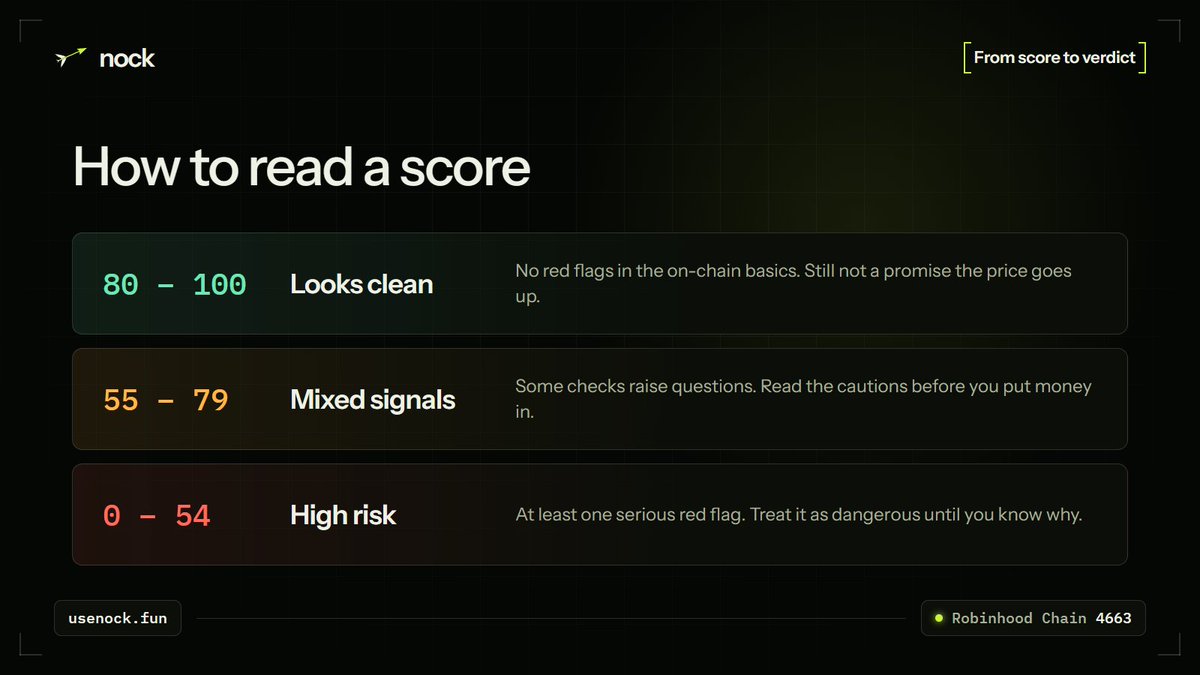
How to read a score:
80–100 Looks clean: no red flags in the on-chain basics.
55–79 Mixed signals: read the cautions first.
0–54 High risk: at least one serious red flag.
Looks clean is still not a promise the price goes up.
A real scan, start to finish.
Paste an address, a DexScreener or GeckoTerminal link, or a Uniswap v4 pool id. Nock fishes the address out and returns nine checks in plain words.
https://t.co/Oupf2pSAfc
The last two checks:
Market age: 7 days or more passes, 1 to 7 days is a caution, under 24 hours fails.
Verified code: pass when the source is verified on the explorer, fail when it is not.
Honest projects verify.
Holder spread and pool depth, in numbers.
Top 10 holders, pools and burn wallets removed: under 25% passes, 25–50% is a caution, above 50% fails.
Pools: $50k+ passes, $10k–$50k is a caution, under $10k fails.
Check 03: Owner powers. Weight 15, critical.
Fail on a hidden owner, reclaimable ownership, balance edits or self-destruct.
An owner who can blacklist you, pause transfers or swap the code can change the rules after you buy.
Check 01: Can you sell. Weight 20, critical.
Fail when GoPlus flags a honeypot or a sell limit, or when there were 20+ buys and zero sells in 24h. Caution when sells are under 10% of buys.
A honeypot takes your buy and blocks your sell.
Your first scan, in four steps:
1. Find the real address
2. Paste it in
3. Read the warnings first
4. Pin it and pick a move
From a ticker you saw on X to a call you can explain.
Nock runs nine checks on every Robinhood Chain token.
Their weights add up to 100.
The four critical ones:
Can you sell: 20
Mint function: 15
Owner powers: 15
Buy and sell tax: 10
A fail on any of these caps the score at 54. That always reads as High risk.
The other five:
Holder spread: 12
Pool depth: 10
Liquidity lock: 8
Market age: 5
Verified code: 5
A pass earns the check's full weight. A caution earns half. A fail earns nothing.
The score is points earned over points possible, out of 100.
When a source can't answer, the check is skipped and removed from both sides. Missing data never nudges the score either way.
Every rule is on the Method page: https://t.co/FoMJbfqJrm
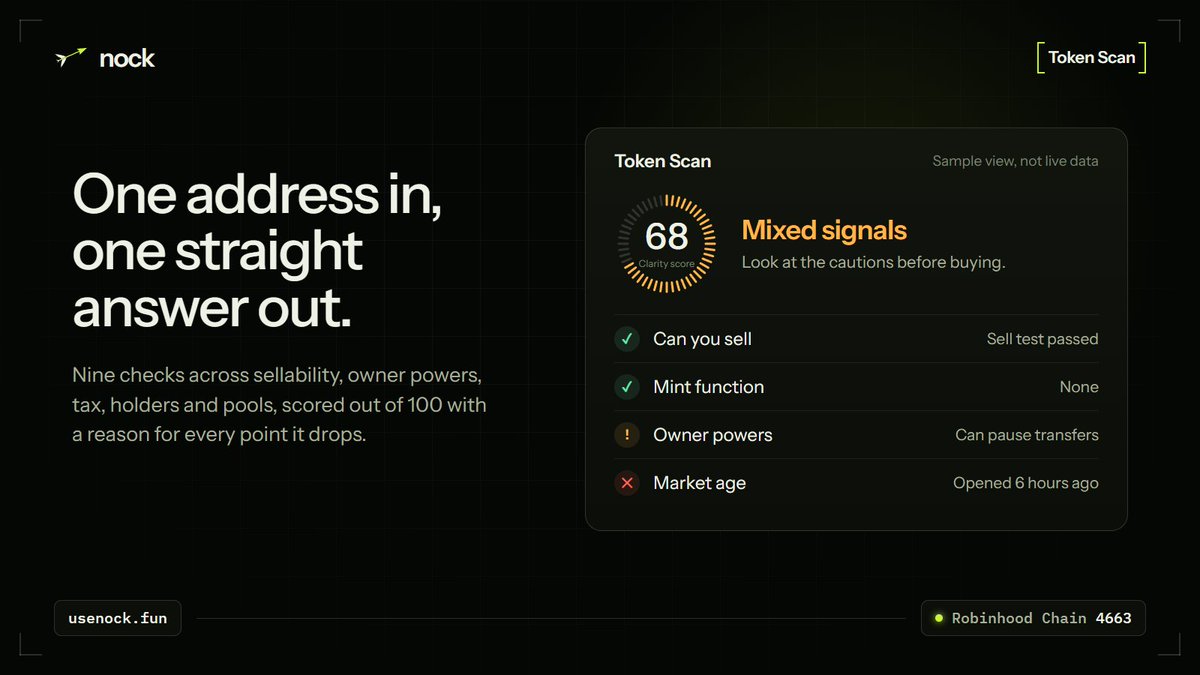
This is what a Token Scan looks like.
A clarity score out of 100. A verdict. Then every check, marked pass, caution or fail, with one line on what it means for you.
Start with the rows marked Fail or Caution.
Nock is built for one chain: Robinhood Chain, the public Ethereum layer 2 that Robinhood runs. Chain ID 4663.
Nock is independent. It is not made by, affiliated with or endorsed by Robinhood.
Why Nock:
→ Nothing to connect
→ Plain words, not raw flag names
→ Every rule and weight on the Method page
→ Free, no sign-up, no email
Your watchlist and recent scans stay in your own browser.
That is when the worst calls get made: a loud ticker, a fast candle, no time to read.
Nock is quick enough to use right then. Paste, scan, read the warnings.
Results usually land within a few seconds.
Nock looks at every token as five layers.
If one of them is rotten, the rest doesn't matter much.
1. The code
Is the contract verified, or can it be swapped?
Unverified or upgradeable code can do things nobody has read yet.
2. The exit
Can you sell, and what does it cost?
Honeypots take your buy and block your sell. High taxes do it slowly.
3. The pool
Is there enough liquidity to get out?
In a shallow or unlocked pool your exit can vanish in one transaction.
4. The holders
Who actually holds the supply?
Pools and the Uniswap v4 manager are filtered out, so you see people.
5. The owner
Can someone mint, pause or blacklist?
The core of every token. A live mint or a hidden owner caps the score.
See how each layer is scored: https://t.co/FoMJbfqJrm
Four tools. One habit: look first.
◎ Token Scan: one address in, one straight answer out
▣ Wallet Lens: see what any wallet really holds
◌ Radar: new pools the moment they open
⌖ Watchlist: pin it, pick a move, get pinged
https://t.co/hOXNPuqpUm