We're live with $PRISM on @RobinhoodCrypto!
CA: 0x0a1e0cc751f77c2c93760fc957cc8e4e779b2bc8
Prism Network is already in production: Agents rent NVIDIA GPUs with their own wallet, pay per second in USDG, and every lease settles onchain with a public receipt.
Here's what $PRISM does:
› Lock: Get access to capacity priced below the public rate. Up to 20% off.
› Staking: TBD soon.
Prism durable workspaces are now live.
Usually, the GPU you rent is destroyed when you're done and your files go with it. That's fine for a one-shot job but useless for fine-tuning, dataset prep, or anything you pick up again tomorrow.
Now with Prism, the machine is temporary but your work isn't. You can s a directory off a rented GPU, let the machine be destroyed, then restore onto a different one.
Your files are encrypted on your side, under a key derived from a signature by your own wallet, before
anything reaches us.
You can lose the laptop and keep the workspace, and there's no copy of your key with us to leak, lose, or be made to hand over.
Shipped: Prism now in every major agent stack.
Every serious trading strategy has a compute bill. Until now, paying it needed a human in the loop: a cloud account, a credit card, a dashboard.
We've provided a way for agents to pay for it themselves.
Prism now lets an agent with a wallet rent real NVIDIA GPUs the way it does everything else onchain: sign, pay, use, settle.
That means an agent's intelligence is no longer capped by the box it runs on.
When a question needs 200k simulated market paths, it rents the horsepower for the minutes it needs it, then puts the answer to work from the same wallet that paid for the compute.
Research cost becomes a line in the strategy's own P&L instead of a subscription someone set up for it.
And it plugs into the stacks agents already run on. MCP, LangChain , CrewAI, AutoGen, Eliza, Virtuals: compatibility for all 5 shipped today on npm and PyPI 🚢
How many Robinhood tokens are dead?
After tracking 410,960 tokens launched across 7 launchpads, including @TradePools and @Ponsdotfamily, we found that only 3,424 of them are still active.
With survival rate at less than 2%, it shows how quickly attention and liquidity shifts onchain.
Robinhood Chain is in Robinhood Wallet.
Bridge from Solana, Ethereum, Arbitrum, and more, then swap and explore, all in one app.
Download here: https://t.co/fXSB5oHOUy
Everyone shows you the happy path.
The interesting part of renting a machine from strangers is what happens when the machine does not turn up.
On Prism a funded lease that never reaches a working GPU refunds itself.
The deposit sits in escrow, not in our account. When provisioning runs out of time the contract releases it, and anyone can trigger that release, including
the renter. It does not depend on us being awake, solvent, or willing.
This morning a lease tried three hosts in a row that each advertised open ports and reserved none. It gave up and returned the money without anyone asking it to.
If failure needs a human, it's not infrastructure.
Infrastructure is failure resolving itself.
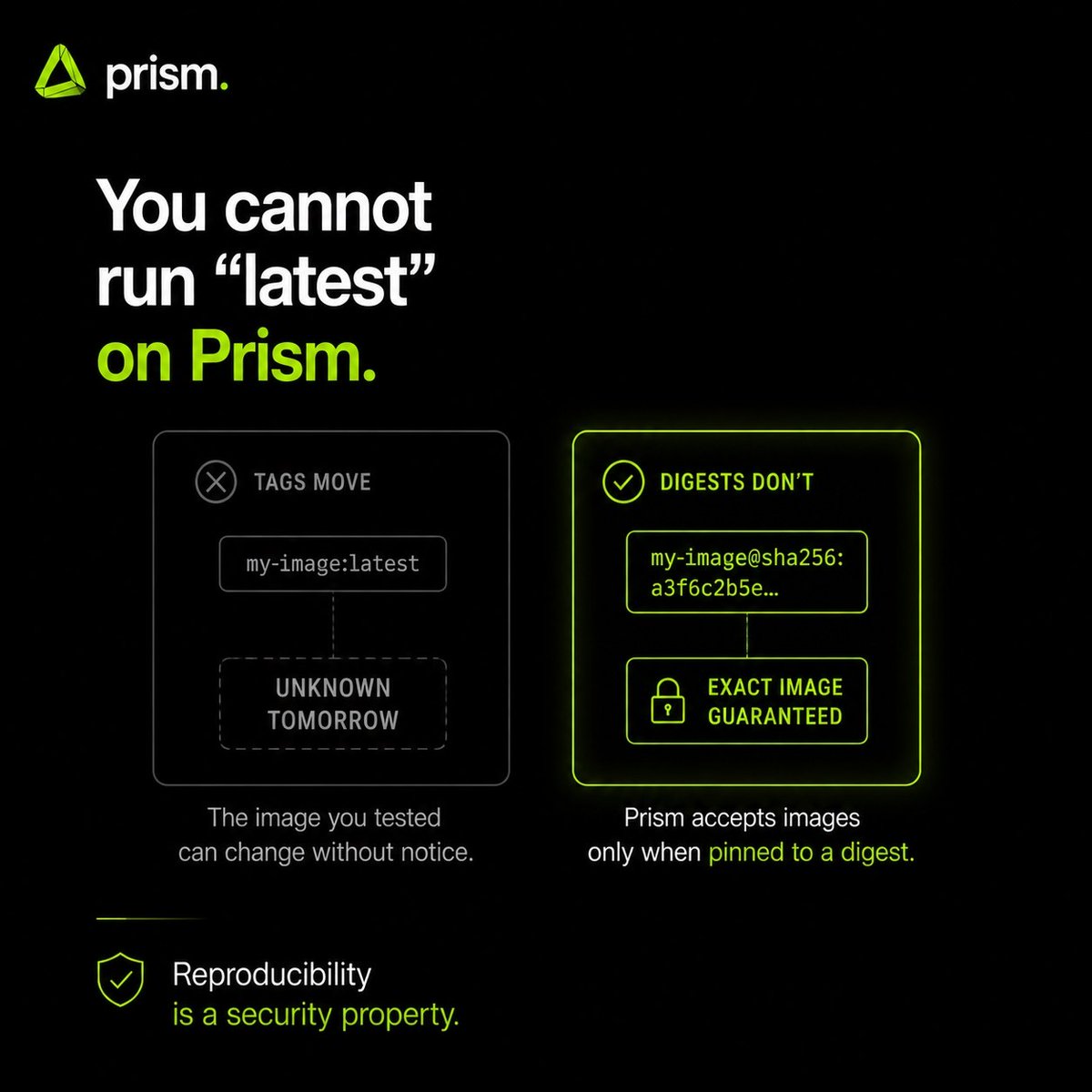
You cannot run "latest" on Prism.
Container tags move. The image you tested and the image that runs can be different things, and nothing tells you.
Prism accepts an image only when it is pinned to an exact digest.
So the workload that ran is the workload you named, and the receipt at the end refers to something specific rather than to whatever that tag happened to
point at that afternoon.
Reproducibility is a security property.
Every GPU cloud decides who is allowed to sell.
You apply, someone reviews you, and if you are the wrong size or the wrong country the answer is no.
Prism has no such step.
A machine joins by staking PRISM in the registry contract and running the node software. No application, no reviewer, nobody to email.
Renters never touch the token. They pay in USDG, by the second. Suppliers stake, customers pay.
Permissionless supply is the part most compute networks quietly skip.
An invoice is a claim. A receipt is a fact.
Every finished lease on Prism publishes a settlement receipt onchain: which
GPU, how long it ran, what was charged, and what went back to the renter.
Nobody has to take our word for the number. That includes us.
It matters more than it sounds. A network that bills you should not also be
the only record of what it billed you for.
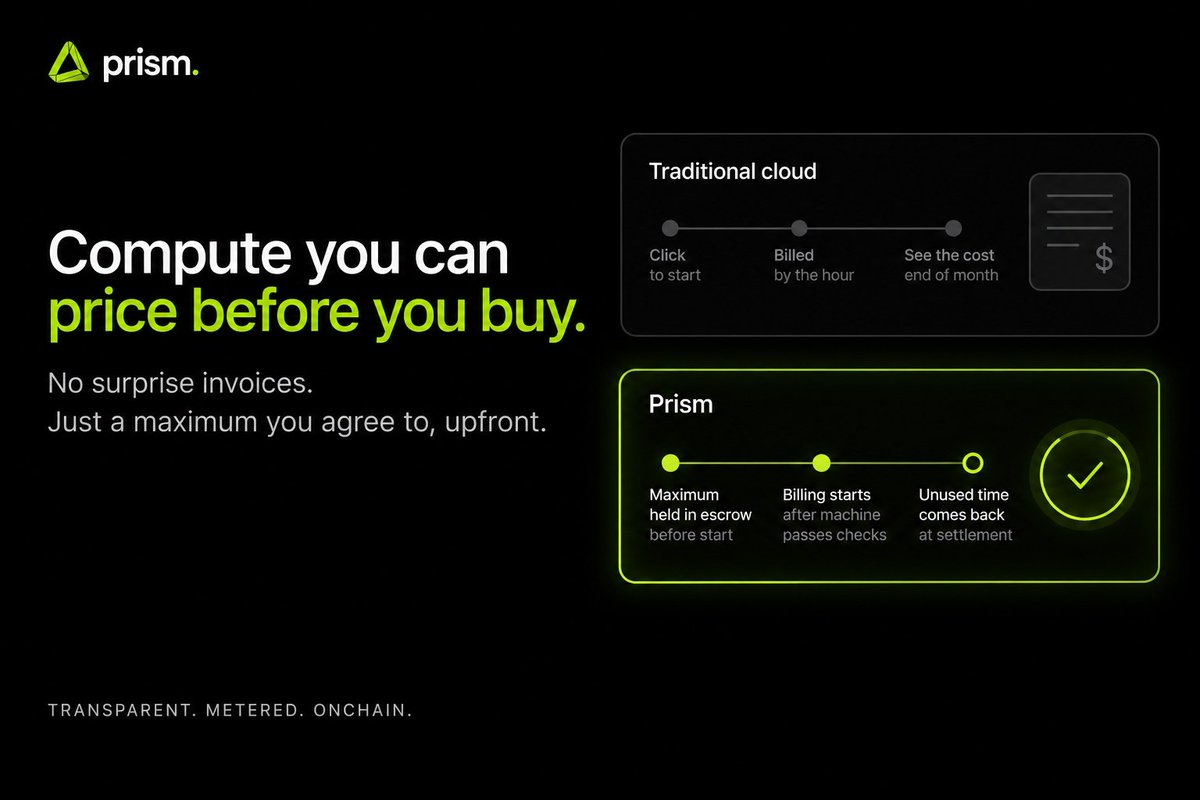
Cloud billing asks you to trust the invoice.
You rent by the hour, you are charged for the hour, and you find out what it
actually cost at the end of the month.
Prism holds a maximum in escrow before anything starts.
Billing begins only once the machine has passed its admission checks, not when
you clicked. Time you did not use comes back when the lease settles.
The most you can be charged is a number you agreed to before the machine
existed.
Compute you can price before you buy it.
Service outage: 13 August
Between 14:10 and 21:15 UTC yesterday, Prism took payment for GPU leases it never started.
If you funded a lease in that window you did not get a machine. Deposits were returned automatically, so nobody is out of pocket, but the rental did not happen and your time was wasted.
We sincerely apologize and ask anyone who was affected by this to write us at [email protected] for compensation.
The issue was caused by a change on our side that created a conflict in how leases were identified, preventing some settlements from being processed correctly.
We've fixed the underlying issue and added independent monitoring against onchain activity so similar failures are detected immediately, rather than relying solely on our internal records.
We've also launched a public status page with live network and settlement data, along with a transparent incident history.
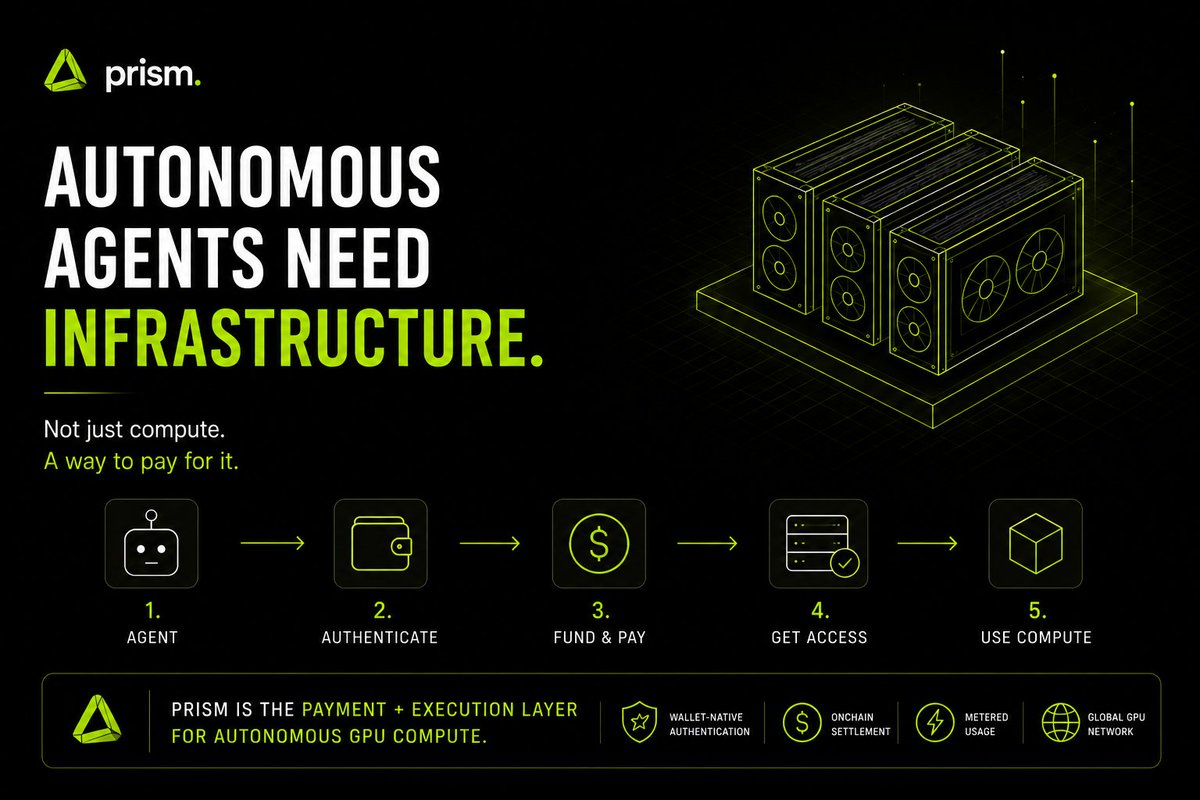
Autonomous agents don't need another GPU cloud.
They need a way to discover, access and pay for compute autonomously.
Traditional cloud infrastructure was designed around people.
Prism is designed around wallets.
An agent can authenticate, fund compute, receive access, execute workloads, and settle usage entirely onchain.
That's what autonomous compute infrastructure looks like ⬇️