nTZS is coming to Qadi. 🇹🇿
Tanzania's stablecoin is joining our supported rails, giving businesses in Tanzania and the rest of the world a fast, low-cost way to move between Tanzanian Shilling and stablecoins, right through the Qadi API.
#ntzs#stablecoins#payments#api
Every Qadi wallet is non-custodial, with built-in controls for how money moves.
- Set transfer limits.
- Require approvals above a threshold.
- Assign roles and granular permissions.
Your team gets the access they need, while you stay in control of the funds.
Control every transaction without slowing your operations.
Book a demo: https://t.co/Ls612zwjyt
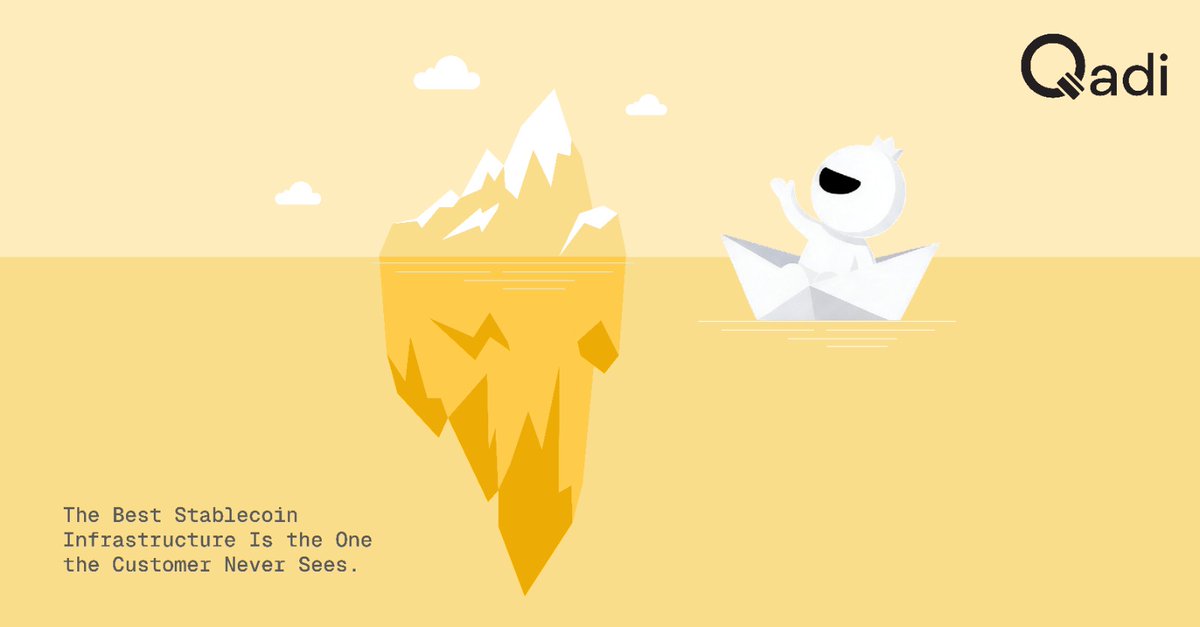
Most fintechs building with stablecoins aren't building crypto products.
They're building payroll, remittances, and B2B payments.
The customer has no idea how the payment settled.
They just know it arrived.
That's the point.
https://t.co/Euu6VV5vKT
@amosuibk Qadi is building the infrastructure that lets businesses move money globally using stablecoins through wallets, payments, treasury management and local fiat on/off-ramps, all through one API.
Qadi is the infrastructure layer for businesses moving money across borders.
From paying suppliers, partners and remote teams to enabling stablecoin settlement and managing multi-currency balances, Qadi supports:
1. B2B payments: Settle with suppliers, partners and contractors globally without slow bank wires.
2. Remittances: Move funds across corridors with settlement in seconds, not days.
3. Fintechs: Plug stablecoin infrastructure into products you already run.
4. Neobanks: Hold and move multi-currency balances without building the rails yourself.
5. Payroll: Pay remote teams and contractors across markets in one flow.
6. Investment platforms: Connect stablecoin settlement to local fiat for your users.
One infrastructure layer for wallets, treasury, payments and global money movement.
When treasury settles in seconds instead of days, a lot changes.
- Liquidity management.
- Cash visibility.
- Reconciliation (on-chain meets traditional records).
- Risk controls.
The underrated part of faster settlement: it changes how finance teams plan.
Instead of building around settlement windows, they can move funds when they need to.
That's a different operating model, not just a faster one.
https://t.co/Ls612zwjyt
The interesting part about Apple Pay hinting at adding stablecoin support is what happens when stablecoins move from crypto-native products into everyday payment infrastructure.
Wallets, settlement, liquidity, compliance and local payout infrastructure all have to work behind the scenes for the user experience to feel like a normal payment.
The infrastructure underneath is where the real shift happens.
The network stablecoin payments run on matters too.
You need transactions to be fast. You need fees to stay low. You need infrastructure that can support payments at scale.
Those three decide whether stablecoins work as payment infrastructure or just sit there as digital dollars.
Exactly. There is shift from stablecoins as a crypto-native asset to stablecoins as programmable payment infrastructure.
The real opportunity is using them to move money across wallets, chains, markets and financial systems more efficiently.
Stablecoins are becoming a major bridge between traditional money and blockchain infrastructure.
The use cases keep expanding:
Payments.
Trading.
Settlement.
Treasury movement.
Stablecoins are no longer just a DeFi liquidity tool.
#Stablecoins#Crypto#Payments
A fintech's second market is where the infrastructure gets tested.
New bank. New rails. New liquidity. New compliance. New settlement.
Every corridor adds a layer, and those layers compound with volume.
The first market proves the product. The second market proves the infrastructure.
Most fintechs find this out somewhere between market two and market three, when the architecture built for market one starts showing its limits.
Local stablecoins represent a major opportunity in onchain finance.
They enable faster and cheaper payments that can pass yield directly to end users while allowing merchants to settle natively. They also eliminate FX friction by enabling direct currency pairs and serving as the essential quote pair for tokenized local assets.
Market cap by asset on @base, YTD:
🇪🇺 EURC by @circle - $60M
🇬🇧 tGBP by @tokenGBP - $7.3M
🇨🇭 VCHF by @VNX_Global - $684K
🇪🇺 EURAU by @AllUnityStable - $117.6K
🇹🇷 TRYB by @BiLira_Kripto - $1.1K
Europe’s growing stablecoin activity on Base is an early signal.
We’re what stablecoins did to remittances, but for the whole shop.
• abstract away the complexity
• provide the data
• handle the underwriting
• wallets, settlement, ramps;all in one.
With just an API, a merchant in Dar gets paid like it’s M-Pesa and settles like its on base
nTZS integration is live.
What that means off X: a trader in Kariakoo gets paid in shillings, settles instantly, pays no FX spread to move money 2,000km. The stablecoin part stays invisible. That’s the whole point.
@ntzs_co@Based_Africa@base
nTZS is coming to Qadi. 🇹🇿
Tanzania's stablecoin is joining our supported rails, giving businesses in Tanzania and the rest of the world a fast, low-cost way to move between Tanzanian Shilling and stablecoins, right through the Qadi API.
#ntzs#stablecoins#payments#api