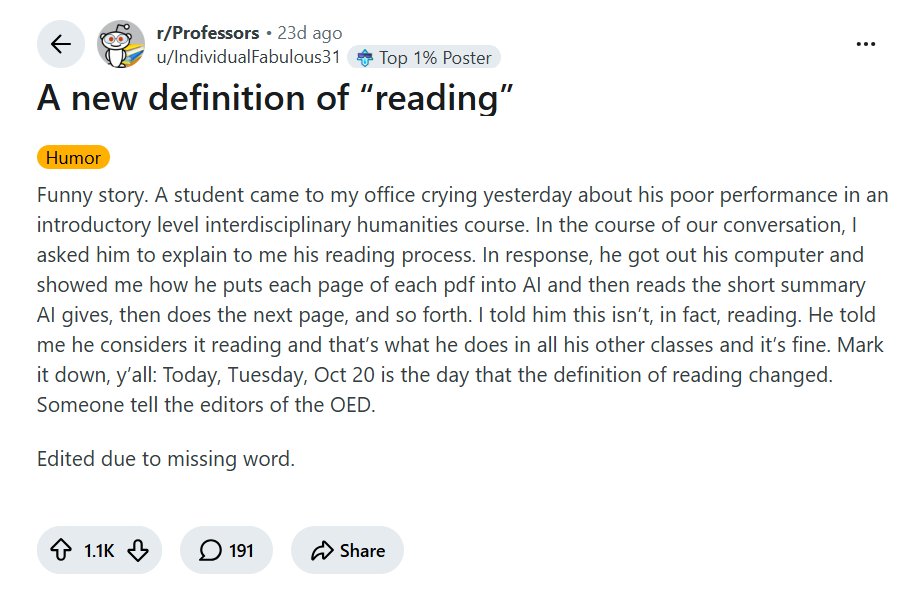
AI does not help when you make it read for you. reducing a written work to its content or even its context is also missing out on its construction. and it's going to show in your limited style and rigid llm-like sentence construction. only actually reading helps you write.
my definition of reading, especially more challenging literary fiction is reading a passage over and over and doing my best to understand it. if i don't, i take a photo of the page and consult gemini, then read it again with the new information+
personally this makes the reading process so much more enjoyable, as opposed to just mechanically reading words on a page and moving on, even when you haven't understood a thing.
The neurodivergent approach to getting things done is to NEVER suppress ur feelings. Say it’s boring, say it’s scary, then observe how you feel as you take action. This helped me greatly w my executive dysfunction. When I tried to motivate myself the neurotypical way? I failed.
The engr. remembers going to china, he's just unable to remember which cities. my dad is around his age, when we're traveling in the ph he doesn't remember, he just goes along with everyone else. if he had known he would be asked the question he probably would have prepared 🧵
‘HINDI MO MAALALA NAGPUNTA KA NG CHINA?’
House private prosecutors Amando Ligutan and Lorna Kapunan express their disbelief at the answer of witness Davao City assessor Engr. Jaime Adalin, saying he cannot recall the alleged all-expenses-paid trip to China.
“‘Yung napaka-simple ‘yung isang witness hindi maalala kung nagpunta siya sa China, last year, 2025. Ano ba ang ginagawa ng isang taong bumabyahe? You have to secure a visa, passport is ready, magpapaalam ka sa family mo. You will prepare ‘yung clothes, you prepare everything,” Ligutan said on Monday.
“Hindi naman ‘to like gigising, pupunta ng coffee shop. I forgot I went to a coffee shop. ‘Yung pagpunta sa isang foreign land, hindi mo maalala? What would you make of that? Parang nakakagalit minsan eh… Hindi mo maalala nagpunta ka ng China?” he added.
“Lalong-lalo na libre… Chinese-sponsored,” Kapunan quipped. (Video by @bellacariaso /The Philippine STAR)
5/ and then they're going to tell him to stop laughing. eh sino bang hindi matatawa kung ipipilit mong makakita ng koneksyon sa ccp ung simpleng travel for pleasure with a group of colleagues. i don't remember the dates when i traveled sometimes, i have to look it up
7/ this reminds me of another study that proved labeling regulated emotion. so as horrible as it sounds to talk shit about yourself in third person, it also removes yourself from the thought and helps you see how crazy it is. no need to reason that it's wrong
i did this and also unearthed some beliefs ive had about how others might be seeing me, too, since referring to myself in third person i also assume the pov of people external to me. 🧵
6/ it also basically takes far less effort than cognitive reappraisal or reasoning with the thoughts, i.e., "of course i belong here. i'm a filipino in california, also filipinos have been in this continent since before it became an english colony"
This is the biggest irony of the whole Alice Huang / Nvidia saga: the Chinese government actually doesn't want Nvidia chips and is actively keeping them out of the country.
Last year it even ordered Alibaba and ByteDance to cancel their Nvidia orders (https://t.co/T4ZMand2BD) and sent customs teams to the ports to check every advanced chip coming in (https://t.co/UFPerK7Cgp).
And right now 600,000 Nvidia H200s are stuck in Hong Kong because Beijing won’t let them into the country (https://t.co/epimhGPQYq)👇
Nvidia also explicitly frames this as a threat to its business in its latest annual report to the SEC: "The Chinese government has encouraged customers to purchase from our China-based competitors and discouraged customers from purchasing, importing, or using our data center products" (https://t.co/TQVwWuix83).
Why does China do that? Because every Nvidia chip a Chinese company buys is one that Huawei or Cambricon doesn’t sell, and domestic chips can only catch up if people actually buy them (which means money for R&D, etc.).
Which means that the notion that Chinese intelligence was running honeytraps to get more Nvidia chips into China gets the whole thing exactly backwards.
In fact, it looks like Megaspeed - Alice Huang's company - was a counter-reaction to official Chinese policy: a private sector workaround to these efforts by the Chinese government to curtail Nvidia.
As was widely reported - including by Western media - Megaspeed built data centers in Southeast Asia and rented their computing power to Alibaba, which the New York Times called "a backdoor way of getting access" to Nvidia chips (https://t.co/tu9Re4WdzM).
That is a backdoor not only - allegedly - around Washington’s export controls, but also around China's own efforts to wean its companies off Nvidia.
I can’t believe the Chinese government was too thrilled about it: it'd make just about zero sense for it to run countless domestic measures to prevent Alibaba from using Nvidia chips, yet at the same time have its top spy agency help the same Alibaba get Nvidia chips through the back door in Southeast Asia 🤷
At the end of the day, as with all such stories, you always need to look at "cui bono?": who benefits? Who benefitted is pretty clear:
- Nvidia itself: it's in the business of selling chips so a customer willing to spend billions of dollars on chips in Southeast Asia is a godsend. Again, as they themselves state in their SEC filings, not being able to tap into Chinese demand would have "a material and adverse impact on our business" (https://t.co/TQVwWuix83).
- Chinese companies like Alibaba: facts are, 1) Chinese chips haven't yet caught up, 2) Chinese chip companies' production capabilities are still limited and 3) Chinese tech firms' historical tech stack runs on Nvidia’s CUDA ecosystem, and rewriting years of code for Huawei chips is painful. Renting Nvidia chips in Southeast Asia is the easy way to stay competitive and serve customer demand in the meantime.
- The US, according to core members of the Trump administration: back in July last year, US Commerce Secretary Howard Lutnick explained that the point of letting Nvidia sell more chips to China was to get Chinese developers "addicted to the American technology stack" (https://t.co/WpaKkS6gOG).
Who does NOT benefit, according to official Chinese policy, is the Chinese state, which has made tech self-reliance one of its foremost priorities.
Which means that, to believe the spy story, you have to believe that a person - Alice Huang - was effectively a spy paid by her own government while simultaneously sabotaging its tech self-reliance drive, which it has spent years and trillions of dollars on - pretty senseless.
Stranger things have happened, I guess, but it doesn't pass the smell test.
And there is another absolutely major contradiction in the media story. According to a Financial Times article published yesterday (https://t.co/7q1UEaUR4y), "a person who knows [Alice Huang] said they had been asked by MSS for information about her earlier this year after news emerged that Singapore was investigating the company in relation to chip-smuggling allegations. The agency wanted to find out more information about Huang, including the nature of her business and connections, the person said."
Which raises a damn obvious question: if she were indeed an MSS asset, why on earth would the MSS need to ask the people around her who she was and the nature of her business?
It's a complete contradiction with the spy story - but very much not a contradiction with what I described above: a private businesswoman running a workaround to Beijing’s own policy, which the Chinese security apparatus would naturally want to look into.
Especially since, around about the same time, Shanghai police detained her business partner, reportedly her husband, in a stock manipulation case (https://t.co/KXimvioTTd): also coherent with Chinese authorities looking into her network, and much harder to square with her being a prized MSS asset.
And, to top it all, there is - to this day - not a shred of evidence that's been published that she is, in fact, a Chinese spy: just anonymous intelligence officials, repeated by journalists who never verified it, as I detailed here (https://t.co/loSwtoVrqr) and here (https://t.co/fIWGMIF3Cr) with one of the key FT journalists on this story actually admitting that he has no idea what evidence US intelligence actually has.
So the claim went to print without anyone seeing the evidence, without anyone being able to check it, and without anyone knowing whether it even exists.
And given everything above, from Beijing blocking the very chips she was supposedly recruited to help get into China, to the MSS asking around about her, to her partner being detained in Shanghai, my bet is that the evidence doesn’t exist at all. If anything, everything we can check points the other way.