The trenches didn't lose because people were dumb. They lost because of how the money moved.
pumpfun took $1.3B in fees, paid on every trade whether a coin lived or died. Creators were paid to launch. Snipers were paid to be first. Holders were paid only for leaving. In August the median Solana memecoin wallet traded $7 all month, and wallets with 10,000+ trades did 83% of the volume. The humans were the exit.
Robinhood Chain fixes the plumbing: first come, first served, no paying to jump the queue, and coins paired with real Stock Tokens. Same month, same data: the median wallet here traded $189, and bots did 16% of the volume, not 83%.
We believe Robinhood Chain makes its comeback and leads the way. A chain decides who gets to the front of the line. It can't decide who gets paid. So we built Stackpad for the Robinhood ecosystem.
Launch a coin on Stackpad and its trading fees go to the coin's own vault. Every few minutes the vault buys the basket the coin chose, NVDA, AAPL, SPY, cbBTC among 100+ assets, and sends it to every holder, with a receipt. From the first trade, no graduation needed.
Hold longer, get more: 1x the day your coins arrive, 2x by day 7. No creator share: the creator buys first, and that's it.
https://t.co/ZMqy8x9fLF is live. $STACK is our own coin: every Stackpad coin's reserve buys it and burns it.
The trenches were never short of people. They were short of a reason to stay.
CA: 0x4baac3432c1f4e4c12a6250a7497dac0e73d2029
@Mrchrisxyz How will wash trading help in getting holder rewards? You have to hold and wash trading would just reset your tenure and you'd get lesser rewards.
The trenches didn't lose because people were dumb. They lost because of how the money moved.
pumpfun took $1.3B in fees, paid on every trade whether a coin lived or died. Creators were paid to launch. Snipers were paid to be first. Holders were paid only for leaving. In August the median Solana memecoin wallet traded $7 all month, and wallets with 10,000+ trades did 83% of the volume. The humans were the exit.
Robinhood Chain fixes the plumbing: first come, first served, no paying to jump the queue, and coins paired with real Stock Tokens. Same month, same data: the median wallet here traded $189, and bots did 16% of the volume, not 83%.
We believe Robinhood Chain makes its comeback and leads the way. A chain decides who gets to the front of the line. It can't decide who gets paid. So we built Stackpad for the Robinhood ecosystem.
Launch a coin on Stackpad and its trading fees go to the coin's own vault. Every few minutes the vault buys the basket the coin chose, NVDA, AAPL, SPY, cbBTC among 100+ assets, and sends it to every holder, with a receipt. From the first trade, no graduation needed.
Hold longer, get more: 1x the day your coins arrive, 2x by day 7. No creator share: the creator buys first, and that's it.
https://t.co/ZMqy8x9fLF is live. $STACK is our own coin: every Stackpad coin's reserve buys it and burns it.
The trenches were never short of people. They were short of a reason to stay.
CA: 0x4baac3432c1f4e4c12a6250a7497dac0e73d2029
What a Stackpad coin can pay in today: NVDA, AAPL, MSFT, GOOGL, AMZN, META, TSLA, AVGO, LLY, JPM, V, NFLX, COST, SPY, VTI, GLD and 90+ more Stock Tokens, plus crypto.
100+ in all, each with a pool deep enough to buy it. Pick one, or a basket of up to ten.
Who gets paid for what on a Stackpad coin, per trade, at the default tax:
Pons: 0.3%.
Holders: 1.19%, every few minutes while it trades.
Stackpad: 0.255%. A reserve that burns $STACK: 0.255%.
The creator: no cut. Their only edge is buying first. After that they're paid like any holder.
How Stackpad works, 1/3: the fee.
At the default 1% creator tax a trade pays 2%: 0.3% to Pons, 1.7% to the coin's own vault. Of the vault, holders get 70%, the protocol 15% and a reserve 15%.
So 1.19% of every trade goes to the holders.
How Stackpad works, 2/3: the round.
Once the holders' part of a vault is worth 0.01 ETH, a round runs, at most every 5 minutes. The vault buys the basket leg furthest behind its target, a Stock Token or crypto, and sends it to every holder with $20+.
Nothing to claim.
How Stackpad works, 3/3: the receipt.
Every round records what the vault bought, the price it was checked against, how many holders it paid, and the transaction hashes.
Every holder's weight is published too, so anyone can rebuild their own share from the chain.
First token on the platform is launched. It pays in a basket of chips token. $WAFER
Launch your own coins and let me know if there are any feedbacks.
https://t.co/wJuGYGWUBk
everyone checks the price. almost nobody checks the exit.
how much you can sell before 10% slippage, right now:
$AI — $1.6M
$SPY — $613k
$COIN — $50k
same chain, 32x apart. liquidity isn't exitability. know your exit before you enter.
why does a $300M token show $9M on DexScreener?
Uniswap v4 keeps every pool inside ONE contract. the "pool address" is really a 32-byte id with no code — screeners built for v3 see nothing there.
on Robinhood Chain that's most of the liquidity. we index it from the source.
Robinhood Chain, last 24h:
$PONS +12%
$AI +4%
$NVDA −1.5%
$HOOD flat
green or red, you only get the real best price if you route across every pool — v2, v3 and v4 — not the slice one venue can see.
free, no wallet to look → https://t.co/ksBbxZXNPU
@_Hazanah_@HoodLockRH There is no team allocation, the project gets funded with half of the creator fees and the other half buys back and burns $FANG. We only make money if the platform is used in the future and users pay a fee for the utility.
robinhood chain, last 24h:
$CME −74%
$FLYBRAIN −69%
$MEME −19%
$JUGGERNAUT −15%
nobody posts the red board. but this is exactly the day the tooling matters — when the question stops being "what's it worth" and becomes "what can i actually get out."
free to route, no wallet needed to look → https://t.co/q4NC7WkDQZ
we built a v4-aware aggregator for a chain that mints more than 11,000 new pools a day, shipped limit orders and TWAP, and charge nothing for any of it.
the token isn't even out yet.
come break it → https://t.co/ksBbxZXNPU
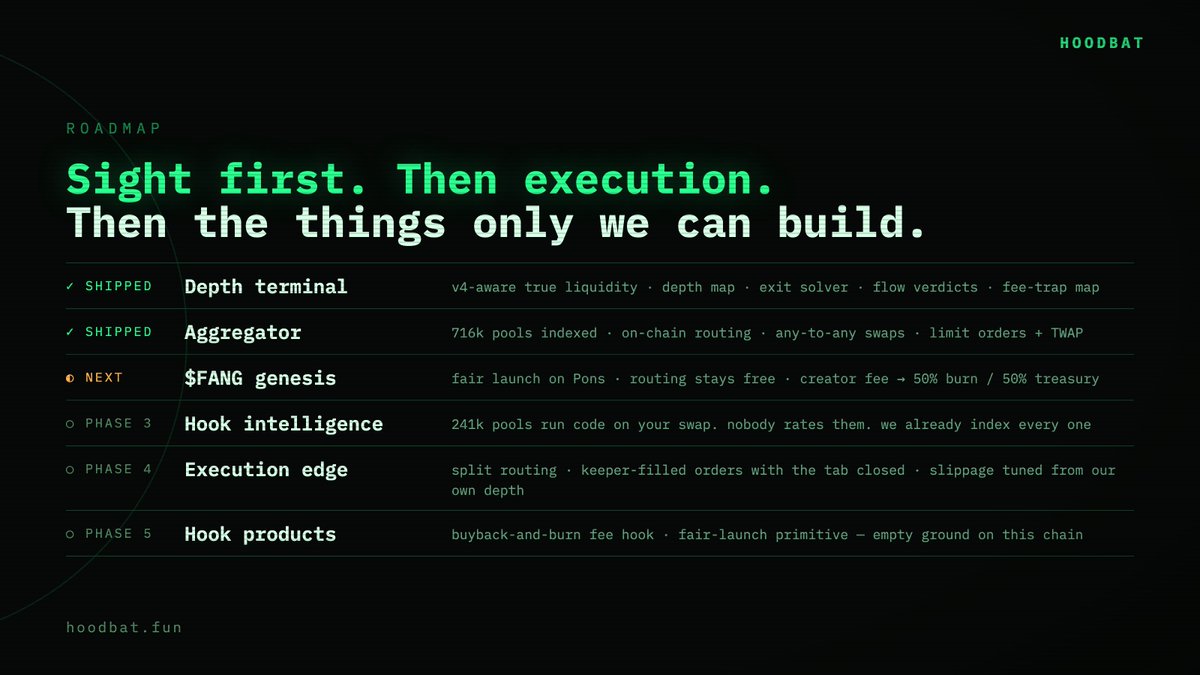
ROADMAP: where hoodbat goes next.
shipped: the depth terminal and the aggregator — 716,626 pools indexed, on-chain routing, any-to-any swaps, limit orders and TWAP.
next: $FANG.
then the part we're actually here for — risk ratings for the 241,223 pools on this chain that run code on your swap. a third of the chain, and nobody rates them today.
TOKENOMICS: $FANG, the whole model in four lines:
· routing is free. 0%. you pay the pool's fee and gas, nothing else.
· revenue is the Pons creator fee — a cut of $FANG's own volume, paid in ETH
· every wei splits 50/50: half buys $FANG and burns it, half to treasury
· team holds zero supply
buybacks are manual to start, with every claim, buy and burn tx published. contract-enforced once the vault is audited.
trading $FANG burns $FANG. no CA yet — we'll announce it here first.