Crypto Twitter has about 500 opinions on every single price move, and most of them are either wrong or written by someone with a token to sell to you.
We send the version that skips all of that and just tells you what actually happened and why it matters.
No noise, no pitch, just the newsletter at https://t.co/BTvr03YJFR
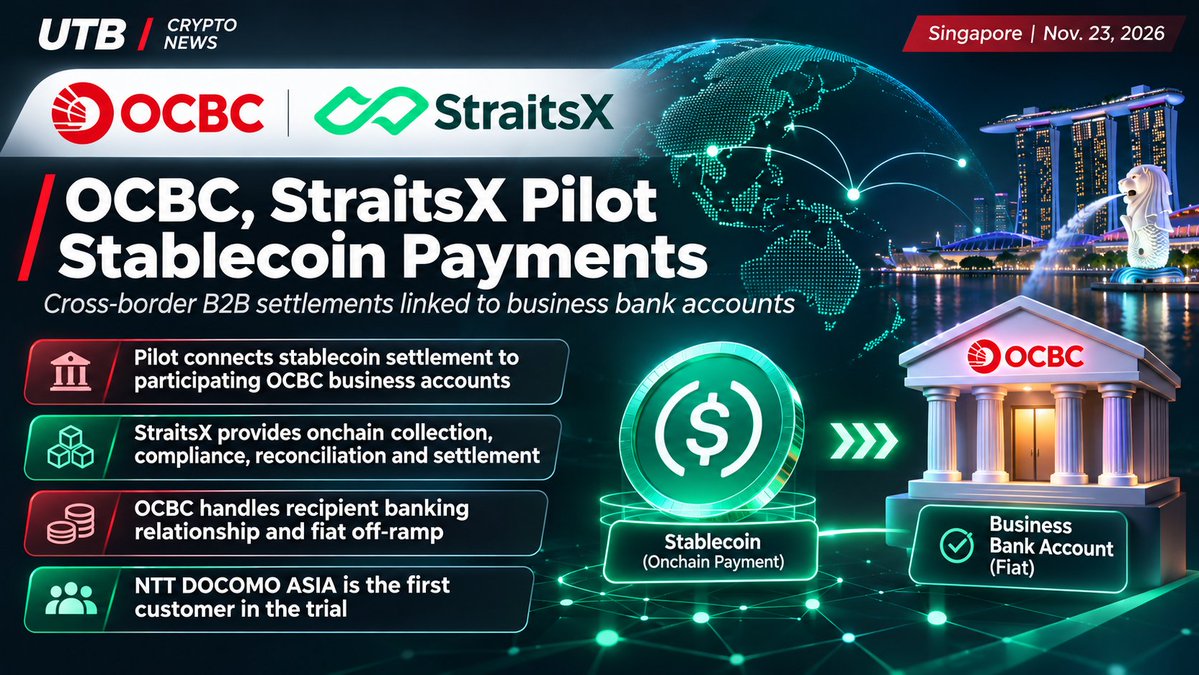
Singapore's OCBC and stablecoin infrastructure provider StraitsX have launched a new pilot to make international business payments faster using blockchain technology.
Announced on November 23, the initiative connects stablecoin settlement with participating companies' existing OCBC bank accounts.
But what makes this different from simply sending USDC or USDT between crypto wallets?
Businesses receiving these payments do not necessarily need to manage the stablecoins themselves.
Instead, StraitsX handles the blockchain payment process, while OCBC provides the banking connection and conversion into conventional currency.
That means participating companies can receive international payments through familiar banking infrastructure rather than opening a separate crypto trading account.
NTT DOCOMO ASIA, part of the Japanese telecommunications group, is the first customer participating in the pilot.
According to the companies, an initial transaction originating from Japan was completed after the usual yen banking cut-off time, with the receiving company's OCBC account credited on the same day.
For context, traditional international payments can involve multiple banks, different operating hours, and delays between sending and receiving funds.
Stablecoin settlement could help reduce some of those delays while improving payment tracking and reconciliation.
However, there is an important distinction.
This is a pilot involving participating businesses, not a public stablecoin payment service available to every OCBC customer.
The trial is intended to test how blockchain-based transfers can work alongside regulated banking services.
For the broader crypto industry, the development is another example of stablecoins being used for practical financial activities beyond cryptocurrency trading.
The question now is whether this model can expand to more businesses and international payment routes.
Cross-chain trading protocol Chainflip has confirmed that its November 21 security incident affected both its Bitcoin and Ethereum vaults, with stolen assets valued at approximately $12.6 million at the time of the attack.
The initial reports focused on about $4.86 million drained from its Ethereum vault.
However, investigators later discovered that Bitcoin had also been stolen.
According to Chainflip's November 23 incident report, the attacker took approximately 122.86 BTC, 520.22 ETH, 3.25 million USDC, and 758,141 USDT.
For context, Chainflip allows users to exchange cryptocurrencies between different blockchains without relying on a traditional centralized exchange.
Its vaults hold assets used to complete those cross-chain transactions.
But that also makes the security of those vaults extremely important.
If attackers gain unauthorized control over the systems responsible for approving transactions, they may be able to move assets that should remain protected.
Chainflip's preliminary investigation is examining its validator and transaction-signing infrastructure, including a possible weakness involving third-party networking software.
The team moved the protocol into full safe mode following the attack, restricting normal operations while security work continued.
Chainflip also offered the attacker a 10% bounty in exchange for returning the remaining 90% of the stolen funds.
That offer had a November 23 deadline, but the public reports reviewed do not establish a completed recovery.
For DeFi users, this incident highlights an important reality.
Even when a protocol supports direct trading between blockchains, its vaults, signing systems, and other infrastructure can still introduce significant security risks.
The investigation is continuing, and the exact impact on users and the recovery process remains subject to further updates.
Wall Street's move toward 24/7 tokenized stock trading has reached another milestone.
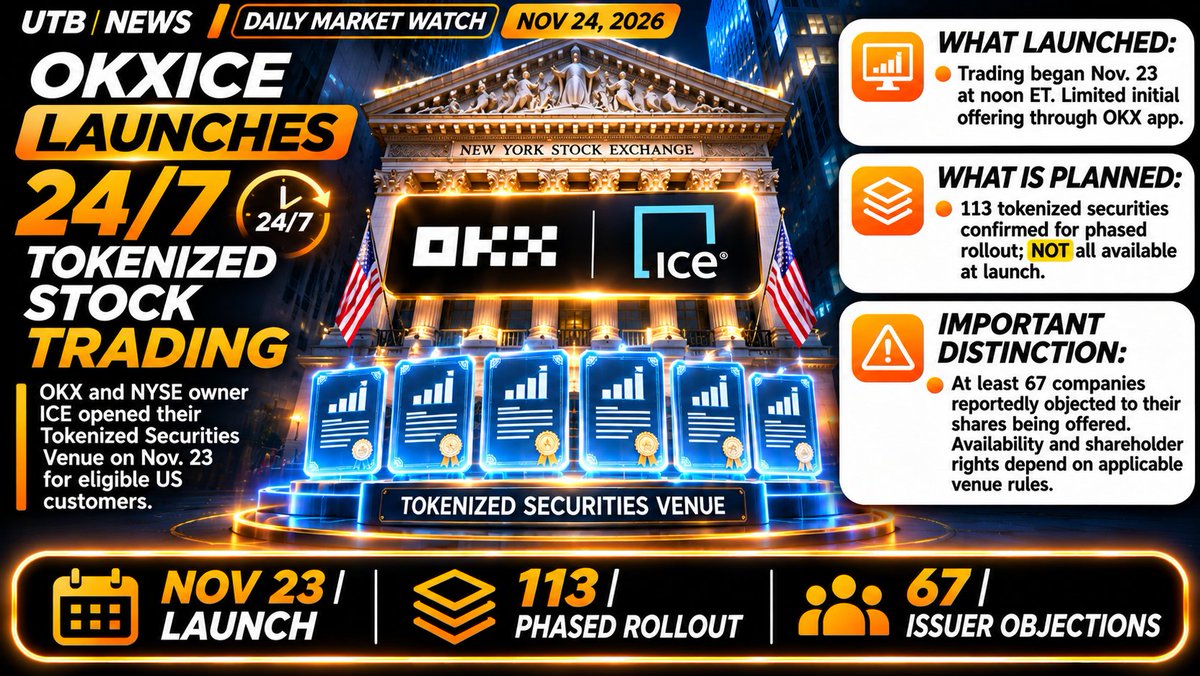
On November 23, OKXICE, a joint venture between crypto exchange OKX and New York Stock Exchange owner Intercontinental Exchange (ICE), officially launched its Tokenized Securities Venue.
The platform allows eligible US customers to trade supported tokenized stocks and other securities through the OKX app, including outside traditional stock market hours.
According to the company's launch announcement, trading became available at noon Eastern Time on November 23.
The venture has confirmed 113 assets for a phased rollout, but that does not mean all 113 were available immediately.
The initial lineup includes six companies, such as Coinbase, Robinhood, Strategy, Circle, Securitize, and BitGo.
There is another important development.
At least 67 companies have formally objected to their shares being offered through the venue, including major names like Apple, Nvidia, Microsoft, and Tesla.
The objections highlight an ongoing debate about how tokenized securities should be issued, traded, and represented on blockchain platforms.
OKXICE operates under a conditional SEC exemption for certain tokenized securities trading activities.
Unlike synthetic products that only track a company's stock price, the venue is designed to preserve applicable shareholder rights and regulatory protections associated with the underlying securities.
However, eligibility, available assets, liquidity, and trading conditions remain subject to the venue's rules.
For crypto investors, the launch shows how traditional market infrastructure and blockchain trading are increasingly coming together.
The next challenge is whether companies, regulators, and investors can agree on how these markets should operate over the long term.
US authorities are seeking to recover more than $1.1 billion in cryptocurrency stolen during the October 29 Binance hack.
On November 23, the Department of Justice filed a civil forfeiture complaint targeting USDC that investigators say was stolen and laundered by North Korean hackers.
According to court documents, the case involves approximately $1.17 billion in USDC spread across 36 blockchain addresses on 18 networks.
But there is an important distinction between this development and the earlier asset-freezing announcements.
The US government is now pursuing a legal process to claim the assets, not announcing that all the money has already been returned.
For context, forfeiture proceedings allow authorities to ask a court to transfer ownership of assets believed to be connected to criminal activity.
If the government succeeds, additional steps may still be required before recovered assets can be returned to their rightful owners.
USDC is issued by Circle, which has the technical ability to restrict certain tokens when legally required.
That makes some stolen stablecoin assets easier to preserve than cryptocurrencies such as Bitcoin, which have no central issuer capable of freezing wallet balances.
The new case follows earlier efforts by Binance and US authorities to freeze funds connected to the attack.
However, the broader investigation remains ongoing, and the total amount eventually recovered may differ from the amount named in the lawsuit.
For crypto users, this is another example of how blockchain tracing, stablecoin controls, and traditional court proceedings can work together during asset-recovery investigations.
The European Central Bank is warning that Europe needs to move faster in establishing common rules for tokenized financial assets.
Speaking at the Frankfurt European Banking Congress on November 20, ECB President Christine Lagarde highlighted the growing market for tokenized securities and the risks of fragmented financial infrastructure.
According to the ECB, tokenized traditional assets on public blockchains were worth approximately €23 billion worldwide in March 2026, roughly five times their value a year earlier.
For context, tokenization allows financial assets such as stocks, bonds, and investment funds to be represented and transferred through blockchain technology.
But just because two financial institutions use blockchain does not mean their systems can automatically communicate with each other.
Different networks may have separate technical standards, settlement procedures, and legal requirements.
That creates problems when financial institutions need to move assets between platforms.
Lagarde warned that Europe has a limited opportunity to develop common standards before incompatible systems become deeply established.
The ECB has already started building infrastructure to support tokenized finance.
In September, it launched Pontes, a system designed to allow certain tokenized transactions to settle using central bank money through Eurosystem infrastructure.
However, the €23 billion figure represents the global tokenized asset market at the March 2026 reference date, not the amount tokenized by the ECB.
For crypto investors, the development shows that tokenization is becoming an increasingly important discussion among traditional financial institutions.
The challenge now is building systems that can work together while meeting the legal and financial requirements of regulated markets.
Cyber, the blockchain project formerly known as CyberConnect, is investigating a suspected cross-chain bridge exploit after unusual CYBER token movements were detected on November 21.
According to blockchain transaction reports, approximately 5.21 million CYBER tokens were unexpectedly minted on Solana, followed by a similar amount leaving the project's Ethereum bridge holdings.
Some of the affected tokens were reportedly exchanged for approximately $968,000 worth of ETH.
But the more immediate concern is how those tokens were created and whether they were properly backed.
For context, blockchain bridges allow assets to move between different networks.
When users transfer tokens from one blockchain to another, a bridge normally locks or otherwise accounts for the original assets before making corresponding tokens available on the destination chain.
If that process is compromised, attackers may be able to create or withdraw tokens without the required backing.
Following the suspicious activity, South Korean exchanges Upbit and Bithumb suspended CYBER deposits and withdrawals as a precaution.
Cyber also asked users to avoid interacting with the affected bridge while its investigation continues.
However, the estimated $1 million impact is still based on preliminary transaction analysis, and the project's full findings have not yet been established.
The team has also warned users not to respond to unexpected requests to migrate tokens, connect wallets, or sign transactions.
For DeFi users, this incident shows why cross-chain transfers involve additional risks beyond simply holding a token on one blockchain.
The bridge's security and the integrity of its backing mechanism matter just as much as the underlying network.
Hong Kong is moving to expand its cryptocurrency regulations beyond traditional crypto trading platforms.
On November 20, the government published the Virtual Asset Services Legislation (Amendment) Bill 2026, proposing new licensing requirements for four additional types of crypto-related services.
These include:
1️⃣ Virtual asset dealing
2️⃣ Investment advisory services
3️⃣ Asset management
4️⃣ Cryptocurrency custody
For context, Hong Kong already regulates virtual asset trading platforms, but other businesses involved in handling or managing digital assets may operate under different rules.
The new proposal aims to create a more consistent regulatory framework across the industry.
But why should ordinary crypto investors care?
When someone holds cryptocurrency through an exchange or custody provider, they depend on that company's ability to safeguard assets and meet its obligations.
Expanding regulatory oversight could introduce clearer requirements for businesses managing customer funds, providing investment recommendations, or holding digital assets on behalf of clients.
However, there is an important distinction.
The bill has been published, but that does not mean all the proposed requirements are already in force.
The legislation is scheduled for its first reading in Hong Kong's Legislative Council on December 2.
For the broader crypto industry, the proposal shows Hong Kong continuing to develop its regulatory framework while positioning itself as a market for institutional and retail digital asset services.
The next step is to watch how lawmakers review the bill and whether any changes are introduced before its eventual passage.
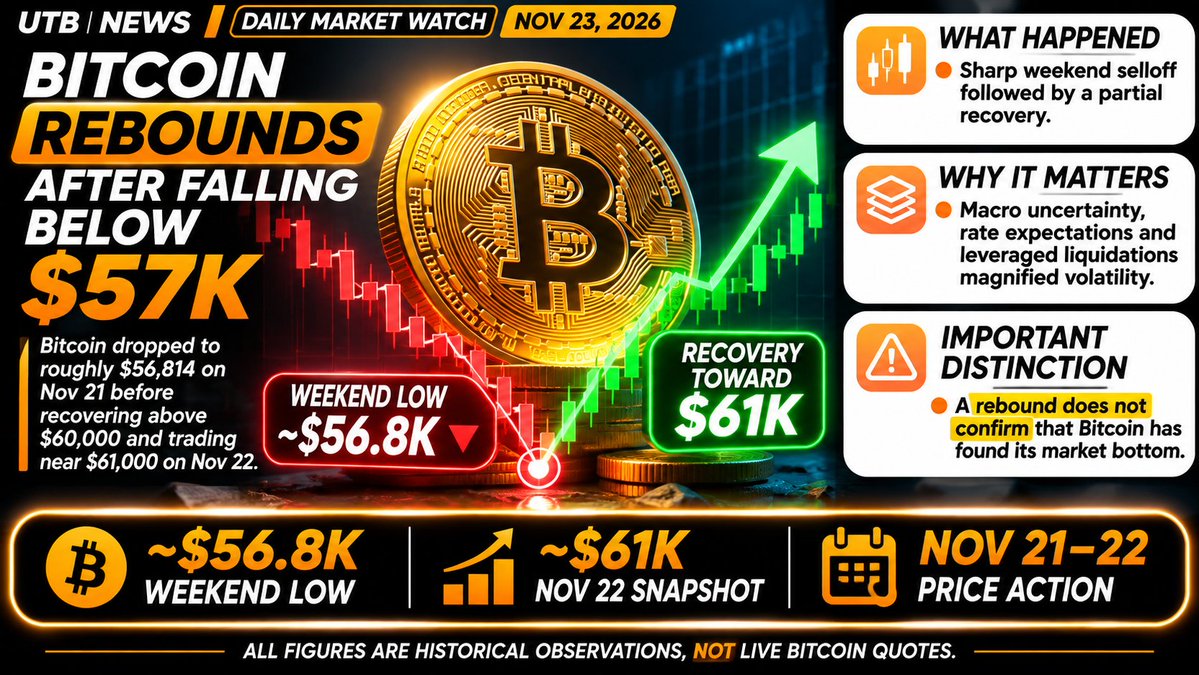
Bitcoin has recovered above $60,000 after briefly falling below $57,000 over the weekend, marking another volatile period for the cryptocurrency market.
On November 21, BTC dropped to approximately $56,814, its lowest level in about two years, before rebounding more than 8% to trade near $60,000.
By November 22, Bitcoin was trading around $61,000 as buyers returned following the sharp decline.
But the bigger question is what caused the selling pressure in the first place.
Over recent weeks, investors have become increasingly concerned about higher borrowing costs, expensive technology stock valuations, and uncertainty surrounding the broader financial markets.
Those concerns have also affected cryptocurrencies as traders reduce exposure to riskier assets.
Bitcoin's decline was made worse by leveraged liquidations, where exchanges automatically close positions that no longer have sufficient collateral.
When many traders are liquidated at once, forced selling can make an already falling market move even faster.
However, a recovery above $60,000 does not automatically mean Bitcoin has established a market bottom.
The cryptocurrency remains significantly below its levels earlier this month, and investors are still watching interest rates, institutional demand, and the performance of technology stocks.
For now, the rebound shows that buyers remain active, but the broader market is still dealing with considerable uncertainty.
Can US residents legally buy tokenized stocks in 2026?
Yes, but not every platform offering tokenized stocks is available to American investors.
For example, Dinari allows eligible US customers to access stock investments recorded on the blockchain through its dShares structure.
Ondo is also developing a separate US offering through Oasis Pro Markets, while its international Ondo Stocks platform and xStocks remain unavailable to US persons.
But there is something important to remember.
Buying a tokenized stock does not automatically give you ownership or voting rights in the actual company. Those rights depend on the product and its legal structure.
We put together a guide explaining which platforms US residents can access, what SEC rules apply, and the risks to consider before investing: https://t.co/nN7eGHiSNE
Sui has officially launched Hashi on mainnet, bringing a new way for Bitcoin holders to access decentralized finance without immediately selling their BTC.
Announced on November 19, the launch includes more than 20 partners across custody, lending, and DeFi infrastructure.
So how does it work?
Hashi allows eligible users to bring Bitcoin-backed value onto Sui through a token called hBTC.
Each hBTC is designed to be backed 1:1 by Bitcoin held through the protocol's custody arrangements.
That token can then be used as collateral on supported DeFi lending platforms.
For example, Fluid is among the first protocols to support hBTC, allowing users to borrow USDC against their Bitcoin-backed holdings.
This means an investor who wants access to stablecoins may be able to borrow funds without selling their underlying Bitcoin position.
But there is a catch.
Borrowing against Bitcoin does not eliminate the risk of losing it.
If BTC falls sharply, the value of the collateral may become insufficient to support the outstanding loan, potentially triggering liquidation.
Users also depend on Hashi's Bitcoin backing, custody arrangements, smart contracts, and the lending protocols involved.
For context, Bitcoin is often held as a long-term investment, while DeFi applications have historically been more accessible to tokens operating on smart contract networks.
Hashi is designed to connect those two markets.
The launch gives Sui another Bitcoin-related financial product and creates additional opportunities for holders who understand collateralized borrowing.
However, the availability of these services does not make borrowing risk-free or appropriate for every investor.
More than $1.5 billion in USDC has been withdrawn from Sky's stablecoin liquidity facility following a report about transactions involving wallets linked to illicit activity.
The withdrawals occurred on November 19 after blockchain analytics company Inca Digital published findings about transactions through Sky's Peg Stability Module, or PSM.
For context, Sky operates the USDS stablecoin, while its PSM allows users to exchange supported dollar-pegged tokens such as USDC and USDS.
According to Inca Digital, approximately $518 million in historical transactions through the system involved wallets flagged for illicit activity, including around $101.9 million associated with North Korea-linked actors.
But that does not mean the entire $518 million was stolen from Sky.
The report concerns historical transactions involving flagged wallets, not a newly confirmed exploit of Sky's smart contracts.
The market reaction was significant.
Onchain data indicated that a large wallet labeled as connected to Poloniex accounted for most of the withdrawals, converting USDS into USDC.
Sky's USDS supply subsequently fell by more than 30%, dropping from approximately $4.6 billion to $3.2 billion during the reported period.
However, USDS continued trading near its $1 peg despite the sharp contraction in supply.
That distinction matters because a stablecoin losing circulating supply is not the same thing as losing its dollar value.
The incident raises broader questions about how decentralized stablecoin systems should handle transactions involving sanctioned or otherwise flagged addresses.
For DeFi users, it is another reminder to watch stablecoin liquidity, backing mechanisms, and counterparty risks rather than relying only on a token's advertised dollar peg.
Could quantum computers eventually break the cryptography protecting Bitcoin and other blockchain networks?
That question is getting more attention from global financial regulators.
On November 19, the International Organization of Securities Commissions (IOSCO) released a report urging financial institutions to begin preparing for quantum-related cybersecurity risks.
The organization represents securities regulators from more than 130 jurisdictions.
According to the report, sufficiently powerful quantum computers could eventually undermine some of the cryptographic systems used to protect financial transactions, digital identities, and blockchain assets.
But there is an important distinction.
No quantum computer currently has the demonstrated ability to break the widely used cryptography protecting Bitcoin.
The concern is what happens when that technology becomes powerful enough in the future.
For context, Bitcoin uses cryptographic signatures to verify that transactions are authorized by the rightful owners.
A sufficiently advanced quantum computer could potentially threaten certain signature systems, creating risks for wallets and transactions that have not been upgraded.
The challenge is especially complicated for decentralized blockchains because changing their security standards requires coordination between developers, miners or validators, exchanges, wallet providers, and users.
IOSCO recommends that financial companies begin identifying vulnerable systems, testing quantum-resistant technologies, and preparing migration plans.
Some experts believe cryptographically relevant quantum computers could emerge within the next several years, although the timeline remains uncertain.
For crypto holders, this is not a reason to assume that Bitcoin is about to be hacked.
It is a reminder that blockchain security needs to evolve as computing technology advances.
Binance has secured a $6.5 billion worldwide freezing order from the Abu Dhabi Global Market Courts as it continues trying to recover assets stolen during its October 29 security breach.
The court order is intended to prevent stolen cryptocurrency from being transferred or disposed of while legal proceedings continue.
According to Reuters, the order involves companies including Circle and World Liberty Financial, whose stablecoin infrastructure may be relevant to restricting certain stolen assets.
For context, some stablecoin issuers can freeze tokens associated with specific blockchain addresses.
That gives investigators a possible way to prevent stolen funds from moving, provided the relevant companies have the technical and legal ability to act.
But there is an important difference between freezing assets and recovering them.
The $6.5 billion court order does not mean Binance has already recovered $6.5 billion.
It represents a legal effort to preserve assets and support future recovery proceedings.
The situation becomes more complicated when stolen funds are converted into assets such as Bitcoin or Ethereum, which do not have a central issuer capable of freezing individual wallet balances.
Tether, which previously reported freezing around $1.5 billion connected to the incident, was not included in this particular court order.
A further hearing is scheduled for December 1 to determine whether the injunction should continue and under what conditions.
For Binance users, the ruling is another significant step in the recovery process, but the return of stolen assets remains dependent on the legal proceedings and the ability to locate and secure them.
Want to invest in gold without buying or storing physical gold bars?
$XAUT and $PAXG let you gain exposure to gold through blockchain-based tokens, with each token representing one troy ounce of physical gold.
Both serve a similar purpose, but there are important differences.
PAXG is issued by NYDFS-regulated Paxos, with gold stored in London, while XAUT is issued by Tether, with reserves held in Switzerland.
They also differ in supported blockchains, fees, reserve reporting, and redemption requirements.
So which one should you choose for long-term exposure to gold?
We compared both tokens, including their benefits, risks, and key differences: https://t.co/O9UvHuIjjP
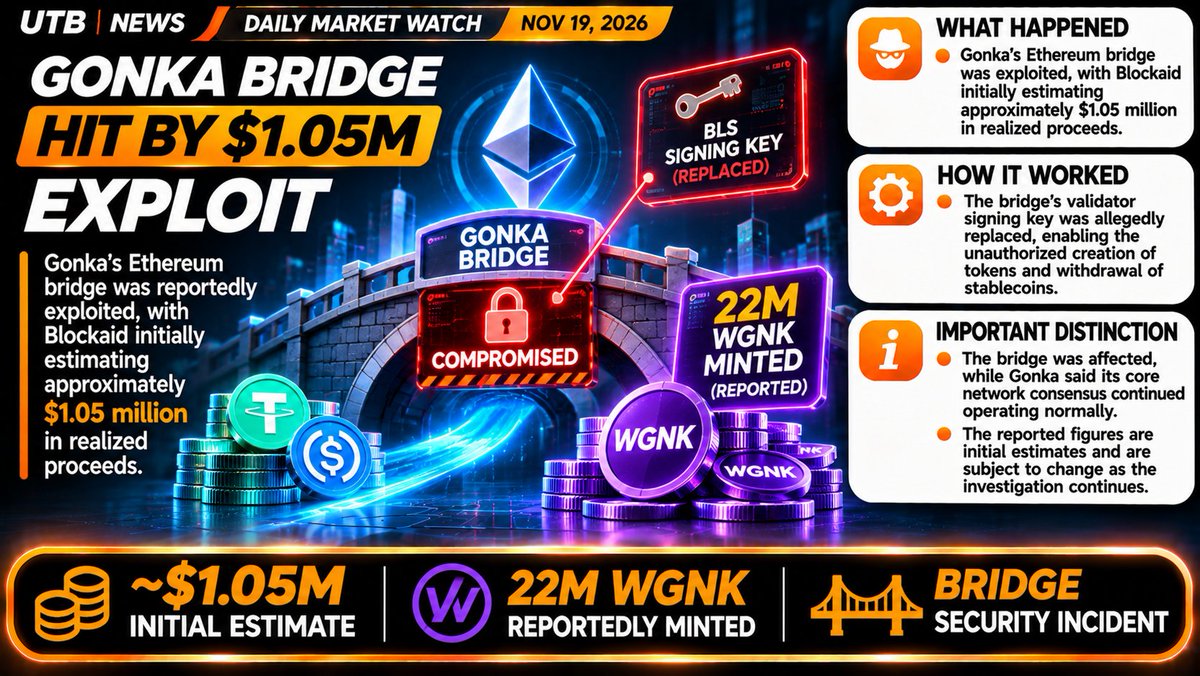
Gonka's Ethereum bridge was reportedly exploited on November 18, with blockchain security firm Blockaid estimating approximately $1.05 million in realized proceeds.
The attack involved the bridge connecting Gonka, a decentralized AI computing network, with Ethereum.
According to Blockaid, the attacker changed the bridge's BLS group signing key, which is used to verify transactions authorized by the network's validators.
For context, a blockchain bridge allows tokens and other assets to move between different networks.
These systems rely on security mechanisms to verify that assets being transferred or created on one network are properly backed by assets on another.
When those verification systems are compromised, attackers may be able to withdraw funds or create tokens that have no legitimate backing.
That appears to be what happened with Gonka.
Onchain reports indicate that the attacker drained stablecoin liquidity and minted approximately 22 million wrapped GNK tokens, also known as WGNK.
However, the number of tokens created should not be confused with the amount of money stolen.
Blockaid's initial estimate placed the realized value of the exploit at approximately $1.05 million, and that figure remains subject to investigation.
Gonka subsequently said its core network services and consensus system were operating normally, while warning users against interacting with the affected bridge and WGNK.
This distinction matters because the reported compromise affected the cross-chain bridge, not necessarily the underlying blockchain itself.
For DeFi users, the incident highlights why a token's security depends on more than the blockchain where it is held.
Bridges, signing keys, and the systems responsible for backing wrapped tokens can introduce additional risks.
Ledger has expanded its investigation into hardware-wallet tampering after new concerns emerged involving devices sold in Dubai and Berlin.
In a November 18 security update, the company advised customers who purchased Ledger devices through third parties in certain affected locations to contact its support team if they suspect tampering.
The warning follows reports from two wallet owners in Dubai who claimed they lost approximately $604,000 in cryptocurrency after using devices purchased through a retailer.
However, those theft claims and the precise circumstances surrounding the devices have not been fully established.
So what makes this different from an ordinary crypto wallet hack?
A hardware wallet is designed to keep private keys isolated from internet-connected devices.
But if someone physically modifies the device before it reaches the buyer, that protection may be undermined.
This is known as a supply-chain attack.
Instead of trying to break into someone's wallet remotely, an attacker attempts to interfere with the hardware before the customer begins using it.
Ledger has been investigating suspected hardware implants and advises concerned customers in the affected locations to seek guidance through official support channels.
There is an important distinction here.
The investigation does not mean every Ledger wallet is compromised, nor does it establish a vulnerability affecting all Ledger devices.
For hardware-wallet users, the safest approach is to check for signs of tampering, follow the manufacturer's official setup instructions, and never use a recovery phrase supplied by someone else.
Recovery phrases should always be generated securely during wallet setup, not provided on a card inside the package or sent through customer support.
The incident highlights why physical device security and the supply chain matter just as much as protecting private keys online.
The World Bank is exploring the use of regulated stablecoins for international payments, with Citi and Circle joining the initiative.
Announced on November 17, the collaboration will examine whether US dollar-denominated stablecoins and blockchain payment networks can improve how development funds are distributed.
For context, the World Bank finances projects that support economic development, infrastructure, and poverty reduction across different countries.
Moving those funds internationally often involves correspondent banks, multiple intermediaries, and different banking schedules.
That can create additional costs and delays.
With stablecoins, the World Bank wants to study whether certain payments could move through blockchain networks while maintaining appropriate regulatory safeguards.
Circle is known for issuing USDC, while Citi brings experience in international banking and payment infrastructure.
But there is an important distinction.
The World Bank has not announced that it is replacing traditional banking transfers with USDC.
This is an initiative to explore how regulated stablecoin infrastructure might complement or improve its existing payment arrangements.
The research will examine areas such as transaction costs, settlement speed, transparency, and operational requirements.
For the crypto industry, this development shows that stablecoins are increasingly being considered for financial activities beyond cryptocurrency trading.
The question now is whether blockchain-based payment systems can deliver measurable improvements while meeting the compliance and security standards required by international financial institutions.
Bitcoin investors have another reason to watch the Federal Reserve closely.
Minutes from the Fed's October meeting, released on November 18, show that nearly all officials expect another interest-rate hike in December as inflation remains above the central bank's target.
Most are looking at a 25-basis-point increase, but some policymakers have discussed the possibility of a larger move.
Federal Reserve Governor Christopher Waller has gone further, arguing that a 50-basis-point hike may be necessary unless the Fed signals additional increases in early 2027.
For context, higher interest rates make borrowing more expensive and can encourage investors to favor cash and interest-paying assets over riskier investments.
That matters for Bitcoin because crypto prices are influenced by broader financial conditions, investor confidence, and market liquidity.
Bitcoin was already trading near $64,000 on November 18, following several weeks of selling pressure.
However, the Fed has not made its December decision yet.
The meeting is scheduled for December 8–9, and policymakers will continue assessing economic data before voting.
For crypto investors, the important question is whether inflation slows enough to reduce expectations of further rate hikes.
Strong corporate earnings may support market sentiment, but monetary policy remains another major factor influencing demand for risk assets.
The US stock market closes at 4 PM ET, but what if you want to trade Tesla, NVIDIA, or other stocks on a Saturday?
With tokenized stocks, that is now possible on certain platforms.
Providers like Ondo Stocks, xStocks, and Dinari allow eligible investors to trade supported tokenized stocks outside regular US market hours, including weekends and holidays.
But there is something important to understand.
24/7 trading does not mean every transaction can happen 24/7.
Buying and selling tokens, transferring them between wallets, and minting or redeeming them are three different activities, and each can have its own schedule.
There are also risks when traditional stock markets are closed.
Fewer buyers and sellers can mean wider spreads, slower order execution, and token prices that differ from the underlying shares.
So while tokenized stocks give investors more flexibility, trading at 2 AM on a Sunday might not offer the same conditions as trading during regular market hours.
We put together a guide explaining which platforms support 24/7 trading, how it works, and what to check before placing an order: https://t.co/3u4HZ1xYdQ
Trezor has disclosed another customer-data breach, this time involving approximately 27,000 orders handled by shipping partner Skladon.
The company was notified on November 15 that an unauthorized party had accessed Skladon's systems containing customer shipping information.
According to Trezor, the affected orders were placed between August 9 and November 7, 2026.
The exposed information may include customer names, delivery addresses, contact details, and order information.
But there is an important distinction.
Trezor said its own systems were not compromised, and the incident did not expose wallet recovery phrases, PINs, passphrases, or private keys.
That means the breach does not automatically give attackers access to cryptocurrency stored in Trezor wallets.
However, exposed customer information can still create serious security concerns.
Someone who obtains a list of hardware wallet buyers may use those details to send convincing phishing messages, impersonate support representatives, or target individuals believed to hold cryptocurrency.
This is also the second reported breach involving a Trezor shipping partner within three months.
For hardware wallet owners, the main precaution remains the same.
Never share your recovery phrase, even if someone contacts you claiming to represent Trezor, a delivery company, or technical support.
A legitimate support request should never require your wallet recovery words.
The incident shows that protecting cryptocurrency involves more than keeping private keys offline.
Personal information connected to crypto ownership also needs to be protected.