Building the RWA record layer for productive machines. Onchain identity, control, work history, maintenance and claim-level evidence. Starting with robots.
We agree that RWAs are much bigger than traditional assets. Productive machines will need verifiable records before they can participate in financial markets. Excited to be building that foundation on Robinhood Chain.
$ZEY is designed to secure verification, not replace commercial payments.
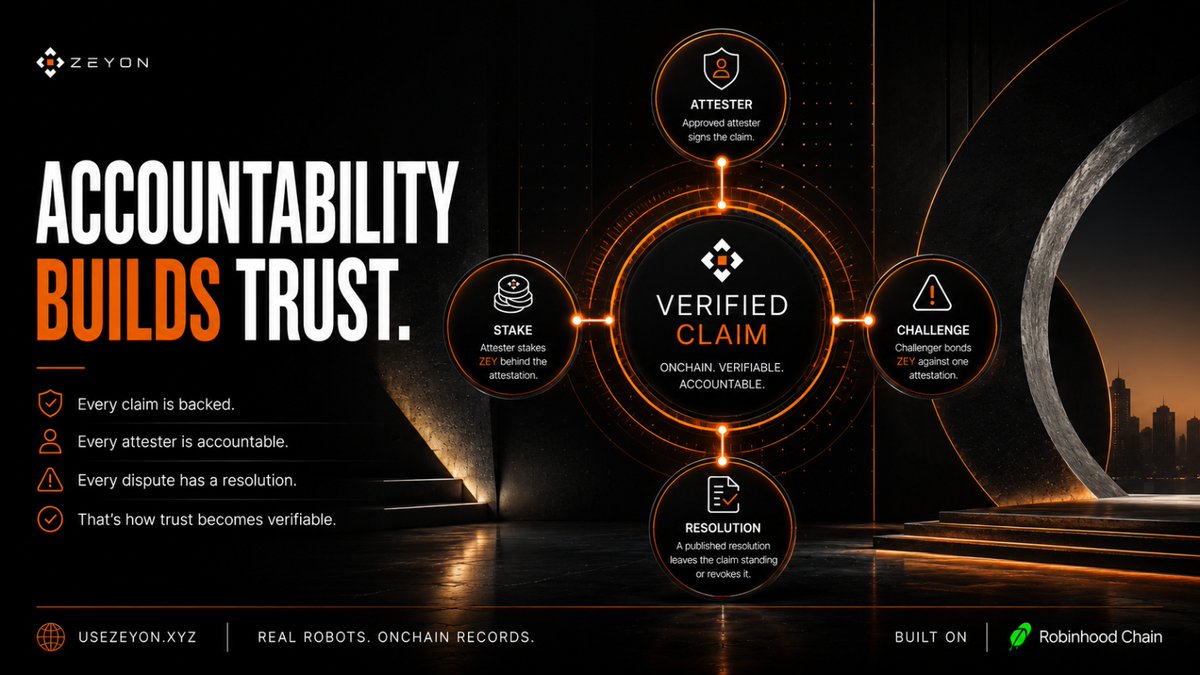
In ZEYON's first planned utility model, approved attesters stake ZEY behind defined claims. Challengers can bond ZEY to dispute an attestation and a published resolution determines whether the claim remains valid or is revoked.
Staking does not make a physical claim true. It makes the party signing that claim accountable under transparent, predefined protocol rules.
Two robots can look identical. Their history shouldn't.
One may have thousands of verified operating hours. Another may have recurring faults, missing maintenance records or unverified performance claims.
Zeyon is building infrastructure where machine reputation is earned through verifiable history not assumptions.
The Zeyon Robot Registry demo is now available.
It shows how a public Robot Record can present machine identity, controller history, operating events, evidence, and claim-level attestations in one inspectable view.
It is designed around three questions:
1. Does this Robot Record exist?
2. Who submitted each claim?
3. What evidence or attestation supports it?
If the product cannot answer those clearly, putting more data onchain will not make the record more trustworthy.
Explore at https://t.co/rUqKjd7DxF
$ZEY is building the economic infrastructure for autonomous machines, starting with verifiable public records for productive robots on Robinhood Chain.
A Zeyon Robot Record provides a machine with a persistent public identity and operating history. It records what a machine is, who controls its record, the work it has performed, maintenance and deployment events, and which individual claims are supported by evidence or independently attested.
CA: 0x9d27e368fE6b90CEC14a0B291348216474F3F745
Official links:
Website: https://t.co/Frd1Zw4uco
Documentation: https://t.co/RzSlEegwHg
$ZEY is now live.
We're building verifiable records for productive robots, starting with identity, work history, maintenance, and evidence.
CA:
0x9d27e368fE6b90CEC14a0B291348216474F3F745
Real robots. Onchain records.
RWA is often explained as putting an asset onchain. That skips the hard part.
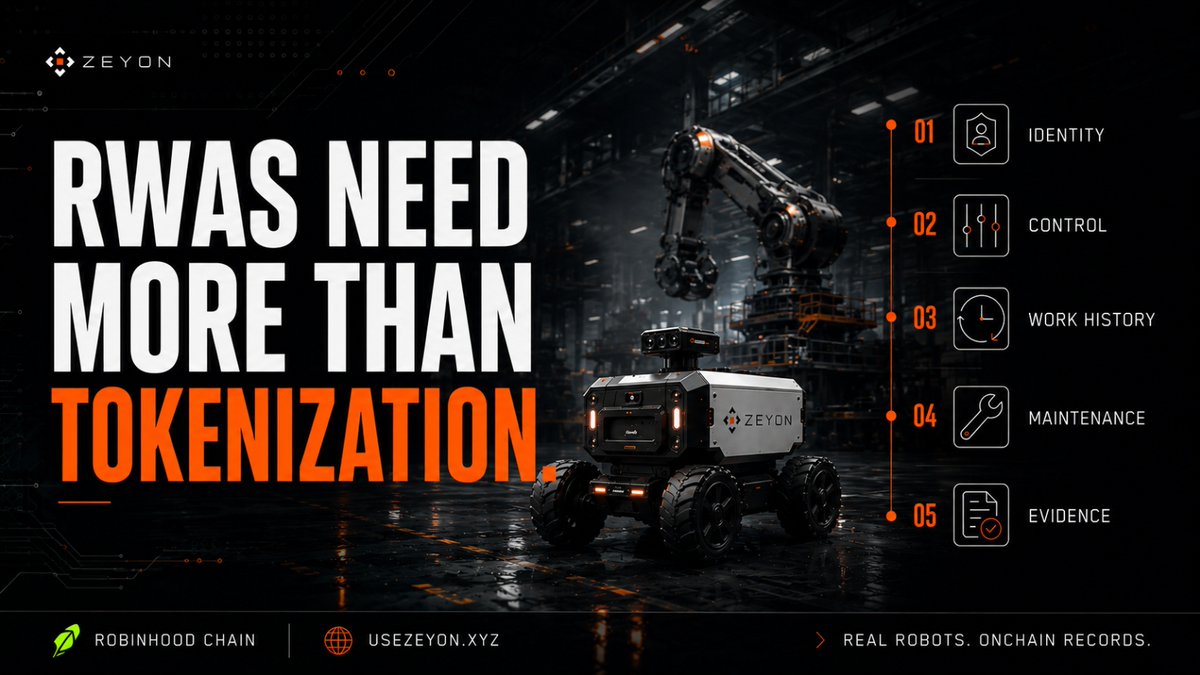
For a productive robot, a useful record begins with identity, control, operating history, maintenance and evidence.
Zeyon is building that record layer first. Finance should come after an asset has an inspectable history.
@vladtenev We believe productive robots will become one of the most important real-world asset categories. At Zeyon, we're building verifiable onchain records for machine identity, operating history, maintenance and evidence, creating the trust layer that makes financing possible.
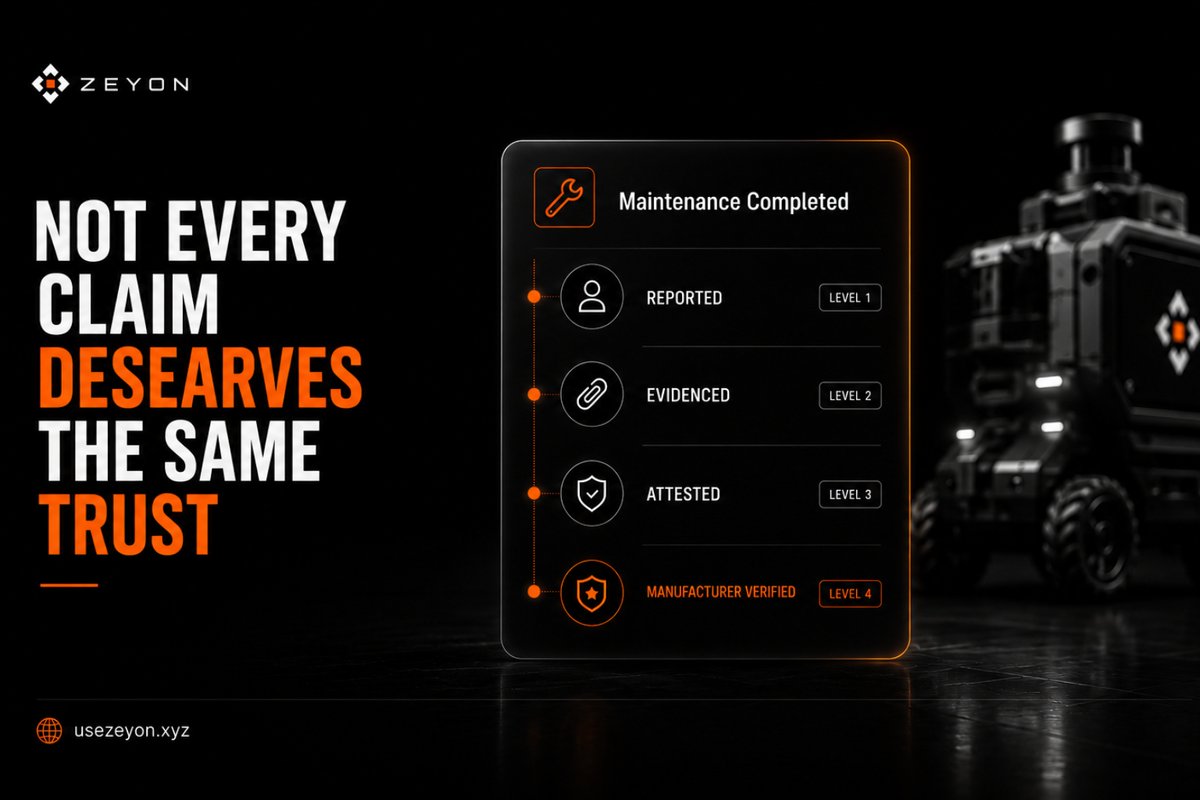
Every claim in a Zeyon Robot Record carries its own level of trust:
• Self-reported
• Evidence-backed
• Third-party attested
• Manufacturer attested
A machine can contain claims with different verification levels at the same time. For example, a maintenance event may be third party attested while performance metrics remain self reported.
Zeyon makes those differences explicit, allowing every claim to be evaluated on its own merits.
One machine. Different levels of trust.
Recording a claim onchain does not make the physical event true.
It proves who submitted the claim, when it was recorded and whether the record has remained unchanged. It does not, by itself, prove that a robot completed a task or that maintenance actually took place.
Instead of assigning a single "verified" badge to an entire machine, Zeyon evaluates each claim independently. Every claim carries its own verification level, making it clear what has been reported, supported by evidence or independently attested.
Trust should be attached to each claim not assumed for the entire asset.
A productive machine rarely stays in one place throughout its lifetime.
It may be operated by different teams, serviced by different providers, deployed for different customers and eventually change ownership.
Yet every maintenance event, inspection, repair, deployment and performance claim is part of the same story. That history shouldn't be lost or rebuilt every time the machine changes hands, it should travel with the asset.
That's the problem Zeyon is solving.
Zeyon is building economic infrastructure for autonomous machines, starting with verifiable records for productive robots.
A productive machine is a real-world asset. Its value depends on what it is, what work it has done, how it was maintained, who controls its record and which claims can be checked.
The first Zeyon product is a public record for that identity and history built on Robinhood Chain testnet.