Attila the Hun is famous for his cavalry, but he was also a clever tactician. When the wide Danube River blocked his path into the Roman Empire, he didn't stop.
His engineers and laborers got to work. They built temporary bridges, rafts, and pontoons from whatever materials they could find.
These weren't for sailing. They were floating platforms to carry thousands of soldiers, horses, and heavy gear across the water.
When Roman forces tried to block the crossing with their own boats, Attila adapted again. He reportedly used his crude rafts to ram enemy vessels.
Archers on the rafts would fire volleys of arrows to sweep the river clear. This 'ship-slaying' tactic showed his pragmatic mind.
He controlled the river to keep his terrifying invasion moving.
The historian Priscus left accounts of Attila's campaigns. He described the Huns' skill at overcoming natural barriers, which included these improvised river crossings.
This adaptability was key. The Huns were not a naval power, but they could quickly build what they needed from local resources.
It turned a major obstacle into a pathway for their army.
#archaeohistories
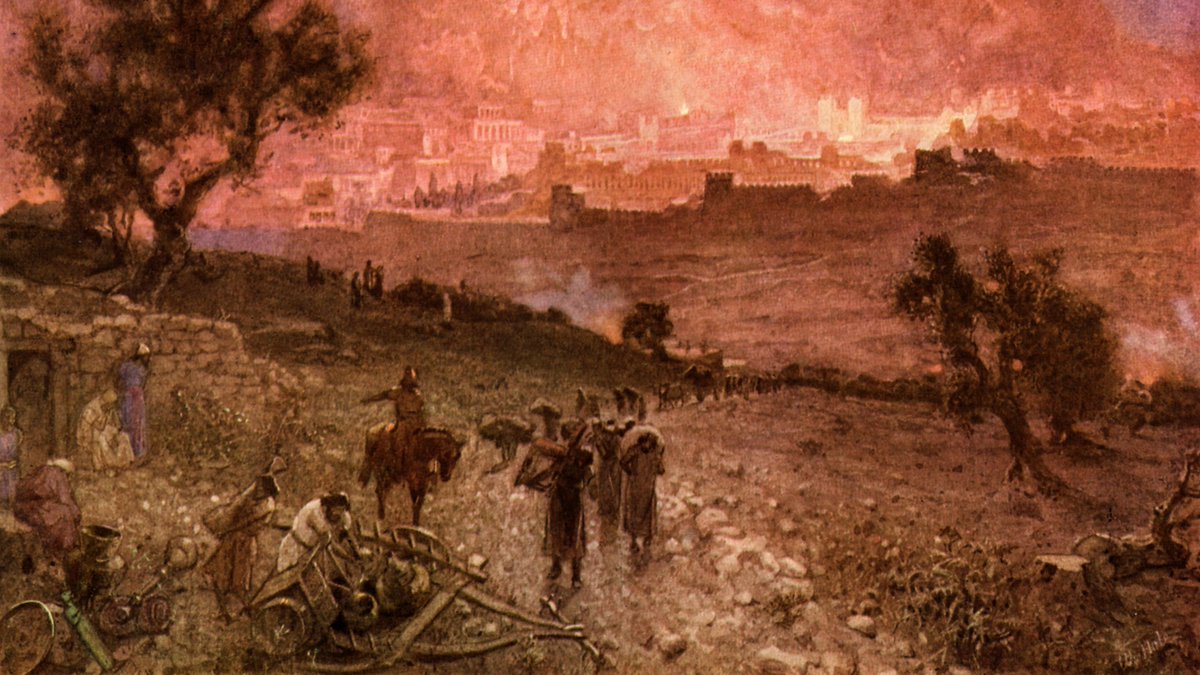
The history of Jerusalem features two catastrophic sieges that permanently altered the course of Judaism and Western history. While the 586 BC destruction by the Babylonians resulted in a temporary exile, the 70 CE destruction by the Romans sparked a massive, global diaspora that lasted for nearly two millennia...
Two cities stood on the same hill, separated by 656 years. Both were called Jerusalem. Both were destroyed in the same month of the Hebrew calendar. Both descents into ruin followed a pattern so precise that scholars have argued about it ever since.
The first destruction came in 586 BC. Nebuchadnezzar's Babylonian army had surrounded the city for eighteen months. The food ran out. Then the water. Then the last reserves of human endurance.
The prophet Jeremiah, who watched it happen, recorded what followed. His account, preserved in Lamentations, describes mothers in the streets of Jerusalem doing the unthinkable to survive. He names it plainly. He does not soften it.
The Temple of Solomon burned. The city fell. The surviving population was marched to Babylon in chains.
Six centuries later, in 70 AD, the Roman general Titus arrived outside the same walls. His legions sealed every exit. The siege lasted months. The famine that followed was, by the historian Josephus's account, unlike anything the ancient world had seen.
Josephus was inside the city. He was a Jewish commander who had defected to Rome, and he wrote his account as a witness. What he recorded in "The Jewish War" mirrors the language of Lamentations almost line by line, down to the same desperate acts in the same streets.
The Temple Herod had built on the same mount as Solomon's was burned in the same month: Av. Josephus wrote that Titus had not ordered the Temple destroyed, and tried to stop it. The fire, by his account, was started by a Roman soldier acting alone. Whether that is true, historians still debate.
What neither side debates is the scale. According to Josephus, over a million people died in the siege and its aftermath. Modern historians consider that figure exaggerated, but the catastrophe was real and total.
The book of Deuteronomy, composed centuries before either siege, contains a passage in chapter 28 that reads, in part, as a catalog of horrors that would befall Jerusalem if the covenant was broken. It names siege, famine, exile, and specific atrocities in terms scholars have connected to both events.
Whether you read that as prediction, coincidence, or the natural logic of siege warfare applied twice to the same place and people is a question this page will not settle for you.
What is settled: two of the most documented catastrophes in the ancient Near East, separated by more than six centuries, unfolded on the same ground, in the same season, and were recorded in language so similar that both Josephus and the authors of Lamentations seem to be describing the same event.
They were not.
That is the part worth sitting with.
Josephus named the soldier he believed started the fire in the Temple. His account was written under Roman patronage. Decide for yourself how much weight that carries.
#archaeohistories
Labour conference will be suffused with the imagery of class politics. Most of the speeches will refer to “working people”, and imply that the party represents the poor and middle-income majority against the rich.
It has been untrue for years. This year, it is less true than ever. Labour voters are richer, better-educated and more middle-class than Conservative and Reform supporters.
Peter Kellner, the polling guru, reports a new survey from Norstat. The company interviewed 5,500 people after the 2024 election, and then again this month. The results show that 57% of Labour supporters were middle class (social grades ABC1) two years ago, which has now risen to 63%. The proportions of graduates and of those earning more than £40,000 a year have also risen sharply.
The study confirms that the Great Class Inversion in British politics, after the Brexit vote 10 years ago, was no temporary blip but a long-run trend that is still happening. All the pollsters consistently report now that Labour voters are the most middle class, Reform voters the most working class (social grades C2DE), and the Conservatives somewhere in between, leaning towards the working class. Greens and Liberal Democrats, on the other hand, tend to be middle class, but not as much as Labour supporters.
This is going to make Labour’s annual conference one long exercise in cognitive dissonance. When Andy Burnham promises breathing space on the cost of living, he is offering respite to people who do not intend to vote for him, on the whole. Labour supporters tend to be the ones who can afford the rent or the mortgage.
When delegate after delegate comes to the lectern to talk about the class struggle, they will be talking about someone else’s class, most of whose members think that Labour does not represent them. If they urge solidarity with the workers, they may mean public sector workers in secure jobs with good pensions rather than the low-paid who feel more of an affinity with Nigel Farage.
The Labour movement has always had middle-class leaders, and it has long been an alliance between intellectuals and organised labour, but this is something different. This is now a party of well-off graduates, with a tiny outhouse of the genuinely disadvantaged attached at the back.
The class inversion has unexpected implications. It may explain why Labour members and supporters are more concerned about issues such as Gaza rather than immigration, which is what bothers the working class. Perhaps it is why Rachel Reeves and Keir Starmer misjudged the pensioners’ winter fuel payment – if most pensioners they know give it to Greenpeace or spend it on wine.
It makes Burnham’s northern working-class appeal seem like a form of historical re-enactment. When he talks about “reindustrialisation” or reversing 40 years of Thatcherism, this feels like an attempt to identify with a mythical working-class past idealised by many middle-class people with working-class origins. It may reflect the tendency of people who are objectively middle class to describe themselves as working class. The self-described working class has expanded since 1948, while the number of people in actual working-class jobs has declined.
Equally, however, Burnham’s provincial working-class ham act could be the key to the electoral coalition that Labour needs. The other important finding of Norstat’s research highlighted by Kellner is that since the last election, Labour has lost more votes to the right – to Reform and the Tories – than to the left, to the Greens and the Lib Dems.
This could mean that Burnham’s working-class pitch is exactly what Labour needs to win back those voters who have defected from the party of the middle class to one of the working-class parties. Especially as the battleground for the next election will overwhelmingly be seats fought between Labour on one side and either the Tories or Reform. There are not many Labour-Green or Labour-Lib Dem marginals.
In Liverpool, expect a lot of middle-class people play-acting as working class.
https://t.co/0SzC1ZLMl2
After the most privileged and expensive school education in the world Harry left Eton with two A levels — a B in Art and a D in Geography. And you want me to listen to what he has to say on AI??!!
“What is the purpose of our defence policy?”
“To defend Britain!”
“No Bernard. It’s to make people believe Britain is defended”
“The Russians?”
“No, the British. The Russians know it’s not defended”
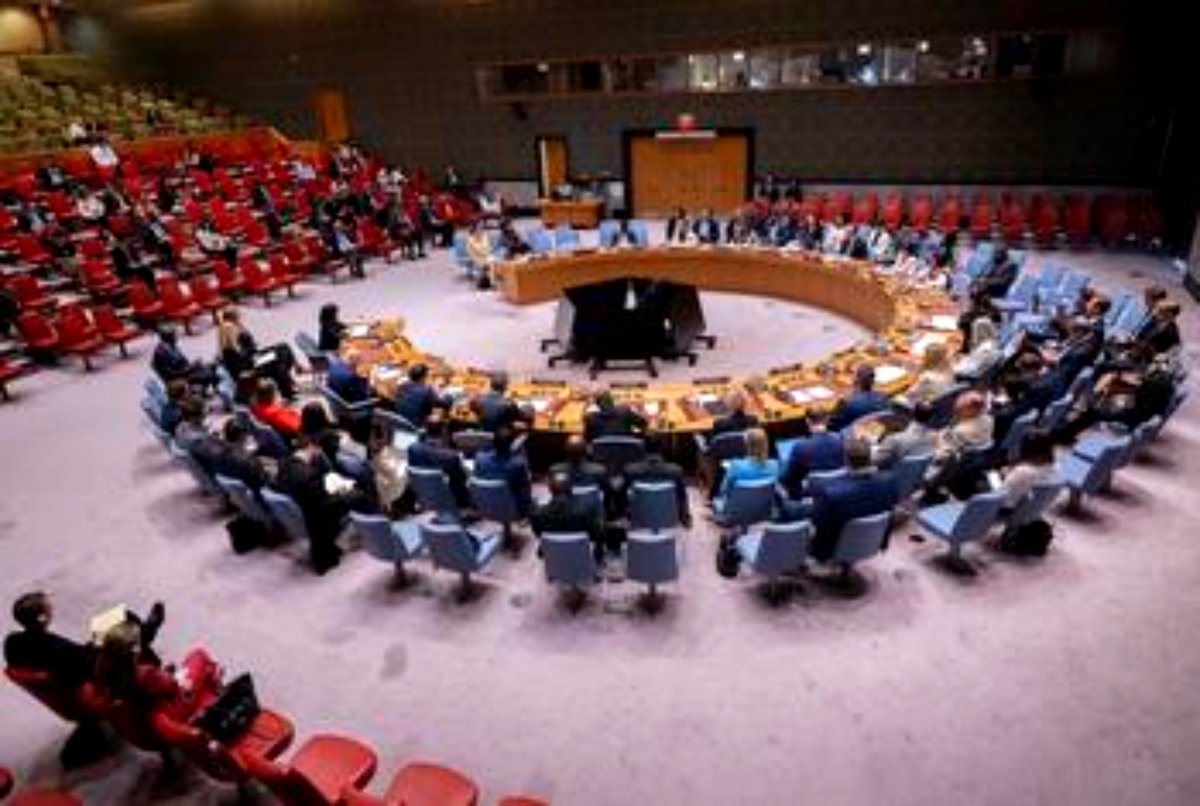
The message from the UN Security Council is clear:
The Houthis’ ongoing attacks on Saudi Arabia are condemned in the strongest terms.
The Council has expressed solidarity with 🇸🇦 Saudi Arabia and affirmed its inherent right to self-defence under international law.
The Houthis wanted to intimidate the Kingdom.
Instead, they are facing international condemnation.
You cannot attack a sovereign state, target civilians and energy infrastructure, and expect the world to look away!
#SaudiArabia #Yemen #Houthis
Saudi Arabian Civil Defense has activated the National Early Warning Platform across several locations including Yanbu, Jazan and Abha City, possibly in advance of a Houthi missile barrage.
Yemen's Iran-aligned Houthis launched a new wave of attacks on Saudi Arabia and were digging into positions on the western coast of Yemen along the Red Sea, Yemeni officials said, as urgent deliberations took place in Riyadh over how to respond to their lightning advance https://t.co/lF0x7ARGje
#عاجل|| أوضح الناطق الرسمي باسم القوات المسلحة الأردنية – الجيش العربي أن منظومات الدفاع الجوي الأردنية تعاملت مع 20 صاروخا باليستيا أطلقت تجاه الأراضي الأردنية، وقد تم اعتراض وتدمير 18 صاروخًا منها بنجاح، فيما سقط صاروخان في مناطق خالية من التجمعات السكانية.
#الأردن #وكالة_الأنباء_الأردنية #بترا
CENTCOM forces destroyed five Iranian crude oil carriers, Sept. 8, after the Islamic Revolutionary Guard Corps (IRGC) targeted a U.S. Navy warship with ballistic missiles twice over the past two days. The U.S. warship successfully evaded the attempted Iranian attacks and continued to patrol regional waters. No American personnel were harmed.
Full statement here: https://t.co/wdLe7s23Ib
It’s a direct threat — but it’s also an implicit admission by Iran that the oil is flowing, beyond its control, via the Strait of Hormuz (despite repeated claims that it has fully closed it).
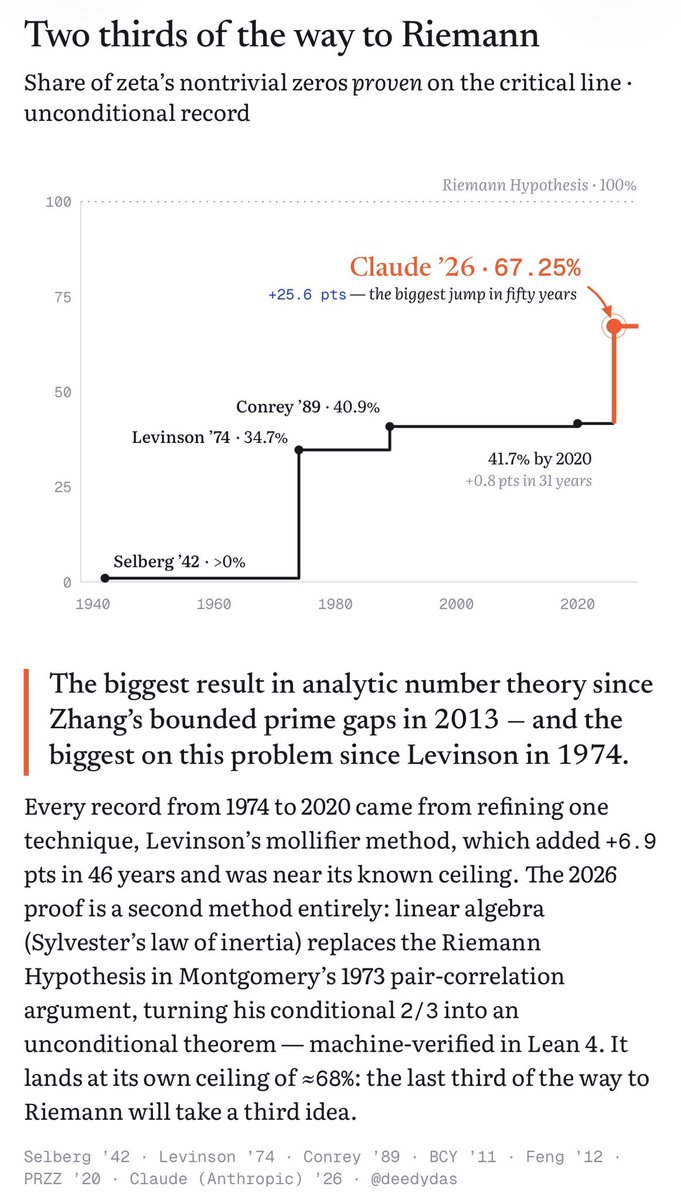
This insane result from Claude is the biggest in analytic number theory since bounded prime gaps in 2013.
It boosted the proven fraction of Riemann zeta zeros on the critical line by 25.6pts. In the 37yrs prior, mathematicians moved it 0.8pts.
Labour overtakes Reform UK in the polls for the first time in 18 months. Latest YouGov poll for @thetimes puts Labour on 24%, Reform on 22%. Statistically nip and tuck but Reform’s lowest polling since March 2025.
I think it reflects a modest Burnham bounce and Farage’s sea of woes.
Greens at 12% going nowhere fast led by the underwhelming and rather strange Polanski, who’s had as bad a year as Farage. Ditto Lib Dems on a dismal 11% under the dismal Ed Davey.
The Tories are up 2 points on 21%. So the reality is that Labour, Reform and Tories are all within polling’s statistical +/- 3% margin of error of each other.
The political story of 2025 was the rise of the insurgents on the Right (Reform) and Left (Greens).
The political story of 2026 (so far) is how the insurgent rise has been stemmed — indeed is somewhat in retreat — while Labour and Tories show modest flickers of renewed life.
In sum, Labour, Tories and Reform have all to play for.
Greens and LDs remain also-rans.
NATO’s European members are rapidly increasing their defence spending, but the headline figures obscure important differences in how countries are allocating these increases. Greater transparency of this funding is key to ensuring credibility among allies, industry and the public.
Read the latest #MilitaryBalance blog by Fenella McGerty (@FMcGerty): https://t.co/60PoF1McMO
INSTEAD OF WATCHING AN HOUR OF NETFLIX TONIGHT.
This 60-minute Cambridge lecture by Demis Hassabis will teach you more about the future of AI than most people will learn in the next 5 years.
Bookmark it and give it an hour, no matter what.