Another poor lady has pawned her jewelry with intention of getting a lease once her Toyota Yaris was cleared, duty fully paid but vehicle never cleared because of cross border LC.
No car, no jewelry with never ending interest payments.
Just one pathetic story out of the lot
Vehicles stuck at the port for years. Owners suffering. Treasury collecting zero revenue.
At last week's #COPF session, I heard the case of a retired Govt servant who used his pension to import a vehicle, still stuck at the port, deteriorating.
We have written to the Secretary to the Treasury: resolve this within three weeks. A fair penalty or demurrage settlement. Let people take their vehicles home.
Nobody benefits from this except the lawyers.
Not something to be proud of. The economic & emotional toll of mothers leaving their families to work overseas as domestic workers is impossible to quantify
On the otherhand, professionals who migrate often settle abroad permanently, resulting in little to no inward remittances
Kuwait has emerged as the leading source of foreign remittances sent to Sri Lanka by overseas Sri Lankan workers, the Sri Lanka Bureau of Foreign Employment (SLBFE) says.
Speaking on the “Ada Derana Big Focus” programme, SLBFE Chairman Kosala Wickramasinghe said nearly 80,000 Sri Lankans travel to Kuwait for employment each year, accounting for around 30% of the country’s annual foreign job departures.
He said Sri Lankans working in Kuwait remitted US$893 million to Sri Lanka in 2025, making it the single largest contributor of worker remittances to the country.
Qatar ranks second in remittance inflows, followed by the United Arab Emirates (UAE), while Saudi Arabia and the United States also remain among the top contributors.
According to the SLBFE, Sri Lankan communities in Italy, the United Kingdom, the Maldives, Australia and Israel also make a significant contribution to the country’s foreign exchange earnings through remittances.
Sri Lanka receives billions of dollars annually through worker remittances, which remain one of the country’s key sources of foreign exchange. (Newswire)
A 24-year-old Polish tennis player arrived in Paris last week ranked 114th in the world, with no sponsors, no guaranteed income, and no certainty she could even pay for her hotel room.
She had to win three qualifying matches just to enter the French Open main draw. Prize money is only paid at the end of the tournament, so a Polish sports drink brand quietly stepped in and covered her hotel bill.
Her name is Maja Chwalinska. And today, she plays in the French Open final.
Before this tournament, she had won exactly one Grand Slam main draw match in her entire career. She had battled depression so severe that in 2021 she couldn't get out of bed. She underwent knee surgery in 2022. She spent years grinding through small tournaments across Europe just to stay afloat.
Then she arrived in Paris, won three qualifiers, and kept winning. Zheng Qinwen. Elise Mertens. Maria Sakkari. Diana Shnaider. Nine straight matches. One set dropped.
She is now the first qualifier in French Open history to reach the final. The last time a qualifier reached a Grand Slam final, it was Emma Raducanu at the 2021 US Open. Raducanu won.
By simply making the final, Chwalinska has earned more prize money than her entire career combined. The runner-up cheque alone is $1.6 million. If she wins today, she takes home $3.25 million.
One week ago she couldn't pay for her hotel room.
How the SL 🇱🇰 Government Manufactured a Dollar Crisis
⭕ Sri Lanka imposed a temporary 50% surcharge on vehicle Customs Import Duty from May 16, for 3 months.
⭕ The LC opening numbers revealed by Dr. Anil Jayantha:
May 07: USD 2.6 million
May 08: USD 4.6 million
May 11: USD 3.8 million
May 12: USD 4.28 million
May 13: USD 8.36 million
May 14: USD 11 million
May 15: USD 23 million
May 18: USD 17 million
⭕ The government’s intention was to delay vehicle imports by making them more expensive for three months. But the market reacted in the opposite direction.
⭕ Instead of waiting, importers rushed to open LCs. This panic response increased demand for dollars, added more pressure on foreign exchange, and further weakened the rupee.
⭕ This is the problem with shallow policy decisions. A tax or surcharge may look correct on paper, but markets do not always behave the way policymakers expect.
⭕ When secondary effects are ignored, the policy can backfire. In this case, the attempt to reduce immediate pressure may have created even more pressure in the short term.
⭕ This is becoming a repeated weakness in the NPP government’s decision-making process. Policies are announced with good intentions, but without properly considering market dynamics, behavioural responses, and long-term consequences.
⭕ Commercial banks in Sri Lanka are quoting the US dollar selling rate at Rs. 354 today.
#SriLanka
Sri Lanka spent nearly USD 600 million on vehicle imports in the first quarter of 2026, with Central Bank Governor Dr. Nandalal Weerasinghe warning the annual bill could climb to USD 2.4 billion, surpassing last year’s USD 2 billion. He noted last year’s imports had already exceeded forecasts of USD 1.5–1.7 billion, boosting Treasury revenue, and stressed that despite rising costs, government tax targets remain unaffected.
D: https://t.co/YAOSqvey4B
There is growing speculation within motor vehicle importer fraternity that another vehicle import restriction may be inevitable. As a result, panic purchasing is taking place, with many rushing to open LCs simply to secure stock now & potentially benefit later from an import ban
I heard that Chamara Sampath Dassanayake stated in Parliament that more than 4,000 LCs were opened following the news about the import surcharge. Even I got to know about this news on Friday after trading hours — a little late compared to others who had known well in advance.
Initially, I heard it as an import ban, and I was of the view that such a move would not be practical, as vehicle imports generate significant income for the government. A ban would negatively impact government revenue again.
I am not expecting a major drop in vehicle imports — maybe a slight decline in a portion of commercial vehicles, but not in buses, lorries, and trucks. Those are essential imports, and businesses will have to purchase them anyway.
The media too carries a significant responsibility. Headlines and fragmented reporting on remarks made by government and Central Bank officials can heavily influence sentiment within the trade.
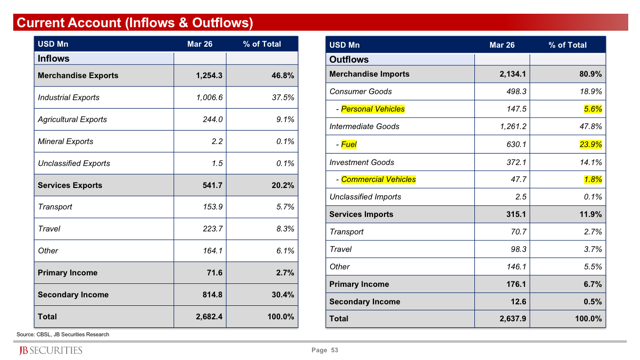
Higher prices disincentivize consumption and investment, total current account outflows in March were USD 2,600 mn, personal vehicles was only USD 140 mn
On passenger vehicles the average taxes are 150 percent, on usd 100 mn the tax collection will be close to lkr 50 bn a month. We are spending usd 600 mn on fuel imports - due to subsidies on petrol and diesel and losses that will need to be compensated to oil companies we need the tax revenue on vehicles badly. President has not been correctly advised.
Hundreds of people have been lining up outside Swatch stores in London, Zurich, New York, Singapore, Bangkok, and Osaka, desperate to get their hands on the Audemars Piguet x Swatch collab.
Retailing for around $400, it's going to sell out fast and then appear on eBay for thousands
Welcome to the latest craze
New Day, New Tax: Sri Lanka’s 🇱🇰 Never Ending Tax Lust
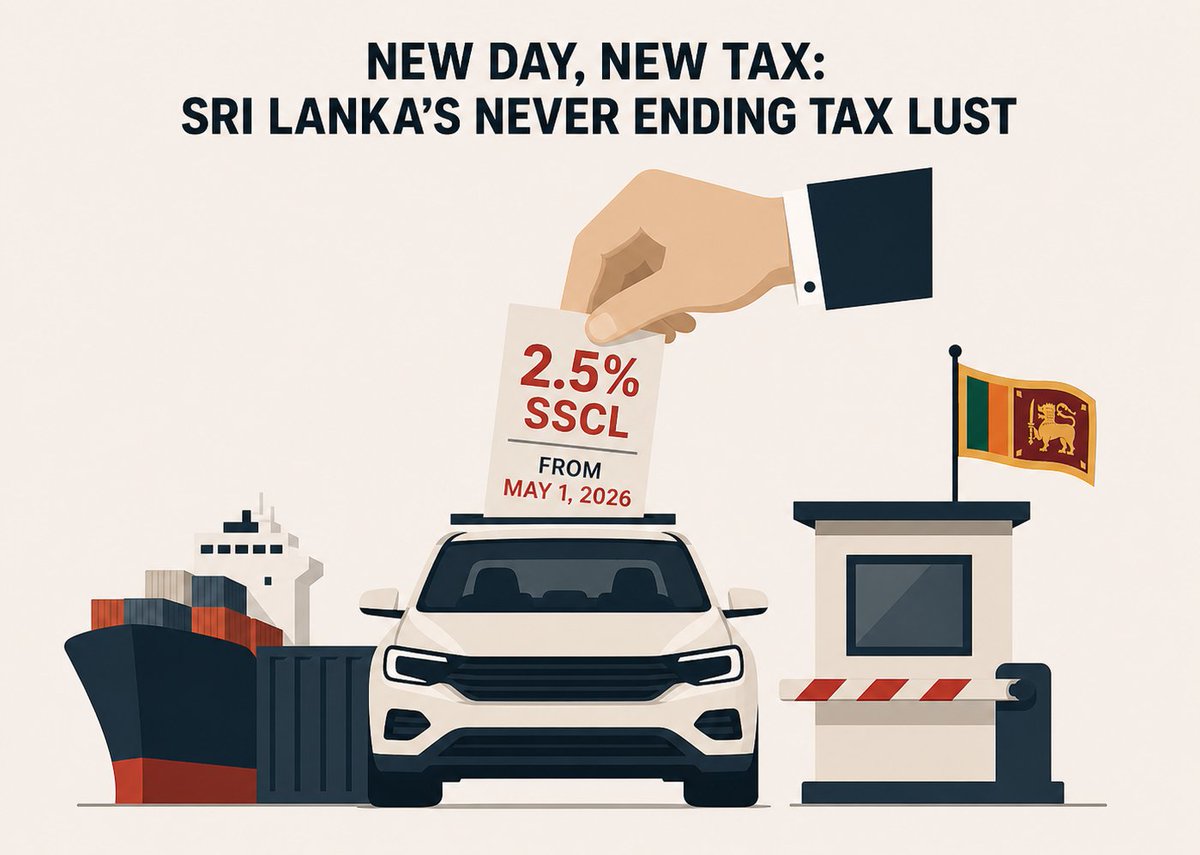
⭕️ From May 1, 2026, the Government has decided that vehicle imports will be subject to a 2.5% Social Security Contribution Levy (SSCL) at the point of importation.
⭕️ “At the point of importation” means that anyone importing a vehicle, including personal importers, will now be subject to this tax.
⭕️ Previously, SSCL was mainly paid by vehicle importers after the sale. Personal importers were not directly subject to this tax at the point of importation.
⭕️ Even vehicle importers may not have properly paid SSCL under the previous turnover-based system, as it left room for anything from creative accounting practices to outright tax fraud.
⭕️ Effectively, this change means that if you buy a vehicle, your cost will increase by around Rs. 2%-3% or more, depending on the CIF value and the relevant taxes for that vehicle.
⭕️ Rs. 7 million -> ~ Rs. 150,000 🔺
⭕️ Rs. 10 million -> ~ Rs. 200,000 🔺
⭕️ Rs. 15 million -> ~ Rs. 300, 000🔺
⭕️ SSCL works like VAT, it is charged on the basis of CIF value and other applicable taxes.
2.5% SSCL = (CIF value + CIF x 10% + CID + Excise Duty + any other taxes) x 2.5%
CID = CIF x 30%
Excise Duty = Changes based on the vehicle type
Other taxes = such as surcharge, PAL, etc. Currently 0 for vehicles
⭕️ SSCL was introduced in 2022 as a temporary tax to support Sri Lanka’s economic recovery by charging 2.5% on turnover.
⭕️ The Government has no real justification to keep increasing taxes on people, especially when revenue generating agencies have exceeded their targets during the last two to three years, and any expected revenue increase from this measure could have already been achieved through improved collection.
⭕️ The only other group that benefits from this change is large scale vehicle importers, as it removes one of the key cost advantages of personally importing a vehicle over buying from an established importer.
⭕️ Adding more taxes on already heavily taxed vehicles does not create any meaningful value for the country in the long run, especially when it locks away capital in depreciating assets like vehicles.
⭕️ Higher taxes do not help grow the economy. They discourage economic activity and reduce people’s ability to spend, invest, and build businesses. In simple terms, it is another case of handing more money to the Government, often the worst manager of money in any country.
⭕️ If Sri Lanka 🇱🇰truly wants a fair and low tax system, the focus should be on widening the tax base, improving the collection system, reducing leakages, and ensuring that everyone contributes fairly.
#SriLanka #VehicleTaxes