There’s a person behind every uniform, a story behind every assignment, and a purpose behind every sacrifice.
In this exclusive interview, I share my journey, my perspective on modern policing, and why effective communication matters now more than ever.
ASP Nahum Kenneth Daso Anipr, FCAI, FIPMD
Police Public Relations Officer
Borno State Command
🎥 Full interview now available: https://t.co/j5bUjTvOo7
Your thoughts and feedback are welcome
@CspIniedu@PoliceNG@BornoPoliceNG@Adanayakafulama 🎥
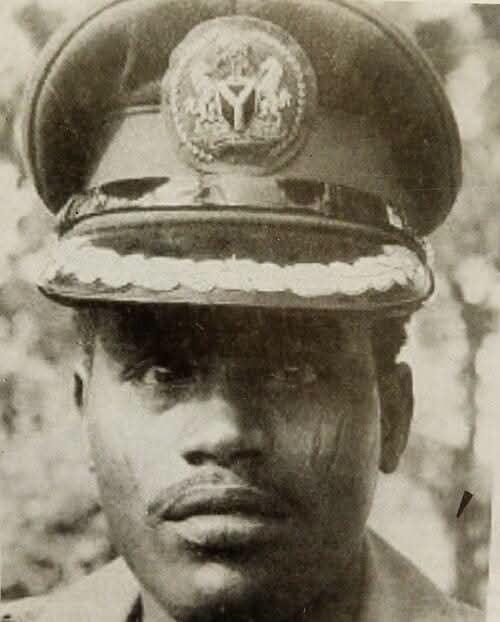
THE SOLDIER OF CONSCIENCE: MAJOR GENERAL MOHAMMED SHUWA
Major General Mohammed Shuwa remains one of the most respected and disciplined officers in the history of the Nigerian Army. A man often described as a soldier of principle and restraint, he stood out during one of Nigeria’s most turbulent eras for his firm commitment to professionalism, military ethics, and the protection of civilian lives.
Born on 1 September 1939 in Borno State, Shuwa received his early education at the prestigious Barewa College, Zaria, where he shared classrooms with future national figures, including Murtala Muhammed. He enlisted into the Nigerian Army in 1958 and underwent military training in Ghana before proceeding to the Royal Military Academy Sandhurst in the United Kingdom, where he was commissioned in 1961.
From the beginning of his career, Shuwa distinguished himself as a calm, highly disciplined, and tactically sound officer. His professionalism quickly set him apart in a generation of young officers who would later shape Nigeria’s military history.
During the 1966 political crisis, then Lieutenant Colonel Shuwa played a stabilizing role in Kano, where he is reported to have taken decisive steps to secure armories and prevent widespread breakdown of law and order. His actions at the time were widely seen as efforts to prevent escalation of violence in a rapidly deteriorating national situation.
However, it was during the Nigerian Civil War (1967–1970) that his name became firmly etched in history. As the first General Officer Commanding (GOC) of the 1st Infantry Division, he led major federal operations in the northern axis of the war. Beyond battlefield command, Shuwa earned a reputation for something rare in wartime leadership restraint.
He was known for what many described as a “line of conscience,” consistently opposing the mistreatment of civilians and discouraging excesses in occupied areas. His insistence on discipline and rules of engagement placed him at odds with some senior colleagues, but it also earned him deep respect within and outside the military.
His principled stance reportedly brought him into professional disagreements with senior figures such as Murtala Muhammed, particularly on operational conduct and post-war policies.
Shuwa also maintained a strong commitment to military honour and remembrance, including advocating respect for fallen officers such as Major Patrick Chukwuma Kaduna Nzeogwu, reflecting his belief that professionalism should rise above political divisions.
After the war, he continued to serve in senior military and advisory roles, maintaining his reputation as one of the Nigerian Army’s most respected elder statesmen.
On 2 November 2012, Major General Mohammed Shuwa was assassinated in Maiduguri, Borno State, bringing a tragic end to the life of a man widely regarded as one of Nigeria’s most principled military leaders.
He is remembered not only as a battlefield commander, but as a rare example of moral courage in uniform a soldier who believed that even in war, humanity must not be abandoned.
Follow @Rise_Forge for more compelling stories on Nigeria’s military legends, forgotten heroes, and defining moments in history.
@channelstv Do more to go beyond states. True federalism is that which gives attention to all from top to bottom. The expansion of such collaboration should be drawn down to all 774 LGAs especially when made as catchment areas for the recruitment pool of the police and the Armed Forces.
least we forget
The symbolic experience of the Libya and Tunisia revolutions provides a strategic opportunity for Nigeria to experiment upon and reappraise its position. We must act fast but cautiously with Western Super Powers who for centuries, are always ready to ruthlessly cash in on their old policy of Divide and Rule. I had reasoned that if the West had deliberately failed to save Iraq, Afghanistan, Syria, Libya, Tunisia and Egypt, there is no earthly reason they will be willing to save Nigeria from collapse. People with a good sense of history would remember that anytime a former Colonial Power was called upon to save her moribund former colony, it was an opportunity for the former Colonial Master to make the former colony to supply more than 80% of the cost of replacing or reconstruction of all the dilapidated infrastructures of the former Colonial Master. It was also a renewed opportunity for the political control and re-orientation over the affected country. The result will be the loss of all development achieved in the last hundred years which would take several multiple folds of foreign dollar loans to rebuild, replace and reconstruct. I recall the show of shame during the fall of Iraq a few years ago which almost resulted in exchanges of open blows between the Allied Countries bickering on who was to repair what. Of course, if I were a former Colonial Master myself of any Third World Country, that is exactly what I would gladly do to stage a comeback through the back door without firing a single bullet. That was why our Founding Fathers in Nigeria – Sir Abubakar Tafawa Balewa, Dr. Nnamdi Azikiwe, the Sardauna Sir Ahmadu Bello and Chief Awolowo and the rest refused to sign any Defence Pact with the British. It is indeed a great pity that the current Nigerian Leadership despite its claim to sophistication and reasonable educational advancement, continues to show its naivety in understanding the machinations of our former Colonial Masters who can be capricious and insensitive sometimes
@BashirAhmaad It is obvious, in Brazil federal police control the interior portion where the majority of the population dwells as well the state police control, patrols and policed the vast ungoverned spaces of land. We have LGAs with vast land spaces unmanned with very low presence of police
@BashirAhmaad We ought to have a balanced federation. Even with state police.
Both humans and land spaces need to be adequately policed.
Equality representation and recruitment models will not yield positive results unless addressed through equity models based on population and landmass.
@BashirAhmaad Catchment areas of recruitment should cover the whole 774 LGAs and not state level because by the virtue of true federal character all states in Nigeria are not equal in terms of landmass and population. Let's learn from the Brazilian or Egyptian example!!
@NigeriaStories In other to have a balanced and just federal character system which will galvanize real gaps that makes it difficult for the best service chief of all the Armed forces plus other security outfits to perform to the expections of those blaming them today!
@NigeriaStories Ironically, the legislature has been a greater burden on Nigerians more than that of insecurity. Terrorism was never real to the elites class not until it started affecting their families.
The blame shifts should remain on the policy and law makers because the fell short of
@NigeriaStories Especially in public service representation,
We have the problems of shortages of personnel but we can not debate on changing the equality (problem) system of representation to a equity based representation in terms of two scientific variables of population and landmass
@NigeriaStories How can three senators represent 15 million people in a state like lagos or kano?
And still if you take smaller states in landmass for example Abia to have the same numbers of representation with yobe.
Where is the justice.
Why can't they amend laws that will correct the errors?
@NigeriaStories Without compromise. Injustices in the house floor is right there happening but no one can put it to the foe. How can we equallise all the whole states in Nigeria despite the fact that there are differences in landmass, population and even wealth creation within the states.
@NigeriaStories *they fell short of foresight on the prosperity of the people they represent and still fell short of foresight to harness,manage,utilise the God given resources buried in the Nigeria soil.
The law makers are in the principal position to derive laws in the best interest of Nigeria
@NigeriaStories Nigeria should rather demand for scrapping the bicameral system of legislature to unicameral system there by reducing Government spending cost and focusing on effective, fast and reliable modalities to save education, security, health, economy from total collapse.
@NigeriaStories Or Nigerians should scrap off Senate or house of repsresentatives.Typically moving away from Bicameral system of legislature to unicameral system.
What's wrong with Equity over Equality.
How will a 360 plus 109 member state represent over 200 million people?
Where is the justice?
professional, well-equipped, people-and-land-conscious Police Force.
I remain open to constructive dialogue and refinement from all well-meaning Nigerians. God bless the Federal Republic of Nigeria. —Ishaq Usman Faruk
@usmanfaroukjnr
Executive Summary Review of My Police Reform Memorandum I am Ishaq Usman Faruk. On 26 March 2026, I submitted a Memorandum on Police Restructuring to the Presidency, Police Service Commission, Nigeria Police Council, Ministry of Police Affairs, and National Assembly.
model Combined with modern equipment and parity, this turns potential challenges into strategic advantages for national security.
The memorandum addresses systemic weaknesses that started after 1966 and offers a practical path to close ungoverned spaces and rebuild a