India’s foreign policy is to dismantle Pakistan. But after the May war, the world sees Pakistan as a peer military power. The Indus Waters Treaty won’t be touched—revoking it risks war, and the world isn’t ready for that.
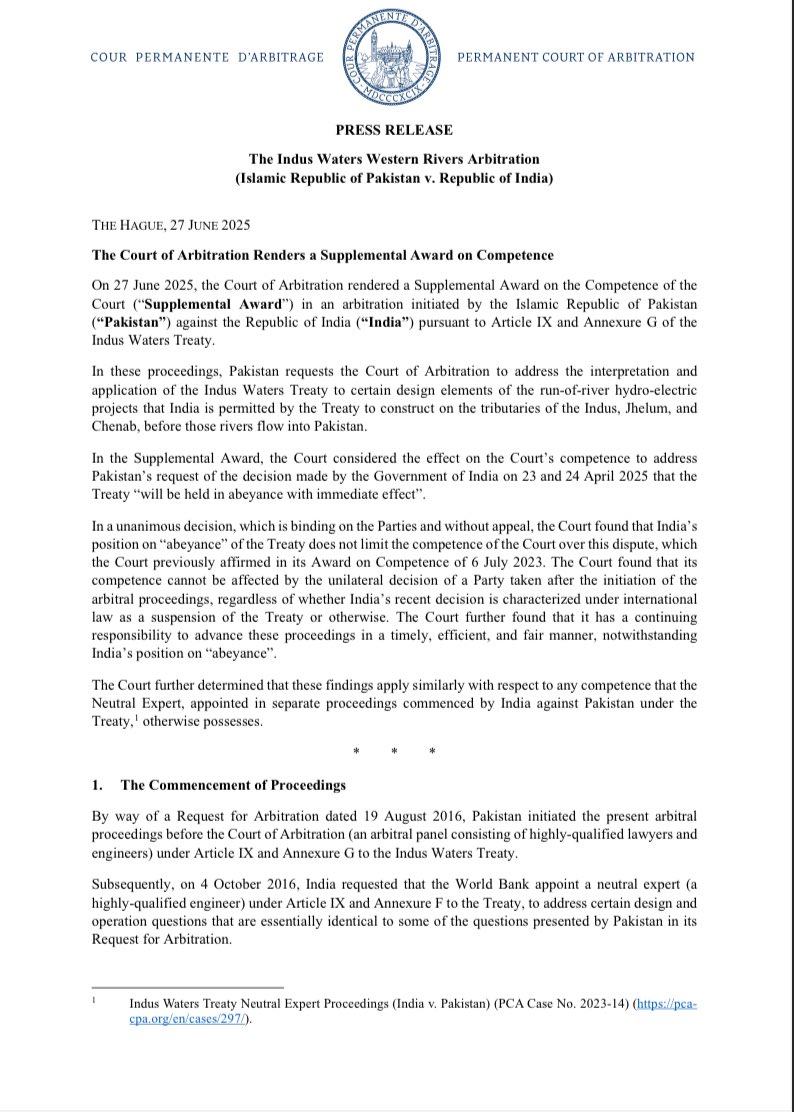
🇵🇰BREAKING: Pakistan Secures Major Legal Victory at World Court🇵🇰
In a landmark ruling, the Permanent Court of Arbitration in The #Hague has rejected #India’s objections and upheld #Pakistan’s right to pursue arbitration under the Indus Waters Treaty.
India had attempted to block the process by calling the treaty “in abeyance” and declaring the court “illegal” but the tribunal dismissed these claims entirely, making it clear that no country can unilaterally withdraw from the treaty or disrupt its legal mechanisms.
At the heart of the case are India’s Kishenganga and Ratle dam projects, which Pakistan argues violate the treaty’s terms. The court’s decision means the arbitration will now move forward, with or without India’s participation.
This is not just a legal win for Pakistan, it’s a powerful reminder that international law still matters. Pakistan’s patience, commitment to legal processes and principled stance have paid off.
🇵🇰 A clear message to the world: Pakistan plays by the rules and wins.
Want to give the world a collective heart attack? —picture this: Pakistan, Iran, and Afghanistan sign a defense pact, slap a shiny logo on it, and call it ‘NATO-From-Hell.’😈
#Pakistan#iran#Afganistan#PakistanIndianWar
reaffirmed stability, Pakistan can now shift greater focus toward strengthening its international relations and economic development. (2/2) #Pakistan#PakistanFirst
By successfully defending itself against an Indian military attack, Pakistan has sent a clear message to internal separatists and extremists: the state is stable, resolute, and not going anywhere. This serves as a strong example that their goals are unattainable. With this (1/2)
All oil-rich countries in the Middle East, except Iran, fall under American security influence. If Iran develops a nuclear bomb, it would prevent the U.S. from ever gaining military control over the country.
intervention. Aware of this public insight, the Pakistani military strategically escalated the situation to a point where both China and the United States were compelled to step in, consistent with their respective foreign policy frameworks. (2/2) #PakistanIndianWar
The Indian public appeared more willing to support a war with Pakistan, largely due to their limited exposure to global geopolitics. In contrast, the Pakistani population had a clearer understanding of how far the conflict could escalate before drawing international 1/2)
If, for any reason, India intended to go to war with Pakistan but couldn’t, it effectively lost the war it started. India agreed to a ceasefire because it realized a full-scale conflict would collapse the region’s economy—a gamble it wasn’t willing to take.
India will be forced to keep its population in poverty if it chooses to divert all its resources toward keeping up in the defense race against the Pakistan-China combo. It will take India around 10 years to establish a truly competent defense R&D industry. In the meantime, 👇
India entered the battlefield to satisfy its ego, while Pakistan engaged in the war to defend its sovereignty. Naturally, the motivation rooted in protecting one’s homeland far outweighed the pursuit of ego.
#PakistanIndianWar#IndiaPakistanWar#operationbunyanummarsoos#pakistan