A fully armed F-15C scrambled from Otis Air National Guard Base seen flying over the World Trade Center on 9/11. Two F-15s were scrambled from Otis that morning, but neither arrived in time to stop American Airlines Flight 11 or United Airlines Flight 175 from striking the WTC. As the North Tower is still standing in the video, it can be concluded that the footage is taken after 9:59am and before 10:28am.
The second video depicts the sound of one of the F-15s as they pass overhead closer to Ground Zero after the collapse of the North Tower. If called upon, these F-15s were armed with live ammunition in an air defense capacity and could have engaged any hijacked aircraft should have that permission been given. No hijacked aircraft were intercepted by any U.S. Fighters that day.
Footage of the deepest shipwreck ever located, USS Samuel B. Roberts. The Roberts was sunk by Japanese Battleship Kongō during the decisive Battle off Samar on October 25, 1944.
During this battle, the Roberts became known as “the destroyer escort that fought like a battleship” as she traded blows with Japanese capital ships. She ended up expending almost all 600 rounds of 5 inch ammunition before being sent to the bottom of the Philippine Sea with 104 men. 120 of her crew survived after spending roughly 50 hours in the water.
The Roberts was discovered on June 22, 2022 at a depth of 22,523 feet, making her the deepest shipwreck ever discovered. This exceeds the record set by the USS Johnston in 2021, which was sunk in the same battle.
Video footage from USS Lexington on October 29, 1989 shows a T-2C Buckeye piloted by Ensign Steven E. Pontell crash into the island of the aircraft carrier, killing 5 and injuring 19.
Ensign Pontell is attempting his first ever carrier landing when he approaches the carrier at too slow an airspeed. The Landing Signal Officer (LSO) is screaming at Pontell to wave off and abandon the landing attempt. The aircraft continues to slow before pitching up and rapidly inverting towards the carrier. The left wing is sheared off and the plane cartwheels in front of the island before coming to rest just in flames behind catapult #1
Just before the jet impacts the island you can see the canopy jettison as Pontell imitates the ejection sequence. Just after the aircraft impacts the island, you can see a flash of fire from the rocket motor of the ejection seat as Pontell is ejected downward directly into the deck of the carrier.
At the end of the video you can see other canopies flying up in the air as other student pilots jettison them to escape from their aircraft.
This ship honestly means so much to me. I visited her twice before she was closed for her dry dock period. I cannot wait for her to be reopened next year. I encourage everyone to go check out the Battleship Texas Foundation on YT. Their VP of ship operations posts weekly repair updates as they work to reopen.
If you have ever played Call of Duty 4: Modern Warfare, you will recognize the menu below and the silhouette of the soldier walking.
What you probably didn’t know is the silhouette is taken from a real photograph of a U.S. Marine taken by Lucian Read during Operation Phantom Fury is Fallujah, Iraq during November of 2004
Before there was Operation Epic Fury, there was Operation Praying Mantis.
On April 14, 1988, USS Samuel B. Roberts, a guided missile frigate, struck an Iranian naval mine in the Persian Gulf. The explosion broke the keel of the Roberts and nearly sank the ship but her outstanding crew was able to save the ship with no loss of life. Pictured below is an image of the Roberts as she is shipped back to the United States for repairs.
As a result, on April 18, 1988, the U.S. struck Iran in the Persian Gulf. Over the course of the day, the U.S. Navy would employ air and surface assets and ended up sinking an Iranian frigate, a gunboat, three speedboats, and destroying two oil platforms. An Iranian frigate and an F-4 Phantom were also damaged.
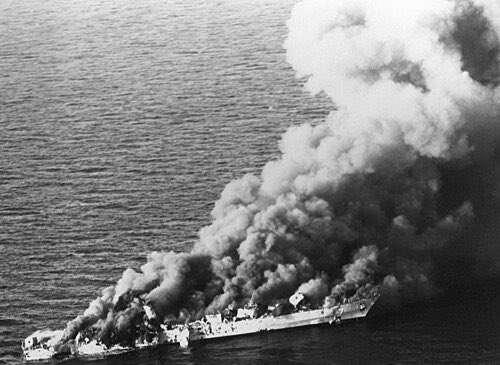
Pictured below is the Iranian frigate Sahand being attack by U.S. A-6E Intruders and burning from bow to stern shortly before sinking. In all, 56 Iranians are killed. Two U.S. Marines are also killed when their AH-1T Sea Cobra crashes into the sea during the night of April 18. The cause of the crash is unknown.
This footage taken by the Taliban is of the Battle of Kamdesh on October 3, 2009 as depicted in the 2020 film “The Outpost.” On this day, 300 Tailban fighters attacked Combat Outpost (COP) Keating at 6:00am from all sides. You can see on the video the moment the attack is ordered along with American soldiers moving to cover throughout the base.
Also visible is an A-10 Thunderbolt II and an AH-64 Apache as they join the fight to stop the attack on the base.
Ultimately, the Taliban fighters will enter COP Keating 48 minutes into the battle, burning down numerous buildings as the small American force collapses to a small perimeter within the base. From there, they push teams outwards to repel the Taliban attackers with the help of concentrated air power throughout the day. The final Taliban fighters leave the base around 5:10pm and the battle is over by 7pm.
Of note to the end of the footage you can see the cowardly Afghan National Army (ANA) soldiers as they abandon their posts and quickly allow the Taliban to enter the outpost. No ANA soldiers held their ground against the Taliban and they even stole property from Americans during and after the battle.
Ultimately, 8 Americans are killed and 27 are wounded. Roughly 150-200 Taliban fighters are killed or wounded. Two Americans, SSGT Clinton Romesha and SSGT Ty Carter are awarded the Medal of Honor for their actions during the battle. COP Keating is quickly closed by the Americans and abandoned hastily.
@huesos0615 Well Americans at the base fought to defend the base for over 12 hours. The Afghans ran within the first hour so yes I describe that as cowardice.
@CostaLefty65147 I wouldn’t go as far as calling it horrible. Unfortunately the studio that made it just didn’t have the budget to do the battle justice. At least they tried to honor the men who fought to defend the base.
The numbers cited in my post are from the official U.S. Army after action report. While it is true that exact counts are not available, the numbers provided represent the best guess from the U.S. Army given all the information available Obviously the Taliban did not provide official counts.
A U.S. Soldier on patrol in Afghanistan notices something buried in the dirt on the path and decides it’s a good idea to pick it up. In a stroke of unbelievable luck, the soldier has picked up an IED that either fails to explode, or the insurgent looking to remotely detonate it just wasn’t paying attention.
Either way, these soldiers dodged the grim reaper. Not a good idea at all.
This video is of the flight deck of USS Forrestal on July 29, 1967 in the Gulf of Tonkin off North Vietnam. An F-4B Phantom has an uncommanded firing of a Zuni rocket which hits the external fuel tank of a fully armed A-4 Skyhawk.
The jet fuel from the external tank spills on the flight deck and ignites, beginning a chain reaction which detonates ten bombs destroying 11 A-4s, seven F-4s, and three RA-5C Vigilantes. 134 U.S. Navy Sailors are killed and another 161 are injured.
Notably, sitting in the pilot seat of one of the A-4s nearest the fire is future senator and presidential nominee John McCain. McCain quickly exits his A-4 by jumping off of the nose of his aircraft and is nearly killed by the detonation of the first bomb.
The below video and photos depict the incident. The first is the flight deck video, the second is the plume of smoke as seen by the USS Oriskany, and the last picture is taken just after the fire begins. McCain’s aircraft can be identified as the third A-4 from right, with the majority of the deck underneath the aircraft on fire.