The UK's finance minister just said the quiet part out loud: data centers need a social license, not just a permit.
John Healey told a parliamentary committee he doesn't want the US data center fight replaying in the UK. That's why a new "data center covenant" got rolled out alongside the October budget. Read that again, a covenant. Not a subsidy, not a tax break. A deal with local communities.
What the mechanism actually measures: consent. AI buildout runs on power, land and water, and those get priced locally. When a hyperscale campus shows up and rates spike or the grid groans, the backlash is real, and it turns into planning delays and political noise. The covenant is basically an attempt to price that friction in early instead of litigating it after construction.
I think this is the more honest version of industrial policy. You can throw money at compute all day, but if the town next door hates you, the timeline slips anyway.
What I'm watching next: whether other governments copy the covenant structure, and whether grid interconnection queues start showing up in the same breath as AI capex guidance.
I keep thinking about Bit Digital's Q3: 163,725.9 ETH on the books, ~$439.4M.
Mining brought in just $2M. The real story is the balance sheet.
Staked 73,683 ETH for 66,192 LsETH, sold 1,625 at ~$2,114.62, bought none.
My mom's on Wegovy, so I read the FDA warning twice.
Rare eye condition, possible vision loss, tied to weight-loss and diabetes drugs like Wegovy and Zepbound.
Doesn't mean stop. Means call your doctor and know the signs. 👀
I pulled up the latest economic numbers this morning, and the thing that jumped out at me is CPI at +0.6% for September. That's a solid monthly jump, not some rounding-error blip. Unemployment at 4.1% in October still looks low on paper, but payrolls only added 165,000, which is decent without being impressive.
Then there's average hourly earnings up just $0.14. Wages are basically treading water against that CPI print. Producer prices for final demand came in at +1.3% for September too, which tells me the pressure isn't only showing up at the register, it's building further up the chain. Employment Cost Index at +0.8% for Q3 fits the same story.
The one that actually got my attention? Productivity at +3.6% in Q3. That's the piece I keep coming back to. If workers are producing that much more per hour while wage growth stays this quiet, companies are absorbing a lot of cost without passing all of it to consumers.
Here's my honest read, and this is just me thinking out loud, not advice: the CPI number is the one the market will fixate on, but the productivity figure is doing more work underneath. It's the difference between inflation that sticks around and inflation that fades because supply is genuinely getting better.
I've been wrong about the timing on this before, so I'm not making any big moves off one month of data anyway.
Trump losing both chambers and then spending his first public speech bragging about a ballroom ceiling is the most on-the-nose thing I've read this week.
Nearly 20 minutes on construction. Corinthian columns, a marble floor, five basement levels, a roof that supposedly shrugs off drones and missiles. Not one word about the midterm wipeout until reporters pushed him. And even then he pointed at the Iran war instead of himself.
Here's my read: this is the same pattern you see in markets all the time. When the numbers go bad, the guy in charge talks about the building. Anything but the P&L.
Two things stand out. He'd already spent real time the day before the election showing off a refurbished reflecting pool, and he openly called the work relaxing. Second, the moment he was asked about losing both the House and Senate, the answer was a war, not a strategy. That's a management team that won't own a miss.
My take: this is a leadership story, not a policy one, and I don't think it tells you much about your portfolio by itself. The trade-off I'll accept is that I might be reading too much into one weird press conference. Fine. But when the person running the show won't say the word "loss" out loud, I want to know who's actually steering before I get comfortable with any position that leans on Washington gridlock.
A ballroom that stops bullets. Cool. Still doesn't explain the vote.
Saw that AI model with three legs trying on clothes and I actually laughed out loud. The result is so absurd, how could that possibly fit right?
It's one of those moments where you remember how far these tools still have to go. We talk about AI disrupting fashion, e-commerce, virtual try-ons, the whole thing. Then a render comes out with an extra limb and suddenly the future feels a little further away.
And honestly? I kind of love seeing the failures. It keeps expectations honest. The market gets so hyped on every demo, every funding round, every "revolutionary" feature. But the messy reality is that a lot of this tech is still tripping over itself. Literally.
Not saying it won't get there. It will. Just saying the gap between the pitch deck and the actual output is still wide enough to fit a third leg through.
One person ran point on this policy doc, start to finish.
A big governance decision, over a thousand comments, only a fraction folded in.
I keep coming back to that ratio. Process on paper, direction from the top.
Lake Minnewaska this time of year is unreal.
Walked the loop last weekend, kid in tow. 2 miles, gravel, gentle hills.
Real talk: most of the trail you can't see the lake. Hold out for the overlook 🍁
Parking's $10. Got there around 2, waited 15 min.
The USDA just cut $8 billion in one-time fuel subsidies for farmers heading into harvest.
That's a real number for a real crunch. Fuel is one of those costs you can't just trim.
Feels like the pressure is finally being named out loud.
2002 vs 2026 Walmart receipts: money supply is up 4x.
Yeah, the last 20 years of inflation really feels like 4x.
McChicken: $0.70 in 2002, $1 in Florida in 2009, $3.50 in LA today.
Sure, a receipt could be AI-made. People still feel squeezed.
Every time I look at agent teams vs one agent, I get the same feeling.
Teams cost 1.8x to 5.1x more. Only one of four tests showed a real quality gain.
Multi-agent mostly buys speed, not smarts. That coordination tax is real.
A healthcare Nvidia just appeared. Eli Lilly (LLY), flying on weight-loss drugs.
Revenue up 48% to $22.97B last quarter, 85.8% gross margin. Two drugs, Mounjaro and Zepbound, made up ~65% of it.
Old pharma, now growing like a chip company.
From chips to rockets, what do these 7 companies actually do?
I've been putting together notes on 7 tech companies, covering AI hardware, software, cybersecurity, commercial space and quantum computing. Get clear on what they do first, then you can follow the logic behind each one.
CRDO | Credo. High-speed data interconnect. It sells connectivity products and chips for data centers. Simple version: it helps AI systems pass data between themselves more efficiently. Under the hood that's SerDes, active copper cables and optical DSP. What I watch: customer demand, product ramp, margins.
AVGO | Broadcom. Semiconductors plus infrastructure software. Custom AI chips, networking and switching silicon, enterprise software. The whole pitch is designing compute and networking together. What I watch: AI orders actually shipping, customer spending, cash flow.
PLTR | Palantir. Data analytics and AI software. It helps companies and governments pull their data together, then turn the analysis into operating decisions and real work. What I watch: projects landing, revenue growth, quality of earnings.
PANW | Palo Alto Networks. Enterprise security. It protects networks, cloud systems and data against threats that keep changing. Identify, connect, automate. What I watch: subscription renewals, recurring revenue, competition.
RKLB | Rocket Lab. Commercial space. Launch services plus spacecraft and key components for satellites and other missions. Electric-pump engines, carbon composite structures, satellite subsystems. What I watch: launch reliability, delivery pace, Neutron progress, capital burn.
IONQ. Quantum. Computing plus related networking and security, pushing toward commercial use through hardware and services. Trapped ions, so every qubit is the same kind of atom and you can link any pair inside a chain. What I watch: error correction, scaling, customer delivery, revenue against losses. Whatever edge quantum has depends on the specific problem.
INTC | Intel. Chip design and manufacturing. PC and server processors, plus a foundry business. RibbonFET, backside power delivery, advanced packaging. What I watch: yield, how competitive the products are, adoption, whether operations actually improve.
When I look at a tech company, I ask three things first:
1. What problem is it actually solving for the customer?
2. Where does the revenue come from, and how does growth show up?
3. What costs and risks come with getting there?
This is for getting to know the companies and the industry. From there you still have to go through financials, cash flow and valuation.
My watchlist sits around space, quantum, AI and cybersecurity. Understand the business, track the trend, mind the risks. Everything here is drawn from what the companies themselves publish. Any images are illustrations, not official. Personal study notes, not investment advice.
Chatbots talk. Agents ship.
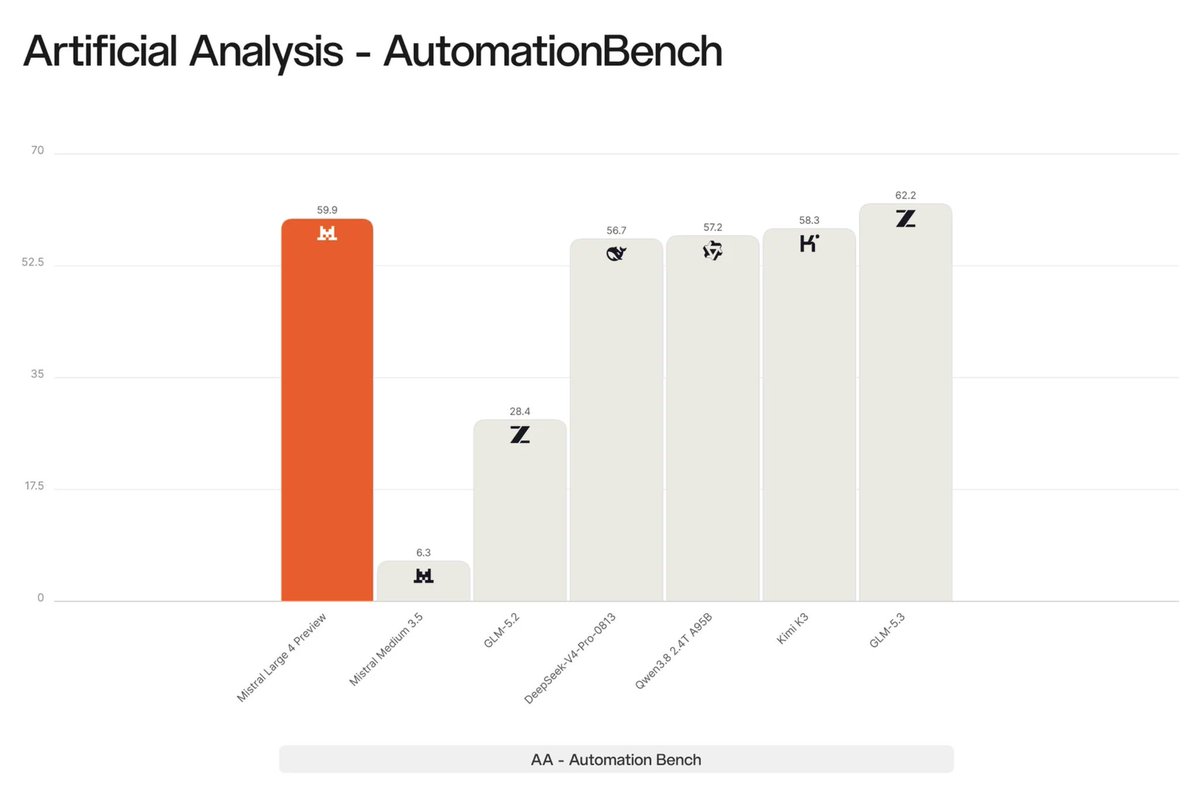
Mistral Large 4 ran 657 business workflows across simulated Gmail, Sheets, Slack and Salesforce, ahead of every rival model on AutomationBench.
It's also the #1 open-source model on Harvey's legal benchmark.