CfP: Digital Sustainability in Developing Countries special issue of Telecommunications Policy journal
Submissions invited that explore the relation between digital and sustainability in the Global South
Deadline: 19 Dec 2025
Details: https://t.co/IYu9sqG3bp
#ICT4D
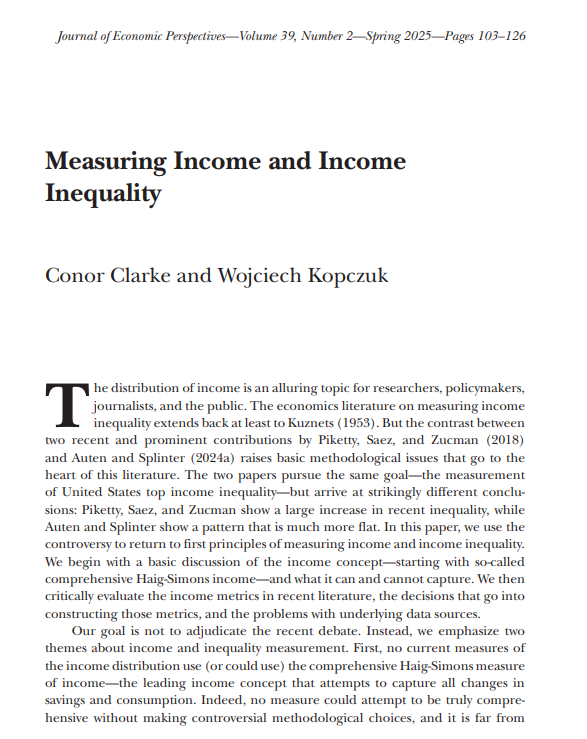
In this new piece in Journal of Economic Perspectives, @wwwojtekk discusses the measurement of income inequality. Its a good read.
One note of satisfaction. The focus is entirely on the post-1960 era which makes me happy. It means that I think that more and more people are implicitly accepting that all of the pre-1960 estimates constructed by Piketty, Saez and Zucman are totally unreliable.
See more here: https://t.co/OoMQcinv2r
Are you interested in hierarchical dimensionality analysis? Here's our new "Taxonomic Graph Analysis" used to model the IPIP-NEO Personality Hierarchy. The project is led by Andrew Samo and Alexander Christensen, with the collaboration of Luis Garrido, Paco Abad, Sam McAbee, and me!
In our preprint (link in the comments) we introduce a new approach to understanding personality structure: Taxonomic Graph Analysis (TGA), is a comprehensive network psychometrics approach that identifies hierarchical personality structures from the bottom up rather than imposing existing theoretical models. We applied TGA to the open-source 300-item IPIP-NEO dataset with over 149,000 participants and reveal a three-level structure of personality:
28 first-level dimensions (facets)
6 second-level dimensions (traits)
3 third-level dimensions (meta-traits)
What makes this approach very interesting is how it addresses longstanding methodological challenges in personality assessment:
Local independence violations
Wording effects
Dimensionality assessment
Structural robustness
While some dimensions aligned with traditional IPIP-NEO structure, we found significant deviations. The emergence of novel dimensions like "Sociability," "Integrity," and "Impulsivity" at the second level and a "Disinhibition" meta-trait at the third level represents a major departure from the traditional five-factor model.
Our research effectively integrates empirical findings scattered across personality literature into a coherent hierarchical structure. This data-driven framework demonstrates TGA's value for investigating complex psychological constructs and offers a rigorous new perspective on personality taxonomy.
This work exemplifies how innovative psychometric methods can reshape our understanding of fundamental psychological constructs. Its implications extend beyond personality assessment to potentially revolutionize how we conceptualize and measure human traits across psychology.
HICSS59
📷 Important dates & details: https://t.co/eBWXrrEHSK
📷 Information: https://t.co/ZSV8SYCTX8
Looking forward to your insights!
Manuel Pedro Rodríguez Bolívar, Gabriela Viale Pereira, and Erico Przeybilovicz
📷 Smart and Connected Cities and Communities Mini-Track Chairs