Your agent needs a decision, not another paragraph.
decision-cascade is a local decision engine for builders adding routing, classification, or scoring to AI workflows.
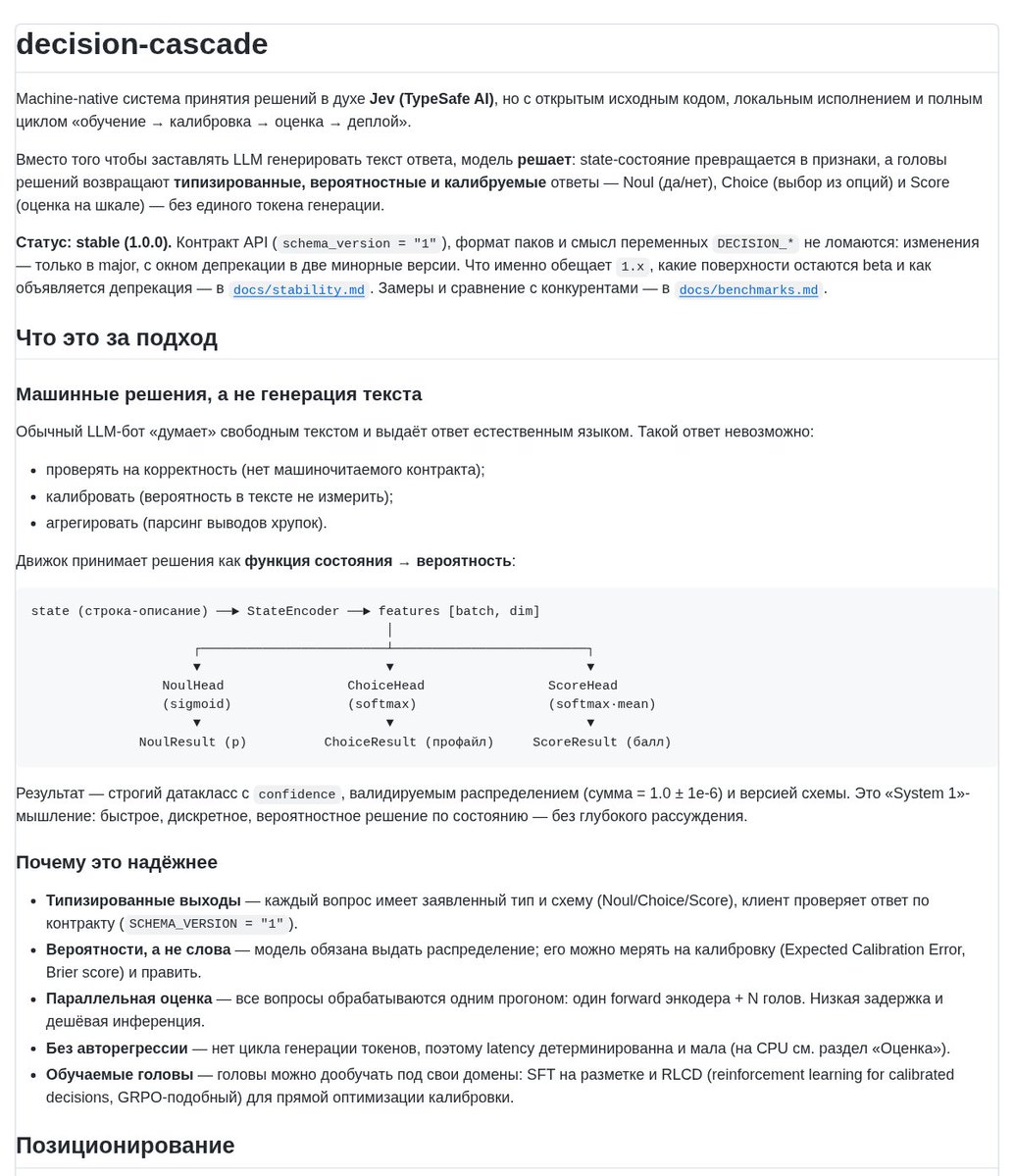
It helps you return structured decisions instead of parsing generated text by encoding the input state and passing its features to trained decision heads.
Key features:
• Typed outputs – Noul, Choice, and Score return yes/no probabilities, option distributions, or scores with a versioned schema.
• Local-first cascade – answer locally, then escalate low-confidence questions to an external SystemOne-compatible model.
• Calibration tools – measure probability quality with ECE and Brier scores rather than taking confidence at face value.
• Training recipes – train heads on labeled examples and calibrate them, with train/validation/test workflows included.
• HTTP + Python SDK – integrate the decision engine into your own application without building the API layer yourself.
One important caveat: default heads are randomly initialized. Meaningful decisions require training or a compatible trained weight pack.
It’s open-source (Apache-2.0 license).
Link in the reply 👇
Google Research's PaperOrchestra is an open-source (Apache-2.0) team of AI agents that turns raw research notes and experiment logs into a submission-ready LaTeX paper, handling the outline, literature review, section writing, editing and plots.
Source: https://t.co/g0VuUfEx7O
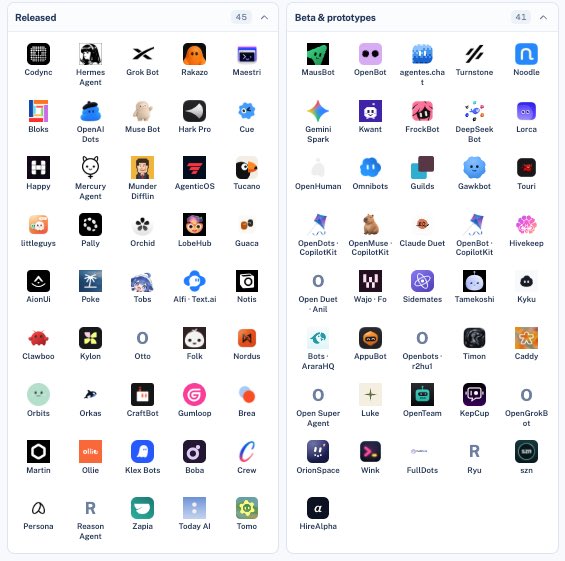
Of all the bot frenzy .
These are the my final results
@OpenBot_ simply the best.. so so easy and it just works out of box. Makes you feel like an Apple Original app.
@bot the OG. Terrific but too expensive
@mausbot_ feature rich, but learning curve
@rakazobot reliable
It is becoming f*cking dangerous: Microsoft Research made Claude Code 23.6% cheaper by letting it learn from its own past sessions, and 6 more repos stop it from repeating your old mistakes
1. Install TokenEconomizer and let it learn your repo from past sessions, a fact loads at session start once 3 sessions confirm it, and contradicted facts get dropped: https://t.co/Sy7sDCaZlk
2. Run loom, ClickHouse's self-hosted MCP server, so what one agent learns the next one can find, its Claude Code plugin loads context at start and records each session: https://t.co/tYPUzFaTJq
3. Run npx @globalmpc/nomore to find the instructions you repeated in 2+ sessions and turn them into CLAUDE.md rules that survive compaction: https://t.co/CqGBtqQ9Tu
4. Add stalemap to catch dependencies that changed after the model's training cutoff, it writes a ranked list of changes into CLAUDE.md before the agent starts: https://t.co/fMpGvqemW3
5. Install landmines to find open GitHub issues filed against the exact versions in your lockfile, the agent's edit stops once and gets the workaround from the thread: https://t.co/RtRc1zrkbc
6. Open Rulebook to see every CLAUDE.md and AGENTS.md across your projects, it flags diverged files, broken @imports and files over 200 lines: https://t.co/n61jH5IpeR
7. Give small jobs to lean agents, subagents that start at about 7.4k tokens instead of 131.1k because they skip CLAUDE.md, the skills list and MCP tools: https://t.co/RWIVXbrvQb
TokenEconomizer on 277 SWE-Bench tasks: 18.4% to 30.9% lower cost across 5 setups, cheaper in all 30 cells
All 7 repos are less than 6 weeks old, Rulebook needs macOS 14+
Full guide in the article below
Kitesurf, our experimental browser engine for AI agents, is now open source. Inspect the code, run it locally, or deploy your own instance on Cloudflare Workers. https://t.co/gZeSsQzmr2
There's an AI streamer that goes live on Binance Square every night. Now anyone can run one.
open-yoki is the open-source base behind her:
→ Cloned voice and a real-time digital face
→ Reads the chat, replies in seconds, remembers regulars
→ Live crypto prices on screen
→ Goes on and off air by herself
One server is all it takes.
https://t.co/jE44A47f53
I'm open sourcing Shader Lab! :)
And to celebrate you can now switch between different types of windows that change the direction of the rain.
The GitHub repository includes instructions on how to run it on your own HomeView virtual machine.
https://t.co/VyWXx9c8E9
Enjoy!
Introducing Costco for Agents.
Your agents can now shop 3,000+ APIs and tools with no subscriptions and zero markup.
How: Monid buys in bulk. Your agents pay per call.
What's on the shelves:
> Lead gen and enrichment
> Social media data
> Image, music and video generation
> SEO and GEO
> Ecommerce data
One key, one balance, everything under one roof.
Fine-tune LLM agents without fine-tuning LLMs!
Memento is a memory based continual learning framework for LLM agents that lets them learn from experience over time without touching model weights.
It maintains a Case Bank of past trajectories including tasks, step sequences, tool usage, and outcomes.
When a new task comes in, the agent plans and acts by pulling from similar past cases instead of starting from zero.
Memento follows a planner and executor setup:
1. The Planner (an LLM) breaks the task into subtasks, retrieves relevant cases, and chooses a plan.
2. The Executor runs those subtasks using tools like search, code execution, or document processing through the Model Context Protocol (MCP), then logs the results back into memory.
Key Features:
• Memory based continual learning that improves agents through stored experience
• Planner and executor architecture with case based reasoning for task decomposition
• Unified tool ecosystem for search, code execution, document processing, media analysis and more
• Learning without weight updates by retrieving and reusing relevant past cases
• Strong results on long horizon and out of distribution tasks in reported benchmarks
It is 100% open source.
Link to the GitHub repo in the comments!
11 open-source repos for a research → write → slides → video → voice workflow you can hand to Claude Code (2 are brand new):
01 last30days-skill → research a topic across Reddit, YouTube, HN and the web (MIT)
https://t.co/yl3RozkaOs
02 claude-video → let Claude watch any video and answer questions about it (MIT)
https://t.co/uv8T4QFzbr
03 humanizer → strips the signs of AI writing from your drafts (MIT)
https://t.co/53LgBmnnlV
04 frontend-slides → animated HTML slides from a prompt or a PowerPoint file (MIT)
https://t.co/Py38e0ywwD
05 ppt-master → documents to editable PowerPoint decks, with narration from speaker notes (MIT)
https://t.co/SQysYTt5pd
06 HyperFrames → write HTML, render video (Apache 2.0)
https://t.co/ZQYzJ0FoQs
07 video-use → edit raw footage by conversation, needs an ElevenLabs key (MIT)
https://t.co/WtxIenDzjX
08 OpenMontage → your coding agent runs a whole video production (AGPL-3.0)
https://t.co/iq8RosVfH0
09 Pocket TTS → text to speech on a CPU (MIT code)
https://t.co/jJRriow8yJ
10 Phonon → NEW: on-device text to speech, released Oct 20 (code Apache 2.0, the multilingual weights are non-commercial)
https://t.co/yuBHtidDlT
11 ZONOS3-Mini → NEW: text to speech with voice cloning in 43 languages (Apache 2.0 weights)
https://t.co/wCrJLDObeh
Research → write → slides → video → voice.
Check each license before you use it commercially, and only clone a voice with the speaker's consent.
Introducing Orion, a foundation model that predicts where you look. Orion finds twice as many UX bugs as frontier models, cuts computer-use latency by 31%, and even won a drone race.
Someone built a free, open source AI app that turns receipts and invoices into organized financial records automatically.
It’s called TaxHacker. Run it on your own server, upload a photo or PDF, and it can:
> Pull out items, prices, dates, merchants and taxes
> Sort expenses and transactions into categories
> Convert currencies using past rates, including crypto
> Store records in a searchable database
> Export reports for bookkeeping and tax prep
You can use a local AI model to keep your receipts and invoices on your own server.
TaxHacker is still in early development. It’s open source and free to self-host.
We benchmarked Genie, powered by Genie Ontology, against two frontier agents on enterprise data tasks. Here's what we found.
In collaboration with @turingcom, we developed a benchmark that tests more than table queries. Agents had to use business knowledge spread across notebooks, dashboards, and saved SQL queries in a live Databricks workspace, running each agent five times per task.
Genie passed 91% of runs, compared with 45% and 58% for the other agents, while using less than half the tokens and finishing 3–4× faster.
The key difference is business context. A valid SQL query can still produce the wrong answer if it uses the wrong definitions or calculation rules.
Genie Ontology retrieves and prioritizes business knowledge, helping agents find and apply the right context instead of relying on table schemas alone.
Explore the benchmark and methodology: https://t.co/q5xup45puH
We built a faster, cheaper, more accurate rea-video skill
@HyperFrames_ reverse-any-video skill vs REA-Video:
Ours took: 81 s vs 1,595 s, ~20× faster
SSIM (Similarity score): 0.96 vs 0.78
See the results for yourself
Skills 2.0 is here!
(8x fewer tokens and 2x faster)
We package repeated workflows as skills all the time, but the agent still re-reads the skill and decides every step on every run, which costs tokens and time.
Devs just open-sourced Swamp, where your coding agent turns a repeated skill into a workflow that it builds once and runs again and again.
You describe the task once, and the agent breaks it into reusable behaviors connected in a workflow.
Every behavior has typed inputs and outputs, and plain code decides which step runs next. Swamp then gives you:
- model calls only on steps that need judgment
- secrets pulled from vaults and redacted from output
- versioned data from every run that you can query later
- a full record of what happened on each run
Here's the repo: https://t.co/GtaNpqAngp
(don't forget to star it ⭐ )
Swamp plugs into the coding agent you already use, like:
- Claude Code
- Codex
- Cursor
- OpenCode
- And 5 more agent harnesses
In Swamp, the model is a step in the workflow, not the thing deciding what happens next.
The model steps still reason like any LLM call.
However, in this case, code owns the loop, so the agent doesn't spend tokens rediscovering the same process every time.
Here's an official result, where they turned a code-review skill into a Swamp workflow:
- Skill in Codex: about 4.6M tokens, 23 agents, 12.8 minutes
- Swamp workflow: about 506K tokens, 3 agents, 6.6 minutes
That is ~8x fewer tokens in about half the time, and most of the savings came from replacing the coordinator agent with plain code.
You can keep using skills while you prototype. Once a task starts repeating, ask your agent to turn it into a Swamp workflow.
This helps answer practical questions such as:
- Which steps actually need a model?
- What exactly happened on last week's run?
- Can a cheaper model handle the one step that needs judgment?
Once it's built, you can run the workflow from your agent, the CLI, a schedule, or an API, with every run recorded.
So you are no longer paying a model to figure out the same workflow on every run.
Instead, you spend tokens only on the steps where the model's judgment adds something.
The animation below shows how Swamp differs from Skills, and I worked with the team to put this together.
If you want to understand the coordination layer that Swamp replaces with code, I wrote a full breakdown of how Claude Code splits work across subagents and agent teams.
It covers when a single subagent is enough, when you need a team of agents that coordinate with each other, and what that coordination costs in context and tokens.
Read it below.
Today I’m open-sourcing Tess Core: a complete agent runtime for Python with zero runtime dependencies. 🎉
Tess Core is the engine behind my commercial products, including Drost, my coding agent and personal AI, and the RL rollouts behind my model fine-tuning work.
It is also the foundation underneath the agentic work I’ll be releasing over the next few weeks. 🥂
GitHub: https://t.co/u1dWoOE27I