Dear @careinsuranceIN need a resolution from you its been over 2/3 months and have tried reaching out multiple times via customer care and DM - why is it so hard to resolve small queries ?
“Flame University in Pune has this library of mistakes. There are only two in this world, second one is in Edinburgh.”
“It has all the chronicles of business decisions gone wrong. The humans before us have done the same mistakes as we do only with marginal deviations.”
“Smart people learn from mistakes of other people rather repeating it.”
- Kuntal Shah (Oaklane Capital)
@Kuntalhshah@oaklanecapital
Some milestones are worth pausing for. This is one of ours.
📍Our Mumbai team has moved into a new workspace.
For an investment firm, Mumbai is more than a financial centre. It is where capital, enterprise and ambition meet, and where many of the conversations shaping Indian business begin.
The move marks an important milestone in Oaklane’s growth and the next phase of our journey.
It reflects how far we have come, but more importantly, the scale of what we are building from here.
A glimpse inside our new workspace in Mumbai. Here’s to the next chapter.
-
Oaklane Capital Management LLP
SEBI Registration No: INP000006624
Disclosure Link:
https://t.co/1lEwxyPaib
What 35 Years in the Market Taught Me?
A few lessons from my conversation with @kushallodha548
1) Experience is a great teacher, but she sends terrific bills. I have paid quite a few. The mistakes have taught me more than many of my winners. My costliest mistakes weren’t bad purchases. They were premature sales.
2) A great business is not always a great investment. Price remains part of the compounding equation. “Buy at any price” often means avoiding the uncomfortable valuation question. Price is part of the compounding equation, and you can’t remove the starting valuation and still reach the destination.
3) Numbers alone are also not enough. I like to triangulate every investment through:
Narrative + Numbers + Accounting.
Touch only one part of the elephant, and you’ll confidently describe the whole animal wrong.
4) A great story without cash flows is dangerous. Reported profits can also mislead if you do not understand where the cash and net worth went.
5) History is perhaps the most underrated investing tool. The catalyst changes from railways and automobiles to renewable energy and AI.
6) Human behaviour does not. Greed, fear and stupidity continue to drive asset prices. That is why one can invest bottom-up, but must always worry top-down.
7) Skill matters. Choices matter. Luck matters far more than successful people admit. The best response is to increase your surface area of luck through curiosity, hard work, good people and reputation.
8) Learn from everyone, but blindly copy no one. Your capital, temperament and time horizon are your own.
9) Don’t ask “What is this company worth?” Ask “What must this company deliver for today’s price to make sense?” Reverse DCF turns valuation into interrogation.
10) Buy and hold is a strategy which works when things don't change much, not a religion. Your holding period should match the rate of change in the industry, not your ego.
11) Before you invest, assume it failed badly in five years. Write down exactly why. When reality shows up, you won’t freeze or rationalise.
12) At 80 or 90, which decisions would you regret? Use inversion now. Experience’s real job is to stop you from paying the same bill twice.
Full conversation:
https://t.co/nfG2KZ6HnP
The most dangerous thing in investing is a borrowed conviction.
Buffett said diversification is a hedge against ignorance. Berkshire is one of the most diversified conglomerates in the world.
He preached the twenty-hole punch card. His portfolio has churned actively through his entire career.
He called airlines a bad business. He has owned all four major ones.
This is not hypocrisy. What Buffett practices is a craft he answers to himself for. What he teaches is meant for the general public. The mistake is ours, quoting him verbatim and applying it to a game he is not playing.
Your mandate, your capital, your horizon, and your temperament are different from his. And from everyone else you admire.
Before copying any great investor's playbook, ask one question: am I playing their game, or mine?
Borrowed ideas can make you money. Borrowed conviction will make you sell at exactly the wrong time.
The fall does not create weakness, it reveals it.
Downside resilience is built long before markets turn.
It comes from owning quality businesses, paying sensible prices, and leaving enough margin for error.
Most investors sell their best compounders way too early. They see “fair value” in their mind and exit lock, stock, and barrel. Do NOT sell merely because something is fairly valued. Why?
As a great business compounds earnings and scales, it attracts big institutional money. Their required rate of return is much lower than yours. They happily pay higher multiples → your “fairly valued” stock keeps running. This is literally how multi-baggers are made after the initial re-rating.
Combine the 4 zones with Reverse DCF, instead of building a dreamy DCF to justify the price. Use reverse DCF — not to justify the price, but to interrogate whether the market’s embedded expectations can realistically come true.
Ask: “Under what conditions would the market’s current expectations actually come true?” If those conditions look unrealistic → you’re probably in Zone 3 or 4.
Liquidity and Interest rates are the gravity that pulls all these zones. When rates rise and liquidity dries, the zones shift left, and that's the time to sell.
Some practical aspects of invetsing and portfolio construction
Model 1: Use AI like a Ferrari, not autopilot
AI is incredibly powerful for retail investors — but only if you respect its limits.
• Data cleaning is 80% of the work (don’t dump raw 600-page PDFs)
• Create a curated “binder” document first
• Make the model confirm it understood context
• Run 4-5 LLMs as a “council” playing devil’s advocate
• Then apply human judgment, experience & justification.
AI narrows the search dramatically. It does not replace thinking.
Model 2: Ruthlessly eliminate 99.5% of stocks first. There are 4,000+ listed companies. You only need ~20 high-conviction ideas.
Eliminate top-down on fragility, leverage, stressed promoters, anything outside your competence or time horizon. This removes ~97% of the universe.
Then go deep, not wide. Missing some gems is a feature, not a bug. The science ends at 97-98%. After that, qualitative judgment (promoter behavior, runway, treatment of minorities) takes over. Investing is the last liberal art.
Model 4: Prepare for asymmetric bets (don’t try to predict).
You cannot predict black swans. But you can prepare. Best asymmetric opportunities appear when frightened or leveraged sellers are forced to sell (2008, 2020).
• Map the full range of outcomes + probabilities
• Seek disconfirming evidence (when you like a company, read only the bad reports)
• Do a pre-mortem before investing
• Fix a ruthless sell trigger in advance
• Keep a “tenth man” in your process
Downside should be finite and knowable. Upside can be open-ended.
Model 5: Portfolio construction & temperament. Concentration is powerful but behavioural, not scientific.
• Barbell: ~80% in 7-8 stable core compounders (sleep-well-at-night) + ~20% in 10-12 small optionality bets
• Only 16-18 genuinely non-correlated ideas are enough
• As your capital base compounds and you have more to lose → become more conservative (he now leans 20:80 instead of 80:20)
Invest bottom-up, but always worry top-down.
These 5 models work together: AI helps you process information faster →Ruthless filtering reduces noise →
Valuation zones + reverse DCF keep you disciplined →
Asymmetric bet thinking protects capital → Barbell portfolio + temperament lets you stay invested through cycles.
The goal isn’t to be right on every stock. It’s to build a process where good things happen more often than bad ones over decades. The biggest edge in investing today is not more information. It’s better filters, clearer mental models, and stronger temperament.
https://t.co/0etO30hyb0
The market does not only test your analysis.
It tests your behaviour.
Overconfidence, impatience, envy, fear and information overload quietly damage portfolios.
Strong investing is not just about prediction.
It is about process, temperament & discipline.
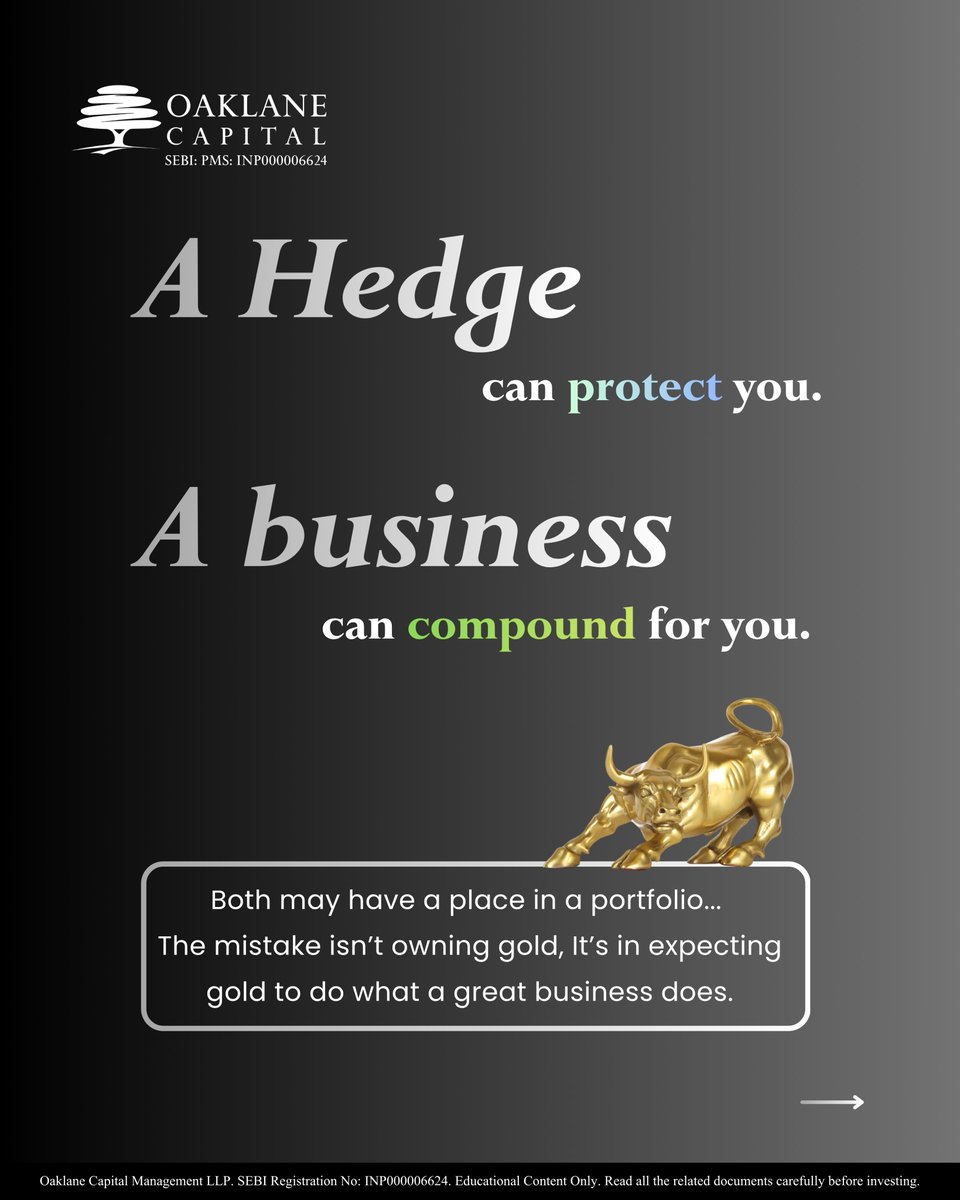
Gold preserves wealth. Businesses grow it.
Gold hedges uncertainty, currency swings, & preserves purchasing power.
A business generates cash flows, reinvests profits, and compounds over time.
Each asset has a distinct role. Understanding the difference is key
No Fable. No problem. 🧵
Claude Fable 5 is excellent - and now under US export controls, suspended for everyone. If your financial workflows rely on a single frontier model, your roadmap isn't yours.
Needl's context engine plus agentic harness is LLM-agnostic and runs securely in your VPC. On @databricks OfficeQA Pro, we sit within 2 points of the new SOTA, outperforming GPT-5.5 and Claude Opus 4.8.
👇 Why the system matters more than the model:
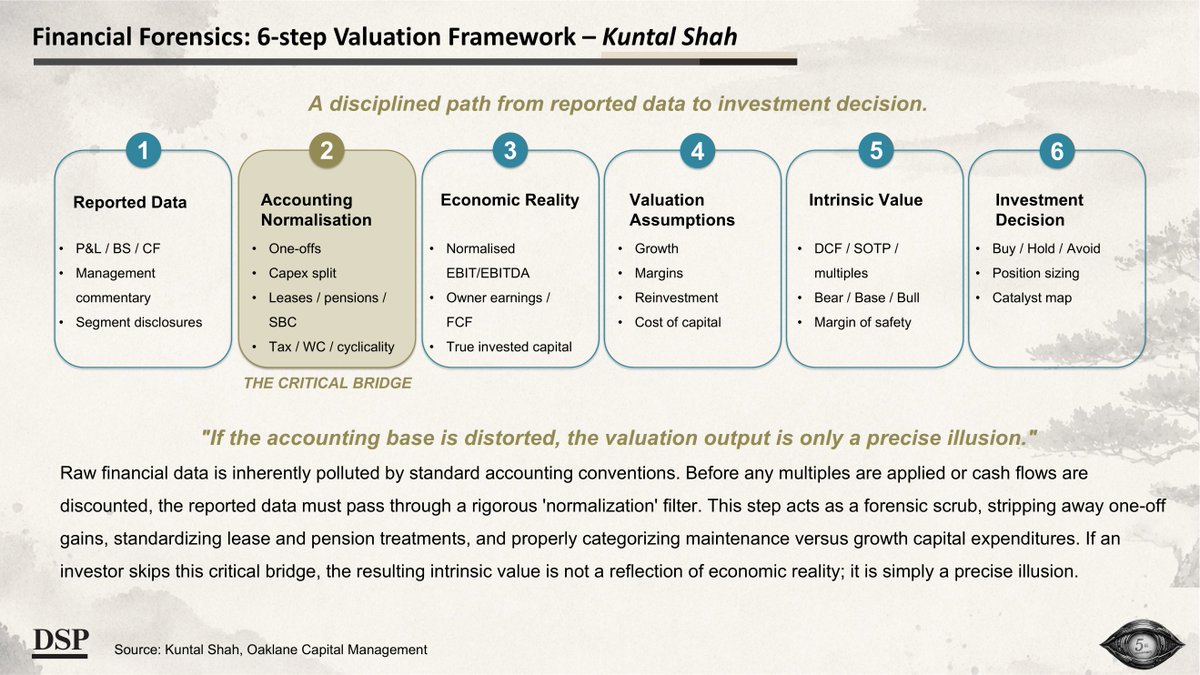
Financial Forensics:
6-step Valuation Framework of Kuntal Shah, Founding Partner, Oaklane Capital Management
In 5th Anniversary Edition of DSP Netra- Process Knowledge
"If the accounting base is distorted, the valuation output is only a precise illusion."- @Kuntalhshah
Not every profitable business is great. Some earn well for a few years, others for decades. 📈📉
The difference?
A moat - The durable competitive advantage that defends profits, market share, and compounding potential over time.
More than half the S&P 500's total value is now in stocks priced above 10x sales. This was once considered an outlandish valuation, as it leaves little room for error. The list includes Nvidia, Apple, GOOG, MSFT, Broadcom, Tesla, Micron, Eli Lilly, AMD, Oracle, and 57 more.
"Markets have a way of finding your weakest personal trait and exploit it against you."
Borrowing from history, I am reminded of Scott McNealy, CEO of Sun Microsystems (Bloomberg Interview in 2002), and I quote:
"Two years ago, we were selling at 10 times revenues when we were at $64....At 10 times revenues, to give you a 10-year payback, I have to pay you 100% of revenues for 10 straight years in dividends ...That assumes I have zero cost of goods sold, which is very hard ... That assumes zero expenses...pay no taxes... Now, having done that, would any of you like to buy my stock at $64?
Do you realize how ridiculous those basic assumptions are? You don't need any transparency. You don't need any footnotes. What were you thinking? "
Most people believe the biggest risk in markets is picking the wrong stock. Kuntal Shah, after three decades, believes the opposite. The wrong stock rarely ruins you. The wrong structure quietly does.
Some interesting compilation by @SahilKapoor, @dspmf, @KalpenParekh
https://t.co/Z6c6l1ITiR
This report will help the reader learn:
How to value stocks
How to value bonds
How to value currencies
How to value Gold and Silver
How to value credits
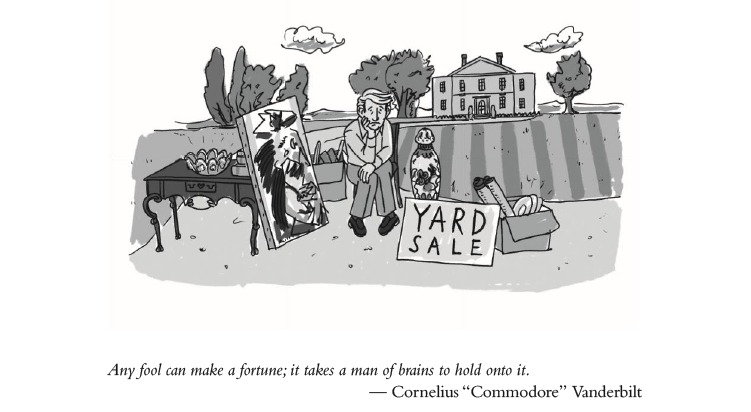
Cornelius "Commodore" Vanderbilt, the 19th-century baron, was a pioneer of railroads in his time, and when Vanderbilt died in 1877, he was the wealthiest man in the world.
His eldest son, Billy, received an inheritance of one hundred million dollars— 95% of Cornelius' fortune. Unfortunately, it came without even the most basic of instructions on how to invest and spend this wealth over time.
Within decades of the Commodore's death, the family wealth was largely dissipated. Today, not one Vanderbilt descendant can trace his or her wealth to the vast fortune Cornelius bequeathed.
If the Vanderbilt heirs had invested their wealth in a boring but diversified portfolio of US companies, spent 2% of their wealth each year, and paid their taxes, each one living today would still have a fortune of more than five billion dollars.
What went wrong?
Read the book and plan your succession and enable your family to manage wealth after you.
@adnahar for the book recommendation.
More on the same: https://t.co/DMgfGSnQ9W