With DracoGPT, Will Wang shows how to extract and model visualization design preferences from generative AI systems — enabling new ways to quantify, evaluate, and efficiently reuse LLM-based chart recommendations. #ieeevis https://t.co/Z4c6vbNAkE
Congratulations to IDL alum @domoritz for winning a VGTC Significant New Researcher award!! A premier honor for early career researchers in visualization!
@CasazzaNY@edublancas@duckdb Mosaic provides a number of optimizations beyond simply querying DuckDB, some of which can provide orders of magnitude performance improvements over naive queries. For more see https://t.co/XclnA9VU8K
@trevmanz@ProjectJupyter@duckdb@motherduck These are the types of portable (notebook/web/etc) applications we are hoping to foster with Mosaic! Components like these can then also interoperate via linked selections with other Mosaic-based plots and dashboards.
Chaining LLM calls can improve output quality, but navigating the massive space of task decompositions is challenging. Revisiting the established field of crowdsourcing, we distill strategies for effective LLM chain design and identify opportunities for future research. [1/11]
“Can we get a new text analysis tool?”
“No—we have Topic Model at home”
Topic Model at home: outputs vague keywords; needs constant parameter fiddling🫠
Is there a better way? We introduce LLooM, a concept induction tool to explore text data in terms of interpretable concepts🧵
The Vega Project is happy to announce the release of version 5.3.0 of the Vega-Altair Python visualization library. This release has been 4 months in the making and includes enhancements, fixes, and documentation improvements from 11 contributors. Highlights in 🧵
Observable Framework 1.3 🆕 integrates @uwdata’s Mosaic vgplot, which can concisely expressive performant coordinated views of millions of data points. https://t.co/cHpTIDVHFj
Chaining LLMs together to overcome LLM errors is an emerging, yet challenging, technique. What can we learn from crowdsourcing, which has long dealt with the challenge of decomposing complex work? We delve into this question in our new preprint: https://t.co/g73CcVPq6m [1/9]
As a kid, #UWAllen@uwdata professor & alum Leilani Battle wanted to be a game developer. At @UW, instead of games, she immersed herself in data. She earned the 2023 @ieeevgtc Visualization Significant New Researcher Award for her work. #ThisIsUW#dataviz https://t.co/vE3enqYNz2
Join us in congratulating Dr. Leilani Battle for receiving the 2023 VGTC Visualization Significant New Researcher Award at #IEEEVIS. 🏆 👏 @leibatt is honored for her work showing how data exploration systems can slow down, confuse, bias, and even mislead analysts.
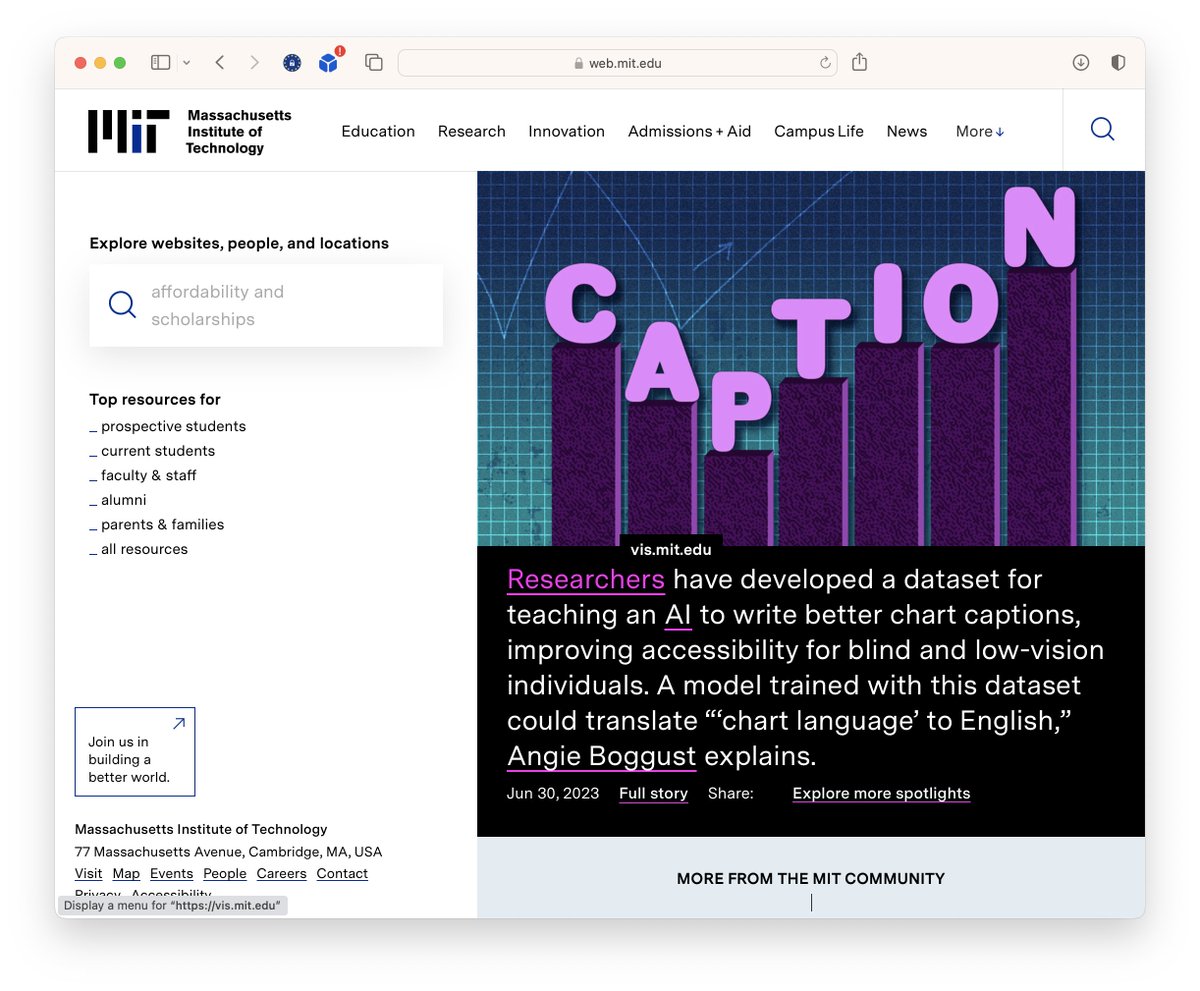
VisText has been a *ton* of work, and 2 yrs of solid effort. So it's exciting to (finally!) be able to talk about it, and it's gratifying to see it featured on @MIT's homepage.
Lead author, @bennyjtang, has a great thread w/details below 👇
And I wanted to offer a few thoughts
Mosaic looks really great! Great to see a viz library thread down to the db level. DuckDB is such a natural choice for something like this.
https://t.co/KtwIDTtFD7







![MadeleineGrunde's tweet photo. Chaining LLMs together to overcome LLM errors is an emerging, yet challenging, technique. What can we learn from crowdsourcing, which has long dealt with the challenge of decomposing complex work? We delve into this question in our new preprint: https://t.co/g73CcVPq6m [1/9] https://t.co/JK97tfSsHV](https://pbs.twimg.com/media/GB4kIVhbYAAcPMa.jpg)