@pootlepress Excellent work, many thanks for that – I hope you get the recognition you deserve!
How much longer will ‘official WordPress’ be able to ignore these needs and opportunities at the same time?
Today AI Video stops being slop.
Introducing Wondercraft Video, an AI video studio built for real work.
Create explainer videos, trainings, product launches, ads, and more by describing what you want.
RT and comment “WONDA” and I’ll DM you 1,000 free credits.
𝗜𝗻𝘁𝗿𝗼𝗱𝘂𝗰𝗶𝗻𝗴 𝗧𝘄𝗶𝗻 — 𝘁𝗵𝗲 𝗔𝗜 𝗰𝗼𝗺𝗽𝗮𝗻𝘆 𝗯𝘂𝗶𝗹𝗱𝗲𝗿.
No setup. Secure. Infinitely scalable.
We just raised a $𝟭𝟬𝗠 𝘀𝗲𝗲𝗱.
After a beta with 𝟭𝟬𝟬,𝟬𝟬𝟬+ 𝗮𝗴𝗲𝗻𝘁𝘀 𝗱𝗲𝗽𝗹𝗼𝘆𝗲𝗱, we’re now opening to everyone.
RT and comment “Twin” — first agents on us. 👇
i trained a custom GPT to generate unlimited video ideas...
how it works:
> you share voice message of your idea
> specifically trained to not give ideas for you or "replace your thinking"
> trained to give feedback based on things steve jobs, lee clow, and virgil abloh + other legends would say
it helps me take any idea from 50-100
reply "idea" + RT and ill send it over (must be following so i can dm)
You know how some people seem to have a magic touch with LLMs? They get incredible, nuanced results while everyone else gets generic junk.
The common wisdom is that this is a technical skill. A list of secret hacks, keywords, and formulas you have to learn.
But a new paper suggests this isn't the main thing.
The skill that makes you great at working with AI isn't technical. It's social.
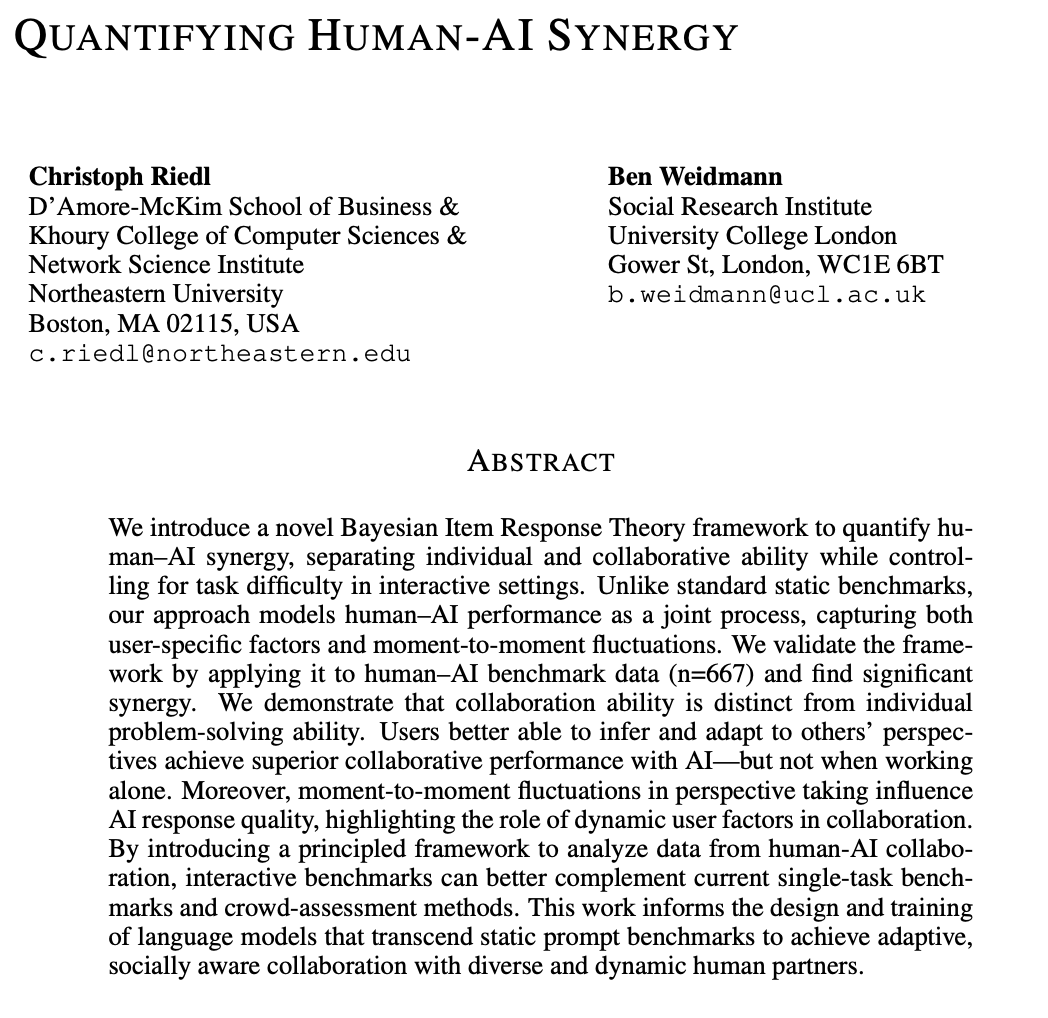
Researchers (Riedl & Weidmann) analyzed how 600+ people solved problems alone vs. with an AI.
They used a statistical method to isolate two different things for each person:
Their 'solo problem-solving ability'
Their 'AI collaboration ability'
Here's the reveal: The two skills are NOT the same.
Being a genius who can solve problems in your own head is a totally different, measurable skill from being great at solving problems with an AI partner.
Plot twist: The two abilities are barely correlated.
So what IS this 'collaboration ability'?
It's strongly predicted by a person's Theory of Mind (ToM)—your capacity to intuitively model another agent's beliefs, goals, and perspective.
To anticipate what they know, what they don't, and what they need.
In practice, this looks like:
Anticipating the AI's potential confusion
Providing helpful context it's missing
Clarifying your own goals ("Explain this like I'm 15")
Treating the AI like a (somewhat weird, alien) partner, not a vending machine.
This is where it gets strange.
A user's ToM score predicted their success when working WITH the AI...
...but had ZERO correlation with their success when working ALONE.
It's a pure collaborative skill.
It goes deeper. This isn't just a static trait.
The researchers found that even moment-to-moment fluctuations in a user's ToM—like when they put more effort into perspective-taking on one specific prompt—led to higher-quality AI responses for that turn.
This changes everything about how we should approach getting better at using AI.
Stop memorizing prompt "hacks."
Start practicing cognitive empathy for a non-human mind.
Try this experiment. Next time you get a bad AI response, don't just rephrase the command. Stop and ask:
"What false assumption is the AI making right now?"
"What critical context am I taking for granted that it doesn't have?"
Your job is to be the bridge.
This also means we're probably benchmarking AI all wrong.
The race for the highest score on a static test (MMLU, etc.) is optimizing for the wrong thing. It's like judging a point guard only on their free-throw percentage.
The real test of an AI's value isn't its solo intelligence. It's its collaborative uplift.
How much smarter does it make the human-AI team? That's the number that matters.
This paper gives us a way to finally measure it.
I'm still processing the implications. The whole thing is a masterclass in thinking clearly about what we're actually doing when we talk to these models.
Paper: "Quantifying Human-AI Synergy" by Christoph Riedl & Ben Weidmann, 2025.