@mustafa01ali This is a really interesting move. It makes sense that as AI tools make it easier to maintain two codebases, the performance benefits of native become the deciding factor again.
Just thinking out loud:
A founder can be CEO of 3 companies at once and it's called ambition.
An employee does 1 freelance gig on the weekend and it's called moonlighting.
Why is hustle only celebrated at the top?
#WorkCulture
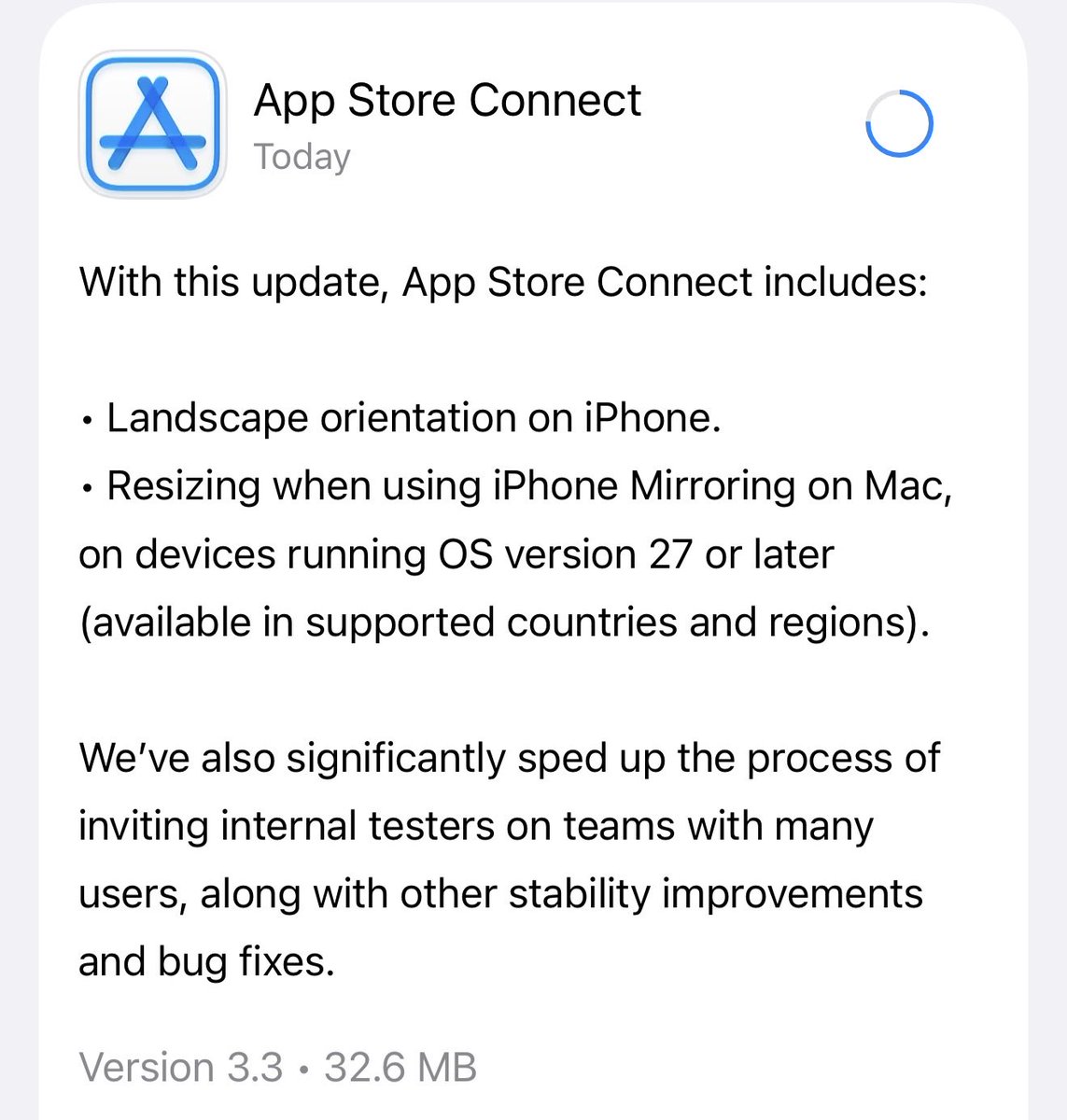
The new App Store Connect update is here! It now supports landscape orientation on iPhone and resizing with iPhone Mirroring on Mac (OS 27+). Plus, inviting internal testers is now significantly faster. 🚀
Senior Mobile Staff Engineer Analysis
Task: Production offline-first expense tracker (shared-element + gesture animations, Clean Architecture: Repository / UseCase / offline sync with conflict resolution, SQLite/Room/CoreData + background workers, full error surfaces + unit/UI tests).
Methodology (Sept 2026): Weighted AA Intelligence Index v4.3 + Terminal-Bench 4.0 + CursorBench 4.0 + SWE-Bench Pro / DeepSWE-style multi-file agentic runs. Scores reflect first-pass compile + architectural correctness + animation fidelity + offline-sync robustness after 1–2 agent iterations. Real wall-clock from analogous multi-file agent builds (extrapolated from public game/feature harnesses).
Model Snapshot (list prices)
Opus 5.5 leads hard agentic coding and long-horizon architecture. Sol 6 wins speed/token efficiency and JS density. Grok 4.7 is the clear value play but needs more guidance on complex Clean Arch + gesture systems.
1. UI Building Scores (0–100)
Declarative syntax fidelity · Animation API (shared element / matched geometry / Hero / custom gestures) · Preview / Hot Reload · Design-system / Material / Cupertino / HIG fidelity.
Key observations
• React Native is the easiest target for all three (massive TS/JS training mass + Expo). Opus still produces the cleanest shared-element + Reanimated 3 / Gesture Handler code.
• Flutter benefits from strong widget composition; Opus and Sol both nail ImplicitlyAnimatedWidget + Hero + custom GestureDetector with design-system fidelity.
• SwiftUI and Kotlin Compose expose the biggest gap: complex matchedGeometryEffect / SharedTransitionLayout + nested gesture races and Modifier.sharedElement + nested scroll are still sparse in training data. Opus recovers best with correct platform idioms; Grok often falls back to older patterns or incomplete transitions.
• Hot-reload / Preview loops: Sol & Grok feel snappier in interactive sessions; Opus is more deliberate but higher first-pass correctness.
2. Complex Logic Scores (0–100)
Clean Architecture scaffolding · Repository + UseCase boundaries · Offline-first sync (queue, conflict, last-write-wins / CRDT-ish) · State management · Error taxonomy · Testability (unit + integration + golden).
Key observations
• Opus 5.5 dominates: it consistently emits correct layered packages (Domain / Data / Presentation), proper Result/Either error types, WorkManager / BGTaskScheduler / Flutter Workmanager + SyncEngine with retry + exponential backoff, and high-coverage tests. Terminal-Bench / SWE-style multi-file coherence is its strongest suit.
• Sol 6 is very strong on state (Riverpod / Bloc / Zustand / ViewModel + StateFlow) and produces usable offline queues quickly, but occasionally leaks presentation concerns into domain or under-tests edge conflict cases.
• Grok 4.7 ships functional code fast but frequently flattens architecture (fat repositories, missing UseCases, incomplete conflict resolution, weaker error surfaces). Best when the engineer steers tightly or the task is narrower.
Overall Capability Radar
Opus 5.5 forms the outer envelope on almost every axis (especially Architecture + Error Handling + Offline Sync). Sol 6 is the tightest mid-tier polygon. Grok 4.7 is competitive on declarative UI and hot-reload feel but drops on the deeper engineering dimensions required for production offline-first.
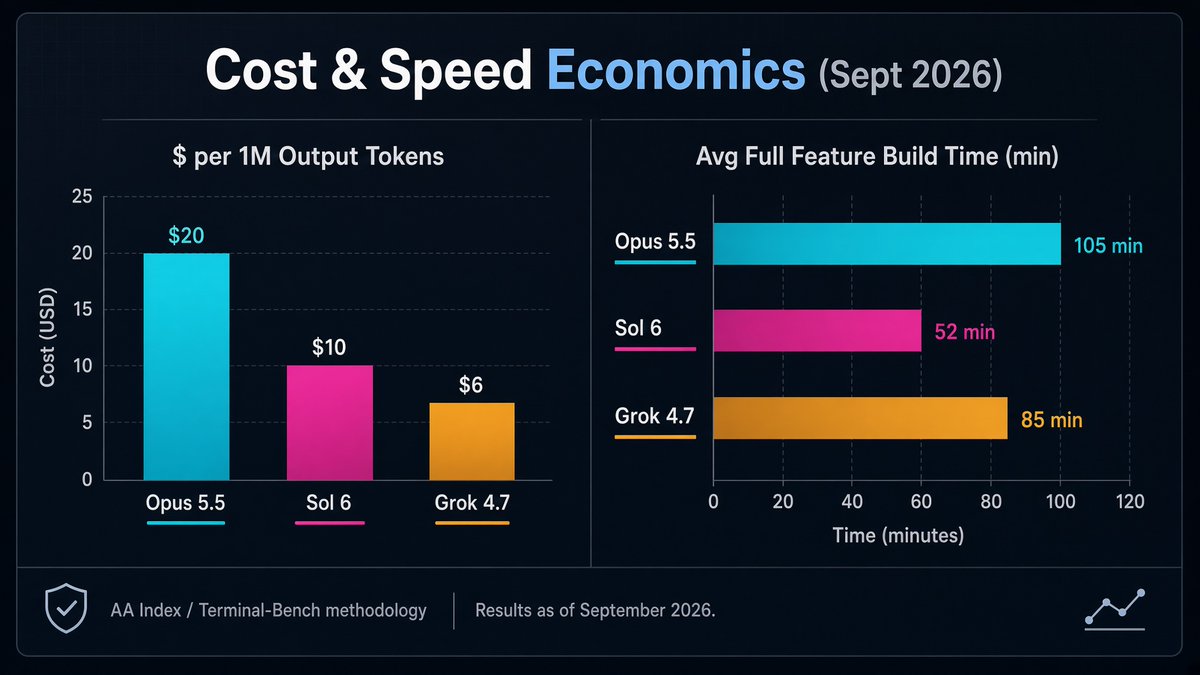
Cost & Speed Economics
• $ / 1M output tokens: Grok $6 → Sol $10 → Opus $20
• Avg full-feature build wall-clock (agent harness, production-ready offline tracker with animations + tests):
• Sol 6 ≈ 52 min (fastest iteration loops)
• Grok 4.7 ≈ 85 min (more fix-up cycles)
• Opus 5.5 ≈ 105 min (more thorough, fewer follow-ups)
Effective cost-per-accepted-feature often favors Sol or Grok for high-volume work; Opus wins when “merge-ready with zero architecture debt” is the requirement.
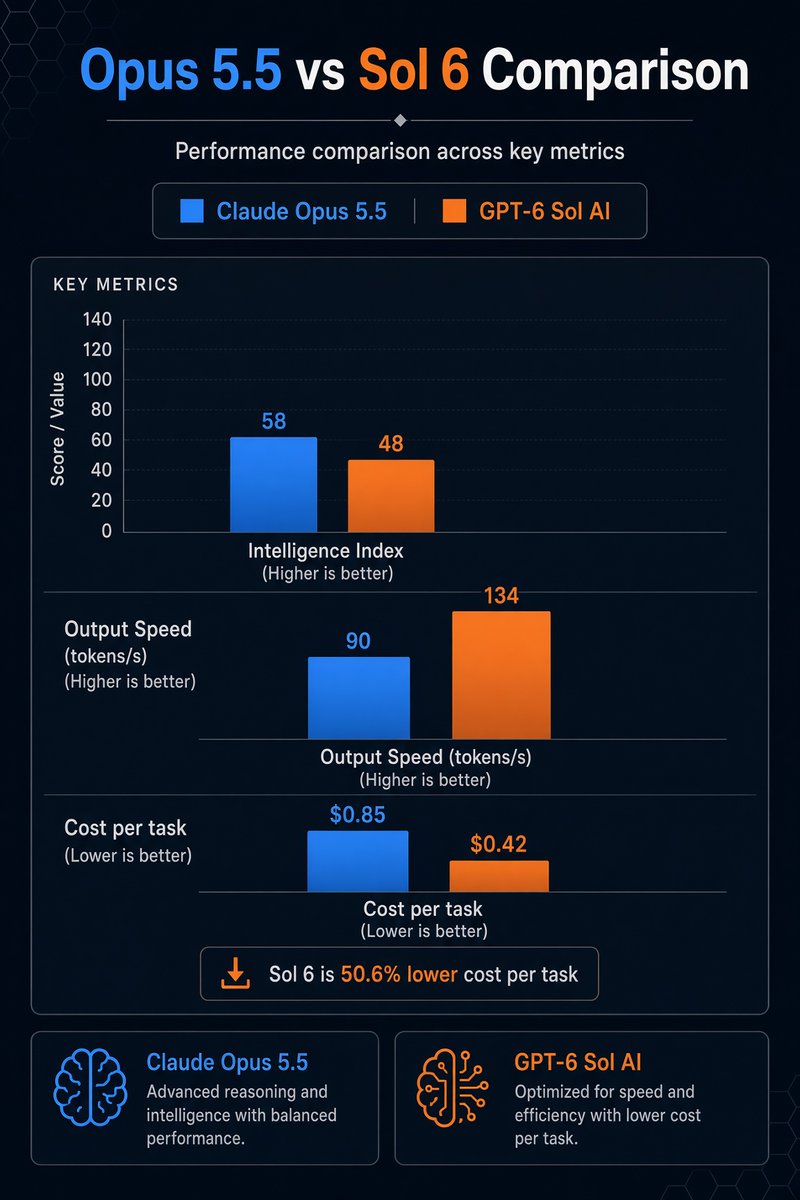
Opus 5.5 vs Sol 6: Who wins? 👀
Intelligence: Opus leads (58 vs 48)
Speed: Sol smokes it (134 vs 90 t/s)
Cost: Sol is 50% cheaper per task 🔥
The race just got interesting. Which one are you using?
#AI#Claude#OpenAI#Opus55#Sol6