While I understand your point banning of insecticides have reduced suicide rates in many countries around the world. But your point stands though. Just an addendum
While I understand your point banning of insecticides have reduced suicide rates in many countries around the world. But your point stands though. Just an addendum
This is why humanities and social sciences are incredibly important.
In 2019, UNIBEN banned sniper in response to high suicide rates; not much later, someone jumped off a building.
My kid: Daddy, why did you left me?
Me: it’s leave …”Daddy why did you leave me?”
Kid: okay. Daddy why did you leave me?
Me: But I didn’t leave you nau
Kid: You leave me
How do I explain to him that it’s “left” this time
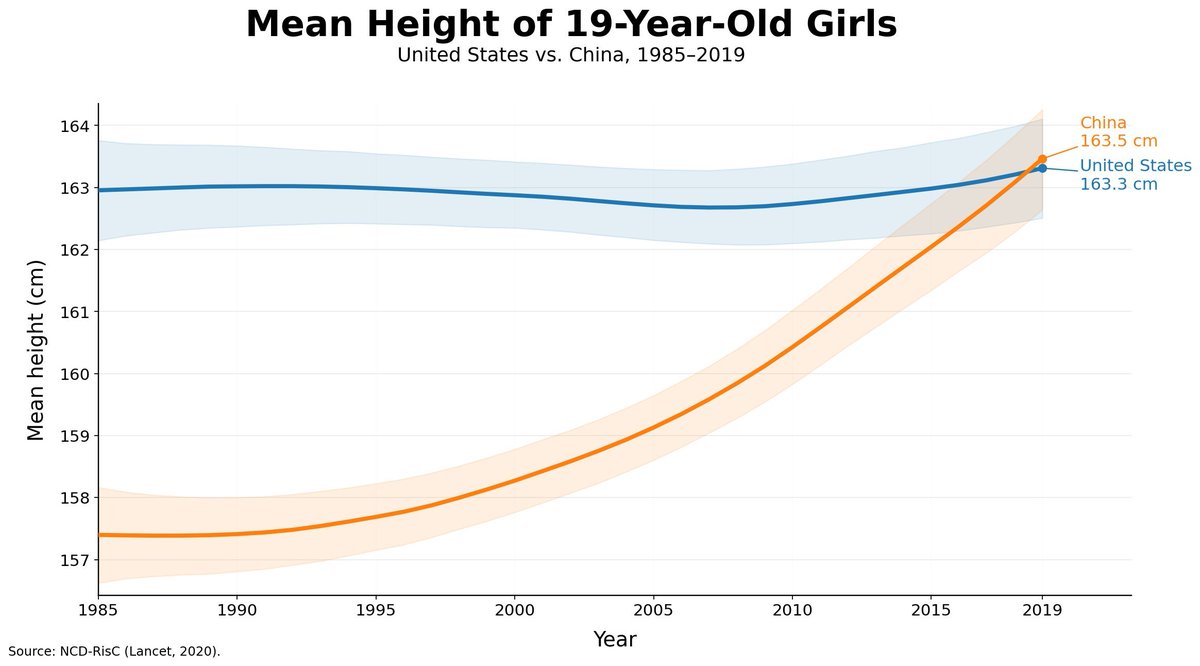
@KwesiVirgins Chinese are growing taller now. Go and check the height of Chinese now. Poor nutrition which stunts growth also affects intelligence. You are the olodo here.
BEING SHY RUINS YOUR LIFE
You’re losing opportunities. Wasting potential. Low on energy. No drive. Lacking courage. Living in fear. Fix it. Stop caring about other people’s opinions. Get what you want. Be unapologetic. Don’t ask for permission. Get angry about your life. Start fulfilling your mission. Pursue your goals. Focus on your interests. Confidence will become part of who you are.
Shyness doesn’t decrease with age.
It fades with experience.
The more you master yourself, which is one of the hardest things in life - the more confident you become, and your shyness disappears.
It comes from childhood, where you were taught to always be polite, but that’s not how the real world works.
A Cornell researcher handed a student a bright yellow Barry Manilow t-shirt, walked him into a room full of strangers, and asked him to guess how many would notice. The student figured about half the room. The real number was closer to one in four.
That experiment, run by psychologist Tom Gilovich in 1996 and published in 2000, has a name now: the spotlight effect. People walk around feeling like a spotlight is following them. It mostly isn't. The students in the embarrassing shirt had pictured an audience twice the size of the real one.
Gilovich thought the embarrassment was the reason, so he ran the test again with shirts students were happy to wear, faces like Bob Marley or Jerry Seinfeld. Same overestimate. The wearers again guessed half the room would remember, but fewer than one in ten actually did. Proud or embarrassed, you assume people are watching who simply aren't.
The nerves work the same way. In a 2003 study, Gilovich and Kenneth Savitsky had people give surprise speeches, then rate how obvious their panic looked. The speakers were sure they came across as a wreck. The audience mostly saw someone calm. Your racing heart, your sweaty hands, the words you're sure are falling apart, almost none of it leaks out at the volume you feel it.
The same team then ran one more version on the nervous speakers. Before they went up, one group was told a single fact: audiences can't read your anxiety as well as you expect. That group gave noticeably better speeches. Not just by their own rating. Independent judges who never heard the tip scored them higher too. Knowing the spotlight is dimmer than it feels made people perform better.
The strangers who do glance over probably like you more than you'd guess. A 2018 study across four universities found that after a conversation, people consistently underestimate how much the other person enjoyed it. The cause is almost funny: you get so busy judging your own performance that you miss the friendly looks coming back at you. Among new dorm roommates, that gap ran from September all the way to February before it finally closed.
So the math of eating alone is on your side. The room is giving you about half the attention you're bracing for, it can't see the nerves you're sure are showing, and the few who do look over are quietly on your side. The spotlight exists. It's just aimed somewhere other than you.
Millennials, it's time to choose your midife crisis
1. Date a 23 year old
2. Quit drinking and become insufferable about it
3. Double down on drinking
4. Train for a marathon nobody asked about
5. Have a panic baby (with wife you hate)
6. "We're opening the relationship" (she bangs)
7. Get divorced
8. Get diagnosed with adult ADHD/autism
9. Niche side quests like rock climbing, hyrox, gardening, handstands
Alan Turing was 41 when he died. Two years earlier, the country he helped win the Second World War put him on trial for being gay, then gave him a choice: go to prison, or take hormone injections that would chemically castrate him. He chose the injections. And in those same final years, he was quietly working out the math behind how a tiger gets its stripes.
Start with the war. At Bletchley Park, Britain's secret codebreaking base, Turing led the team that cracked Enigma, the machine the German navy used to scramble its messages so no one else could read them. He built his own machine, the Bombe, to crack the code faster than a room full of people ever could. That work, some historians think, shortened the war by two years. It may have saved as many as 14 million lives. Then in 1950 he wrote a paper built around one question: "Can machines think?" He even laid out a way to test it. We call it the Turing test today, and every chatbot you have ever used goes back to that page.
He did all of this in secret, and the country he saved never knew. In 1952 the police found out he was gay, and back then that was a crime in Britain. He was convicted, lost his security clearance, and was put on the injections. That same year, he published a paper showing how two chemicals, spreading and reacting across a surface, can cover it in spots, stripes, and swirls all on their own. It started a whole new field: using math to explain how living things grow. A codebreaker had just handed science the rules for how nature makes its patterns.
He was still working on that puzzle when he died in 1954. He was 41. Ten more years would have taken him to 51, in 1964, right as the first working computers were being built and the field he imagined was taking off.
He never got to see any of it. The patterns he predicted on paper were not proven in a lab until 1990, 36 years after he died. It took the British government until 2009 to say sorry, and 2013 to pardon him. In 2021 his face went on the 50-pound note, with a sunflower on the back, a nod to the pattern work he never finished.
Turing asked "Can machines think?" in 1950. The field built on that question got its name, artificial intelligence, at a meeting in 1956. By then he had been dead for two years. He never heard the words. The machine he dreamed up now sits in your pocket, and it answers when you talk to it.