AI Spec-Driven Development is like teenage sex. Everyone talks about it. Nobody really knows how to do it properly. Everyone thinks everyone else is doing it. So everyone claims they are doing it.
You guys are doing it right?
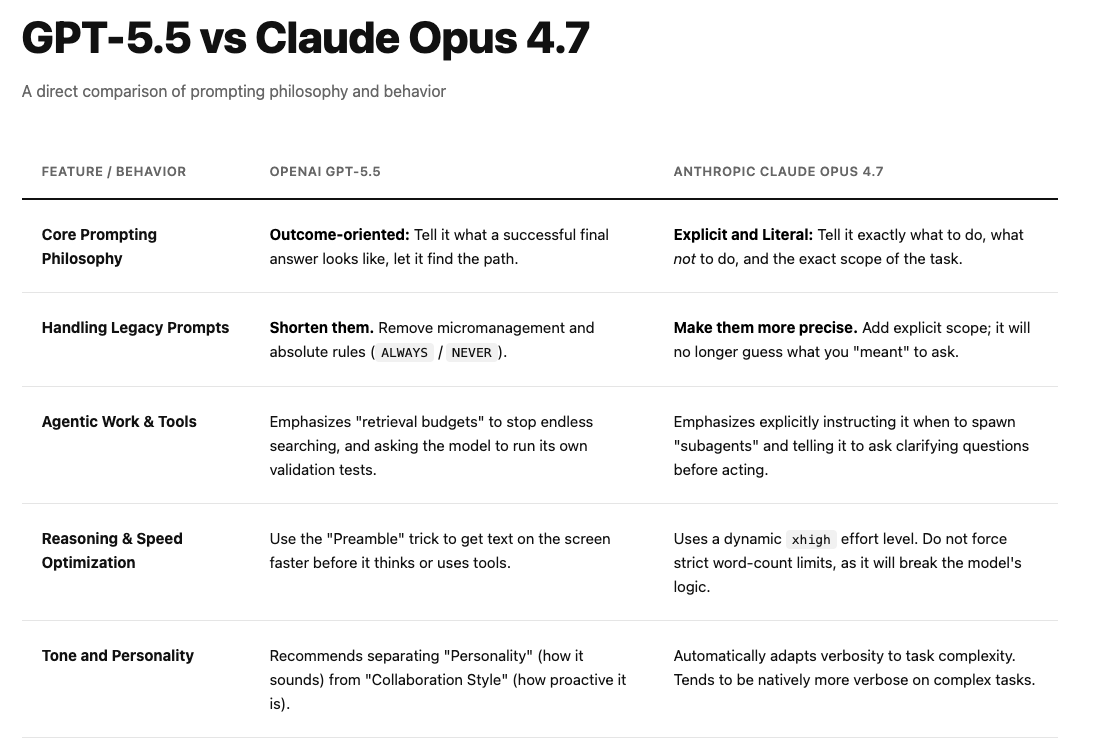
Opus 4.7-optimized prompt with GPT-5.5 model will interpret the hyper-specific, step-by-step constraints as restrictive micromanagement. It will narrow its search space, slow down, and likely produce an overly mechanical answer because you didn't leave it room to find its own efficient path.
If you use a GPT-5.5-optimized prompt with Opus 4.7 model will look at the broad, outcome-oriented instructions and take them completely literally. Because you didn't explicitly define the boundaries, negative constraints, or step-by-step scope, Opus 4.7 will likely give you the bare minimum of exactly what you asked for, entirely missing the unspoken nuances you actually wanted.
Fun time to be in Multi-LLM agentic harness business. If this deviation will continue we will need to have model specific prompt adaptors and/or small LLM which rewrites prompts to the target LLMs
I was reading Opus 4.7 and GPT 5.5 prompting guides and very curious about the different path which they took.
Opus 4.7 wants no-magic, tell it exactly what to do, what not to do, and the exact scope of the task. Which is the reason it reduced calling extra tools if you didn't ask it to.
GPT-5.5. is the opposite, tell it what a successful final answer looks like and let it find the path. How would agentic harness behave if it's prompts are optimised for one or another?
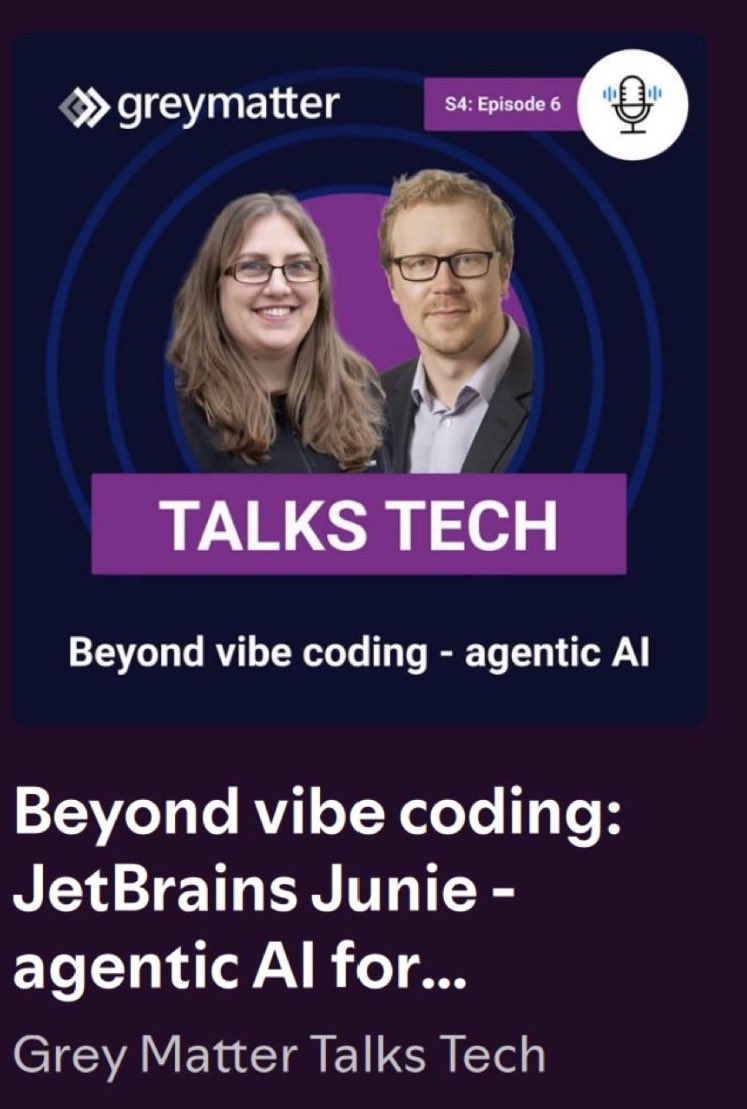
Had a pleasure to do a podcast with Leanne Bevan from Grey Matter
Discussed Agentic AI Development, Jetbrains and of course Junie
Apple Podcast
https://t.co/lB0nL41Vg7
Spotify
https://t.co/mXhJtncNAk
AI agents are not a substitute for bad engineering practices.
AI agenting development is an amplifier. More generated code shifts the bottleneck to code reviews and testing.
If your team somehow survived without proper engineering, it will not be able to keep doing the same in our AI-assisted development times. Not only context engineering is important. Engineering practices need to be back in fashion - unit tests, code coverage requirements, auto-tests, auto-builds, etc.
Here is my engineering maturity list tiers
Junie CLI by @JetBrains now works with OpenRouter 🧩
Connect your OpenRouter API key and use any supported model — with automatic provider failover and centralized billing.
Junie with Gemini is 10x cheaper than Claude Code
Junie scores on-par result to Claude Code on Opus 4.6 on swe-rebench from @nebiusai
Cost per task was under 0.3$ compared to 3.5$
Details on https://t.co/yyN7oYeB4p
Junie ranked top on SWERebench using Gemini 3 Flash, spending ~10x fewer tokens than other agents while maintaining high performance.
We’re offering free access to Gemini 3 Flash for one week, until next Monday.
Try it out and let us know what you think: https://t.co/aRCPZdrvMI
@xlab_os@jetbrains Kimi will come for sure. Maybe open source will come in the future too.
Anyway, on this launch week Gemini Flash model is free (courtesy of Google) so please check it out