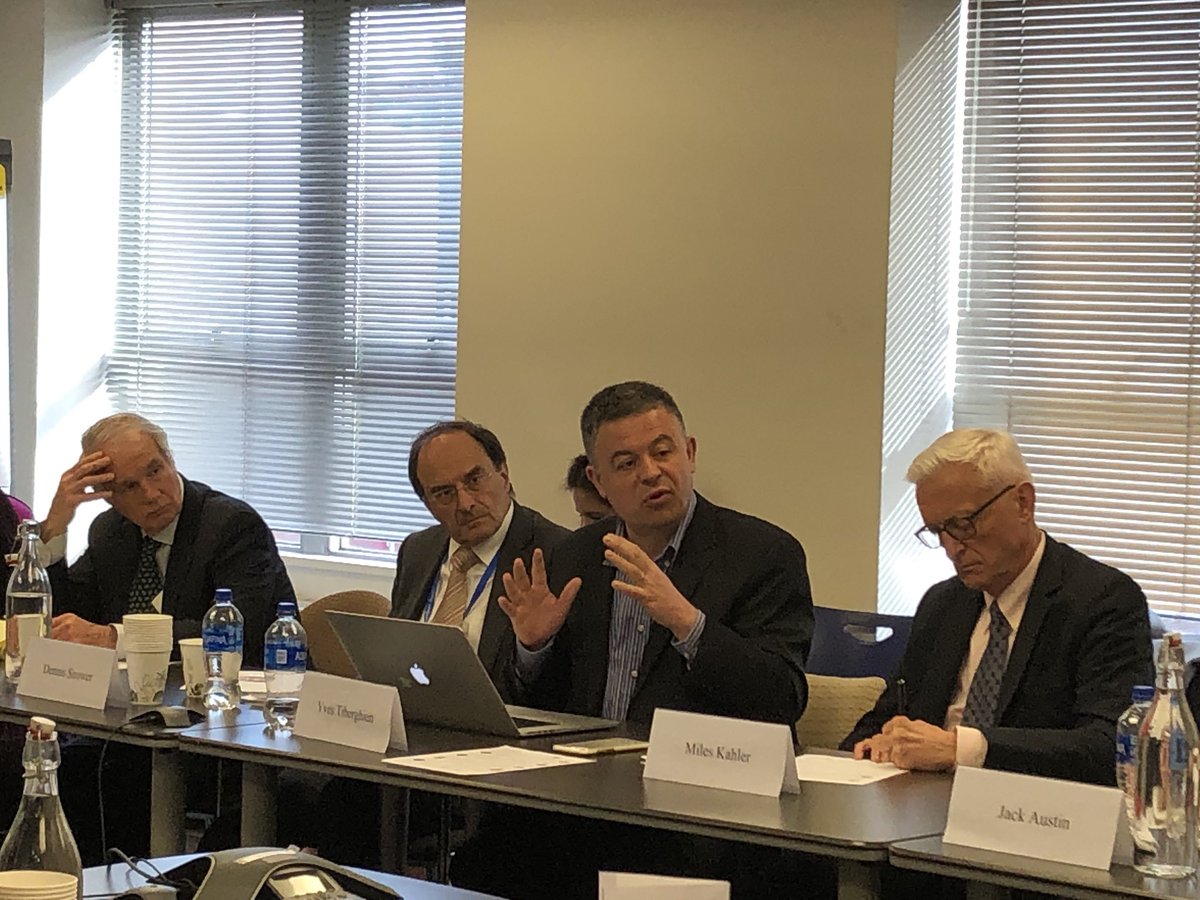
Annual Global Summit addressing #G20 role in future of #GlobalGovernance#SDGs @BrookingsInst @UBC @MunkSchool V20 3.0 - April 18-19, 2018 - Washington, DC
Last month, @CentennialEDU gave me the opportunity to go to Berlin and cover the @glob_solutions summit where German Chancellor Angela Merkel spoke about the future of Europe-Africa relations. Read my piece on @TorontoObserver 👉 https://t.co/yGKkv1fHM8 @centennialjourn
Congratulations to UBC students, Alexandra Martin, Katja Sluga & Natascha Schoepl for their appointments as VISION20 Fellows! Read about their time at the 2019 Brookings-VISION20 Workshop, “Beyond Neoliberalism in Emerging Markets”, held on April 10th: https://t.co/1vWdh9dydR
Fascinating presentation and discussion at the WTO, currently ground zero of the contest for global governance of trade - in the midst of its art work and peaceful space @UBCPoliSci@AsiaPacificFdn@ubcSPPGA@v20summit
@Yves_Global: On the current debate between ‘rational pragmatism’ and ‘now-liberalism’ echoing the debate between the East Asian miracle and and neo-liberalism. “In China there is a name for it, 实事求是, “seek truth from facts”.” Policy models must interact with reality.
@DJSnower asks: “How do we cultivate the formation of trans-national identities to grow societal investment in trans-national issues?” Breaking down the ‘us’ versus ‘them’ mentality is critical to effectively addressing issues that affect the global commons.
Is “Radical pragmatism” the alternative approach to neo-liberalism? Geoffrey Gertz discusses how states versus markets distinction is not helpful in understanding what comes next. How do we integrate both state-led and market-led institutions into this new model?
@Yves_Global: “Has [the G20] been able to touch on some of the key issues such as climate change to make warmer progress, or is the G20 mostly progressing by avoiding the big issues and focusing on the technical areas where the big powers don’t fight?”
“SMEs are the engines of growth in Asia, but they struggle to gather money from banks. We must gather alternative financing options for funding these drivers.”
@laurajaitman: “In the G20 we have all of the communications and discussions and papers, but building and enhancing these relationships between the governments and institutions and people are what is key.”
Live Now: Where is global governance headed next, and what form will this take? Home Karas chairs the discussion as @v20summit and @BrookingsInst host the “After Neo-liberalism” Workshop.
How do we shift the framing away from “strategic cooperation” to that of “strategic engagement”. Recalling the phrase, “global problems require global solutions”, how do we reach that level of dialogue?
“Is the proposal that we wait for the US and China to learn to get along? That is not the way. There has to be a series of escalations of cooperations between institutions that already exist today to build a message of cooperation.”
“From China’s position we ask 3 questions:
Whether/how to form a new pattern of power sharing with China?
How will regional mechanisms make those mechanisms more cooperative or pull us apart?
How would the new mechanisms of international cooperations evolve into multilateralism?”
By using an ill-defined term such as “the West”- that is so readily conceptually associated with the United States-do we create a self-fulfilling division internationally into American versus Chinese-led spheres?
“When we say we are thinking about China and the West we know China but what is the West. Right now we say the West and we mean the changing relationship between China and the US. I think this blurs the lines in a way that is misleading and dangerously self-fulfilling.”
“The last time we heard the word “Uncoupling” its was when we debated how to detach the third world from the Global North. We learned then that that was not the way forward. And I am concerned that we are hearing this phrase more and more again between China and the West.”
In defining this debate as the West vs. China we fail to answer where does Japan fit in? India? Does this binary framework serve the diversity of actors impacted by the rise of China?
On the Belt and Road Initiative: “The BRI is an opportunity to be constructive with China - to figure out ways of interest to China and China’s partner country and countries not identifying itself as partners to China”