Most people think they’re “private” because they use Monero or a VPN.
If your IP is exposed, the privacy is already broken before the blockchain even matters.
$ANyONe fixes the connection layer.
Hide you, not just the transaction.
#Monero#DePIN#Privacy#CyberSecurity#Crypto
@ethereum@thedaofund@Giveth when will privacy infrastructure become a standard part of the stack?
Wallets, RPCs, apps and L2s all leak metadata.
$ANyONe could be a piece of that puzzle.
Some of the most restricted corners of the internet are starting to find Anyone.
🇮🇷 Iran monthly active users up nearly 40x
🇦🇪 UAE monthly active user base up over 5x
����🇧 UK active user base up 50% over 8 days
This is the use case. The VPN for ANYONE facing censorship.
🔹 https://t.co/yZ3F0fLQu9
All signs suggest that the era of a free and open Internet may be coming to an end.
Around the world, governments are introducing new regulations affecting social media platforms, VPNs, encryption, online speech, and data flows. Some measures are aimed at security and combating misinformation; others raise concerns about #privacy, censorship, and digital freedom.
We may be moving toward a world where internet access and online rights vary significantly depending on where you live. Instead of one global Internet, we could see a more fragmented digital landscape with different rules, restrictions, and levels of access across countries.
As governments and centralized entities gain increasing control over the digital landscape, protecting internet freedom may depend not only on policy debates, but also on the technologies we choose to build and adopt.
Decentralized privacy networks such as ANyONe Protocol (@AnyoneFDN) represent one approach to preserving privacy, open access, and censorship resistance through community-powered infrastructure designed to keep communication and information flows open in an increasingly fragmented online world.
The future of online privacy will not be shaped only by those who regulate it, but by those who build the alternatives that preserve it.
https://t.co/OGY3hfbPw7
$ANYONE #VPN #onionrouting #DePIN #InternetFreedom #Decentralization #CensorshipResistance
@ethereum@torproject Tor proved the world needs privacy.
The next challenge is making it fast, scalable and easy enough for billions to use.
That’s where $ANyONe gets interesting.
If you're worried about a potential VPN ban (and given what we've seen so far, we all should be) - get the right software downloaded ahead of time.
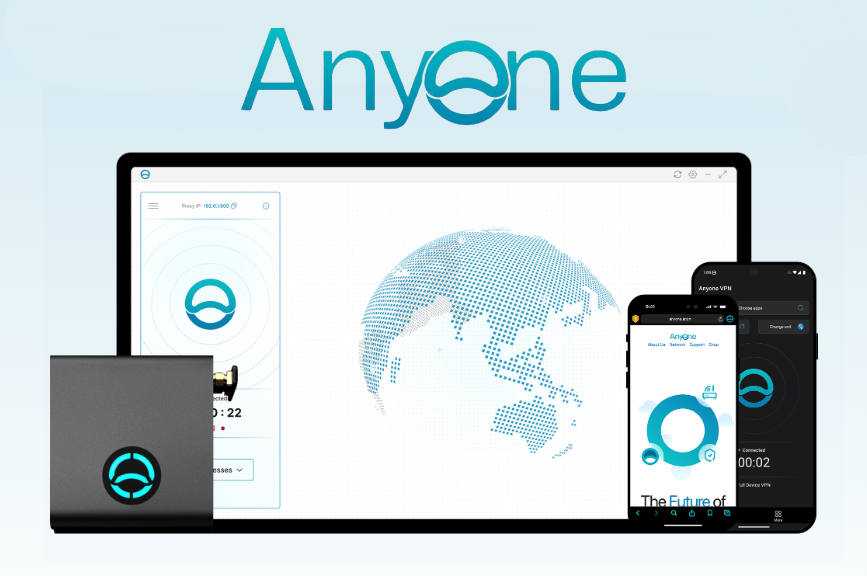
The @AnyoneFDN client bypasses traditional VPN checks as it's an onion routing proxy network. Access sites with more privacy than any VPN with the client!
🔹 https://t.co/6sNXzVEgjz
Promoted as a social media ban for children, but is really a mandatory ID-check for millions of adults.
If you're in the UK and value your privacy, the Anyone Network is the best solution to protect yourself: all traffic is routed over multiple hops around the world using onion routing.
No signup. No personal information. Completely free of charge.
Download our flagship apps for free, now:
🔹 Android: https://t.co/yZ3F0fLiEB
🔹 iOS: https://t.co/sDMjFWRyjR
Hidden Services: Building the private web on the ANyONe Protocol
The internet has been built around publicly visible servers and centralized infrastructure.
ANyONe Protocol (@AnyoneFDN) is helping create an alternative, where services can operate privately, users can connect anonymously, and both can communicate without relying on centralized infrastructure.
Why this matters
The internet publishes DNS records, exposes IP addresses, and reveals where applications are hosted. Hidden services change that model by abstracting infrastructure behind the network, enabling:
▫️ Privacy-first application design
▫️ Censorship-resistant publishing
▫️ Decentralized services
▫️ Community-run infrastructure
Privacy stops being a feature. It becomes a property of the network.
The human-readable .anyone domains
To make hidden services more accessible, ANyONe Protocol has introduced a privacy-preserving DNS system that maps human-readable .anyone domains to hidden services without revealing destination information.
Instead of sharing long cryptographic addresses, users can access memorable .anyone domains while preserving the anonymity and security guarantees of the network.
The goal is simple: make private services as easy to access as traditional websites while preserving anonymity end-to-end.
Beyond websites
Hidden services are not limited to web pages.
As the ecosystem matures, they can support a broad range of privacy-preserving applications, including:
▫️ Private APIs
▫️ Decentralized AI services
▫️ Anonymous messaging infrastructure
▫️ Secure developer tools
▫️ Self-hosted applications
▫️ Distributed file-sharing platforms
▫️ Community-operated communication networks
As .anyone domains, hidden-service tooling, privacy-preserving DNS, and decentralized hosting continue to mature, the network moves closer to its long-term vision:
A private internet where #privacy is the default, not an afterthought.
Check out this early example of a hidden website running on the ANyONe network:
Raw hidden-service address👇http://sovzswxhl3hfchhkle5hpr7pvv5gz5glhvgl5lnqw4vcllsfncmu7bad.anyone
Human-readable address 👇
http://vps-directory.anyone
$ANYONE #DePIN #VPN #HiddenServices #Decentralized #CensorshipResistance
$ZEC was dead for years before the market suddenly realized its true value.
The same story will happen again with $ANYONE (its current market cap is 1180x lower than Zcash)
@AnyoneFDN
The Anyone client and proxy enables popular ethereum:0xe76c6c83af64e4c60245d8c7de953df673a7a33d wallets to be used anonymously! From CLI-based Terminal wallet to point-and-click Railway.
The build continues, with the release of a new client, the Anyone hidden ecosystem and more in May. Find out the details in our development summary:
🔹 https://t.co/H20cK6KKB8
While the world accelerates adoption of personalized and agentic AI.
Less attention is being paid to the obvious, and hidden, privacy risks they create.
Anyone is the anonymity network that plugs directly into AI, the uncompromizing solution to a $20B problem.