A different kind of messenger. A different kind of network.
The way we communicate online is still largely dependent on centralized platforms, phone numbers and infrastructure controlled by third parties. But there is another way.
What if messaging didn't require your phone number, a central server or a company sitting between you and your conversations?
Meet AnonChat: a private, open-source #messenger built on Anyone Protocol, a decentralized #privacy network powered by independent, community-operated infrastructure.
Anyone Protocol provides the transport layer for AnonChat, routing communication through its community-operated relay network. AnonChat builds on this infrastructure, combining decentralized connectivity with modern, end-to-end encrypted messaging.
The result? Private communication that doesn't rely on a central server that could become a single point of control or failure.
Explore AnonChat:
https://t.co/erEYrxSn3g
AnonChat is an independent community project, created and maintained by an Anyone Protocol operator and community member. It is not an official Anyone Protocol product.
@AnyoneFDN $ANYONE #DePIN #opensource
AnonChat is getting stronger, and quieter in the background.
Powered by Anyone Protocol's hidden services, AnonChat continues to build toward more private, resilient, and reliable communication.
Our latest desktop releases focus on the fundamentals:
Security: Updated core components, stricter handling of unexpected data, and improved DNS leak protection for apps using the AnonChat proxy (provided by the Anyone network).
More reliable connections: Smarter retries and automatic recovery when contacts become temporarily unreachable.
Sleep & wake: AnonChat now detects when your computer wakes up, waits for the network to become available, and reconnects automatically.
Behind the scenes: Mailbox Swarms has reached an important milestone.
The mailbox peer, an always-on machine that securely holds sealed messages for contacts who are offline, is now built, tested and ready for phase 2.
The next step: bringing mailboxes directly into the app.
One more piece of the AnonChat ecosystem is coming together.
🌐 https://t.co/Psm0csqZ3F
AnonChat is not an official Anyone Protocol product. It was created and is maintained by an Anyone operator and community member.
@AnyoneFDN $ANYONE #Privacy #DePIN #opensource #messenger
@XMRVoid The Anyone Protocol fixes this @XMRVoid
Decentralized, open-source, and maintained by independent operators, rather than centralized infrastructure.
@AnyoneFDN
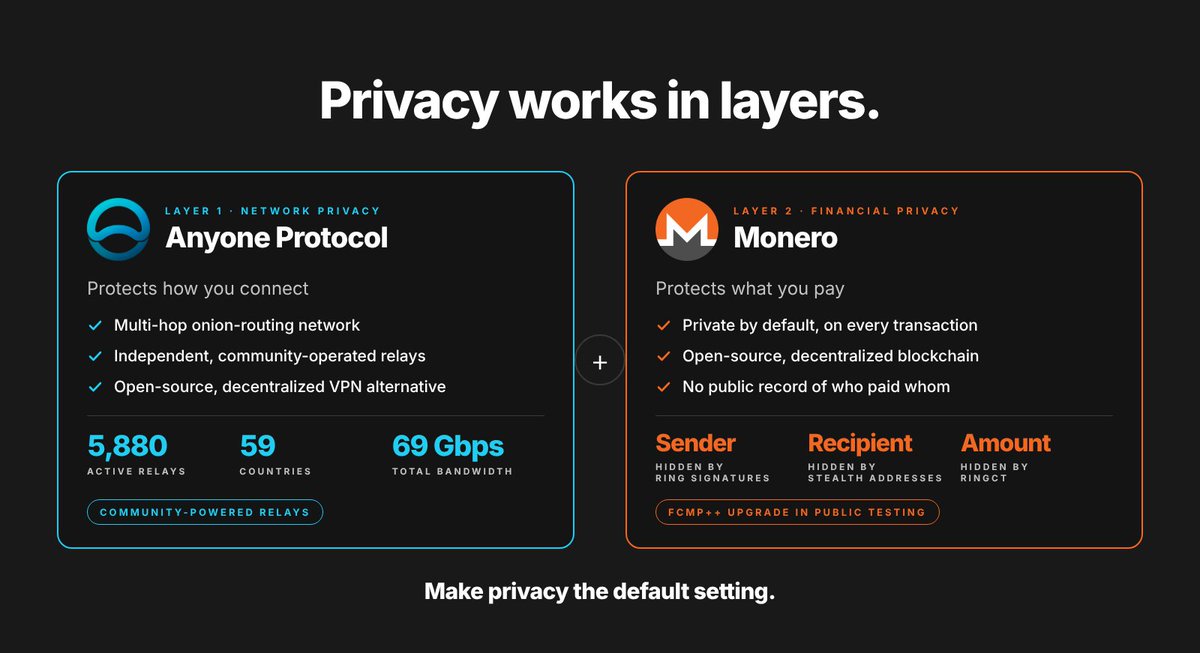
Privacy works in layers.
Personal data has become a valuable asset. Every online interaction can generate information about who we are, what we do, where we go, how we communicate, and how we manage our finances. Much of this information can be collected, analyzed, and shared by platforms, and other third parties.
This creates a broader privacy challenge: protecting our digital lives requires more than securing one type of information or activity. It requires protection at multiple levels, from the financial transactions we make to the networks we use to access the internet.
This is where Anyone Protocol and Monero come into the picture. Both approach privacy from different, complementary layers.
Network Privacy: Anyone Protocol
Anyone is an open-source, decentralized #VPN alternative built on multi-hop, onion-style routing. Traffic passes through independently operated relays, with encryption layers designed to limit what each relay can learn about the communication path.
Today the network counts 5,880 active relays across 59 countries, with 69 Gbps of total bandwidth, all run by a community of independent operators.
Blockchain-based coordination and token incentives support this infrastructure, enabling distributed participation and transparent economic coordination.
Financial Privacy: Monero
Monero is private by default. Ring signatures hide the sender, stealth addresses hide the recipient and RingCT hides the amount, leaving no public record of who paid whom.
Its upcoming FCMP++ upgrade, now in public testing, aims to expand input anonymity from rings of 16 to the broader eligible output set of the blockchain, a significant development in its privacy architecture.
Two layers. Two different challenges.
Anyone helps protect how you connect.
Monero helps protect what you transact.
Neither replaces the other. They address complementary privacy challenges.
Building a more private digital ecosystem means protecting both layers.
Make #privacy the default setting.
@AnyoneFDN $ANYONE @monero $XMR #FCMP #AnyoneProtocol #DePIN
This Microsoft outage, whatever the cause, is yet another piece of evidence that we cannot continue to rely on centralized services.
The more centralized services become, whatever their purpose, the greater the single point of failure.
And the same applies to online privacy: the more we rely on centralized platforms to handle our data and communications, the more vulnerable we become to surveillance, data breaches, and the loss of control over our digital lives.
Centralization creates dependencies. And dependencies create vulnerabilities.
And speaking of privacy, this is exactly what Anyone Protocol is focused on addressing: building a decentralized, community-powered privacy network that reduces reliance on centralized providers and puts control back in the hands of users.
Because privacy, resilience, and freedom should not depend on trusting a handful of corporations.
@AnyoneFDN $ANYONE #DePIN #Privacy #VPN #Micro
What is being built behind the scenes: the mailbox peer.
Peer-to-peer messaging has one hard limit: if your contact is offline, the message has nowhere to wait.
Most messengers solve this with a central server. We chose a different approach.
So the design question became: what is the smallest component that can hold a message safely, without becoming a point of trust?
Our answer rests on four decisions:
1. Seal it twice.
Messages are already end-to-end encrypted. Delivery to a peer adds a second seal, so the peer holds something it can neither read nor attribute to a sender.
2. Keep it small.
A peer does one job: hold, hand over, delete. It is a separate program with a fixed storage budget and a short expiry, which keeps it easy to run and easy to reason about.
3. Keep it on the network.
Peers run as Anyone hidden services. They are reachable only through the Anyone network, like the rest of AnonChat.
4. Make it a choice, not a service.
There is no default operator. You pick your peers: one is enough, and two are recommended so that when one is down, the other takes the message.
What this looks like in practice
The sender leaves a sealed message with your peers within seconds and can close the app. When you come back online, your app retrieves it. The sender sees "Delivered" once your app has stored the message.
Direct delivery remains the fallback, and contacts without a mailbox notice no change.
Given that anyone can run a peer, whether or not they are a relay operator, the expectation is that most will run both in parallel, with priority given to relay operations by design.
Still in development.
More soon.
https://t.co/erEYrxSUSO
AnonChat is not an official Anyone Protocol product. It was created and is maintained by an Anyone operator and community member.
@AnyoneFDN $ANYONE #Privacy #DePIN #opensource #messenger
@0xM0RA@ogenesisc And there's nothing more effective than a distributed network, such as @AnyoneFDN, which does not rely on single entity-controlled servers to enhance privacy at the network level
The real solution isn't finding a VPN company you can trust. It's removing the need to trust one in the first place.
That's what decentralization brings.
Anyone Protocol builds a privacy network powered by independent operators around the world, rather than a single company controlling the infrastructure.
No single owner. No single point of control.
Your privacy shouldn't belong to a company. It should belong to you.
@AnyoneFDN
True privacy needs more than encryption. It needs infrastructure that no single entity controls.
That's the idea behind building a network run by independent operators across the world.
The Anyone Protocol network now spans 5,865 active relays across 58 countries, creating a distributed infrastructure maintained by independent operators.
Why a distributed network matters:
1. No single point of control. There is no central server to seize, subpoena or switch off.
2. Knowledge is split. The entry relay sees who you are, not what you send. No single relay sees both.
3. Resilience by design. If relays drop or a region is blocked, traffic routes around them.
4. Independent operators. Different people, jurisdictions and providers have to be trusted collectively, not blindly.
5. Open participation. Anyone can run a relay, so the network grows with its community.
Run a relay. Strengthen the network. Get rewarded for contributing to a more private, decentralized internet.
@AnyoneFDN $ANYONE #DePIN #Privacy #VPN
Encrypted messengers protect what you say. But who you talk to, and when, can reveal just as much.
AnonChat takes a different approach: no phone number, no email, no account, and no centralized server.
What you get:
> End-to-end encrypted chats, voice calls, and groups of up to 10
> Photo, video, audio message and file sharing
> Disappearing messages, replies and reactions
> Message requests and safety numbers
> Encrypted identity backups
> A live 3D globe showing network circuits
> A SOCKS5 proxy port for compatible apps
> 10 languages support
...and more.
Your computer runs its own Anyone hidden service. Messages travel through the decentralized Anyone Protocol network, protected by end-to-end encryption and multiple layers of network encryption.
Private messaging, built around a different architecture.
Open source. Available now for Windows and Linux.
Explore AnonChat: https://t.co/erEYrxSUSO
@AnyoneFDN $ANYONE #DePIN #Privacy #E2E #ChatControl
Being involved with Monero isn't about seeking wealth; it's about seeking financial freedom, confidentiality, and uniqueness.
#Monero $XMR #crypto#privacy
Encrypted messengers protect what you say. But who you talk to, and when, can reveal just as much.
AnonChat takes a different approach: no phone number, no email, no account, and no centralized server.
What you get:
> End-to-end encrypted chats, voice calls, and groups of up to 10
> Photo, video, audio message and file sharing
> Disappearing messages, replies and reactions
> Message requests and safety numbers
> Encrypted identity backups
> A live 3D globe showing network circuits
> A SOCKS5 proxy port for compatible apps
> 10 languages support
...and more.
Your computer runs its own Anyone hidden service. Messages travel through the decentralized Anyone Protocol network, protected by end-to-end encryption and multiple layers of network encryption.
Private messaging, built around a different architecture.
Open source. Available now for Windows and Linux.
Explore AnonChat: https://t.co/erEYrxSUSO
@AnyoneFDN $ANYONE #DePIN #Privacy #E2E #ChatControl