foldcrumbs 0.11.0: agents learning from each other — explicitly, with receipts.
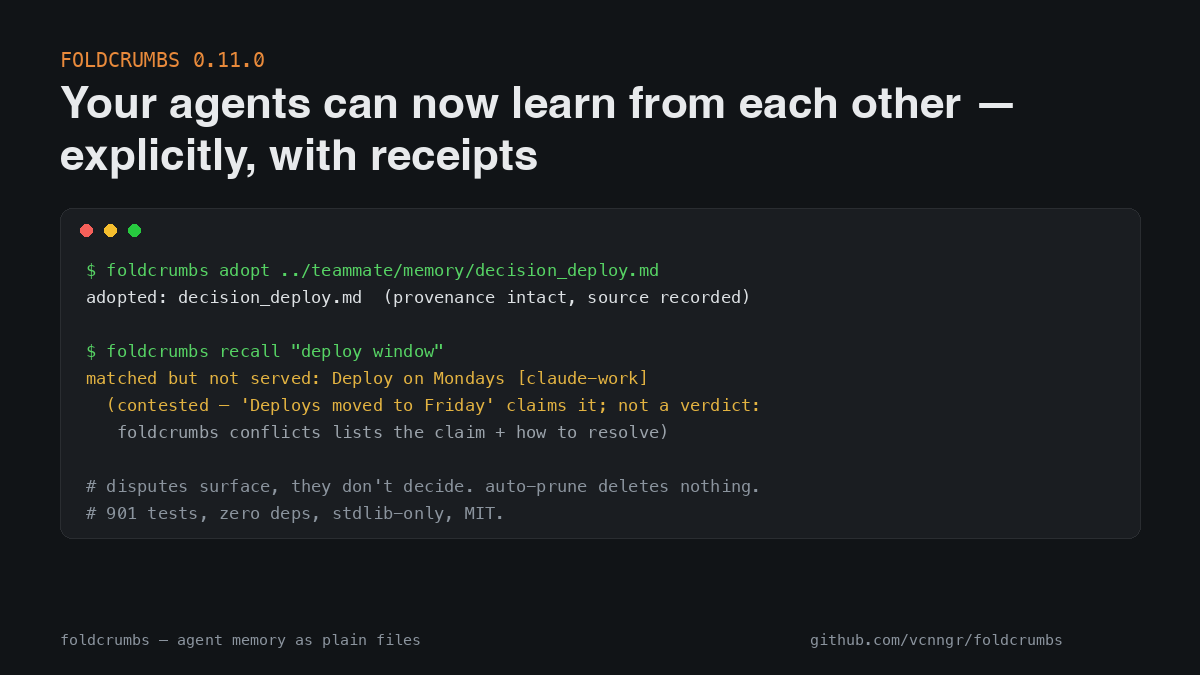
adopt a teammate's memory, provenance intact. check-fresh reports a moved source. contested records surface as "matched but not served" — dispute visible, verdict human.
#AIagents#aimemory
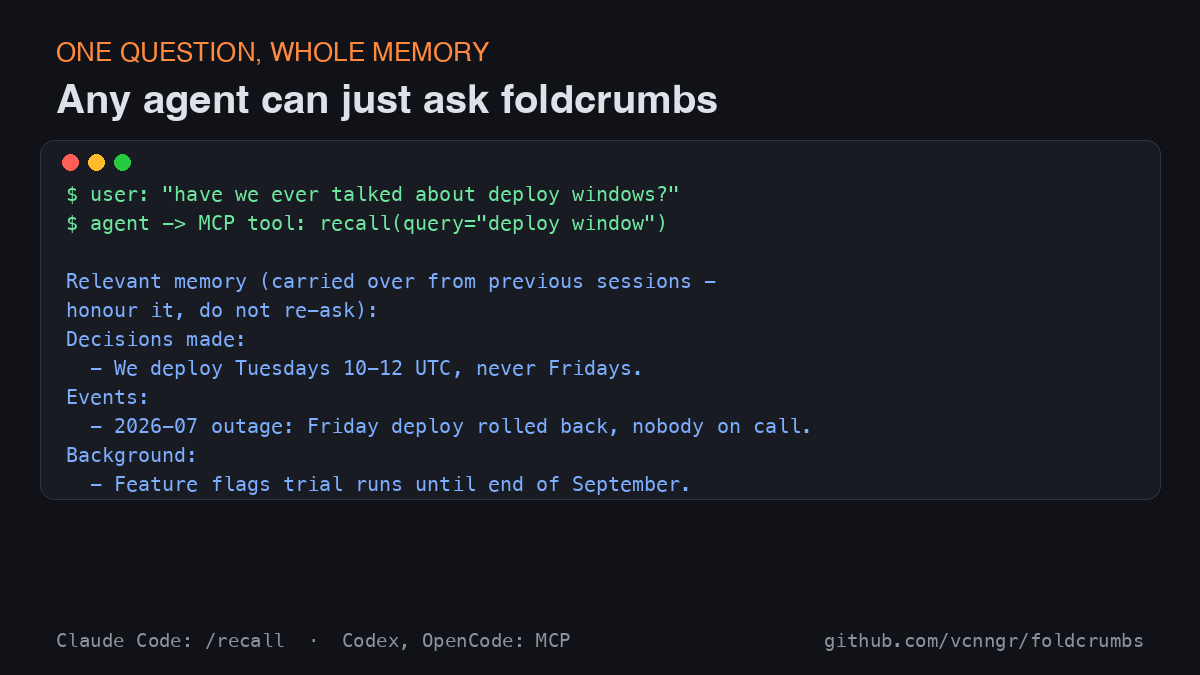
Install foldcrumbs once — every agent on the machine can just ask:
"have we ever talked about deploy windows?"
One MCP call. Back come the decision, the outage behind it, the trial ending this month — from sessions nobody remembers.
#agentmemory#aimemory#AIagents
That ADR nobody reads? Your agent should.
foldcrumbs ingest adr.md → typed memories with provenance, recallable forever. HTML reduced to text, secrets scrubbed, dead URLs fail before writing.
stdlib only — no PDF, no OCR, no headless browser. Deliberately.
#AIagents#devtools
@oaleviola Gap closed — actual recall output now:
matched but not served: Deploy on Mondays (contested — this store records 'Deploys moved to Friday'); not a verdict: conflicts lists the claim + how to resolve
The dispute has a who, and exiting stays a human verb.
I didn't want my agents' memory living in a cloud service I don't control.
foldcrumbs is agent memory as plain markdown files: greppable, diffable, offline. Provenance on every memory, a graph that walks superseded history. 606 tests, zero deps.
https://t.co/tyLPyHfbtZ
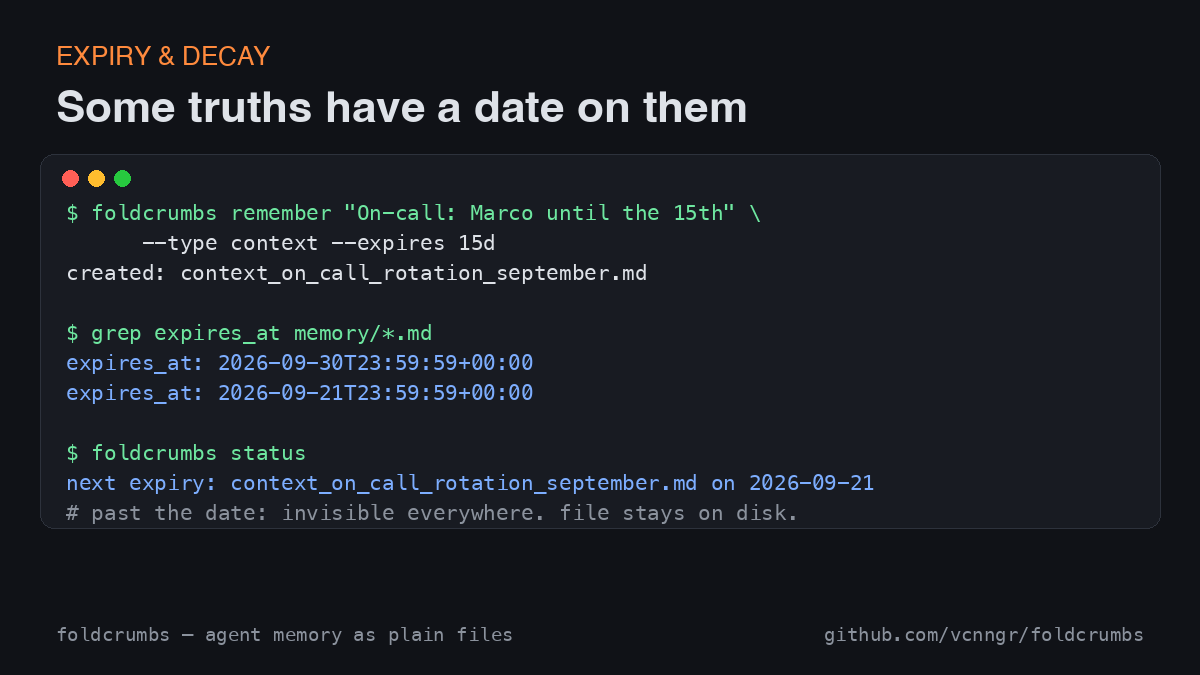
Some truths have a date on them.
"The trial ends in September." "Marco is on-call until the 15th."
foldcrumbs memories can expire: past the date they go invisible everywhere — while the file stays on disk. No silent timers: only you set an expiry.
#AIagents#aimemory
@oaleviola Correction, accuracy is the point: contested hides that record only — claims are directional, so the claimer's newer memory can still be served. Not "neither side." The disputed one goes quiet, conflicts tells you why, exiting is a human verb. Visibility over arbitration.
@oaleviola Fair gap — but the read path doesn't stay silent: a contested memory is excluded from recall by default, so the agent gets neither side, not a coin flip. And foldcrumbs conflicts lists every unresolved pair with the exact command to exit it. Stale warnings in doctor: on the list
Your agent shouldn't just remember decisions. It should remember WHY.
Old decisions get superseded — files stay, audit trail too. Relations carry evidence, and `graph path` walks them:
You can audit why a belief died.
#AIagents#aimemory#LLM
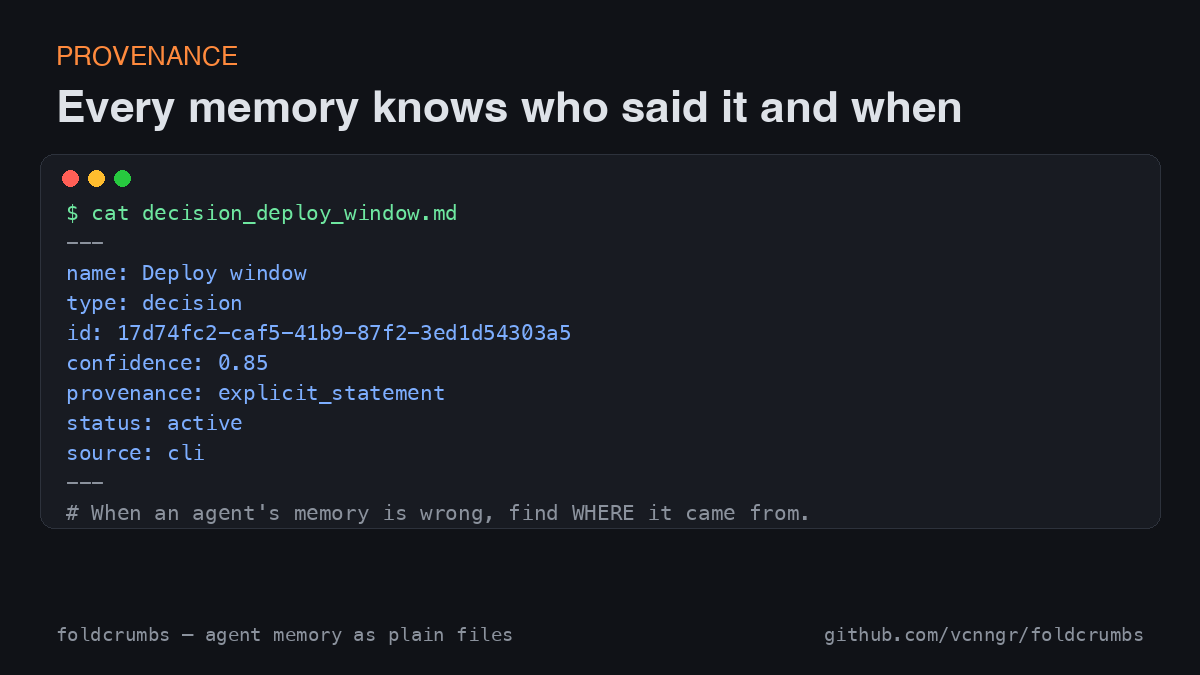
Every memory in foldcrumbs knows who said it and when.
provenance, source, confidence — in the frontmatter of a plain markdown file you can open and grep. When an agent's memory is wrong, you can find WHERE it came from.
Not a vector DB. A folder.
#AIagents#aimemory
@htunlogic That's exactly the split we had in mind — foldcrumbs owns the files and their provenance, your sync owns durability and reach. If Hoodik ends up shipping foldcrumbs stores, happy to look at making the pairing smoother where it's rough.
@htunlogic Right — foldcrumbs deliberately owns no sync at all. Files stay diff-clean (stable order, re-distill never reshuffles), so you hang Syncthing or your E2EE drive off it and the tool never fights you. Durability is your layer; provenance is ours.
@VeritasForge_AI Honest answer: foldcrumbs doesn't watch files — a manual edit is just an edit, your git diff is the trail. What code enforces: no sanctioned path revives a superseded memory. set_status moves active↔archived only; transit walks it, always labelled. New lineage = a new supersede.
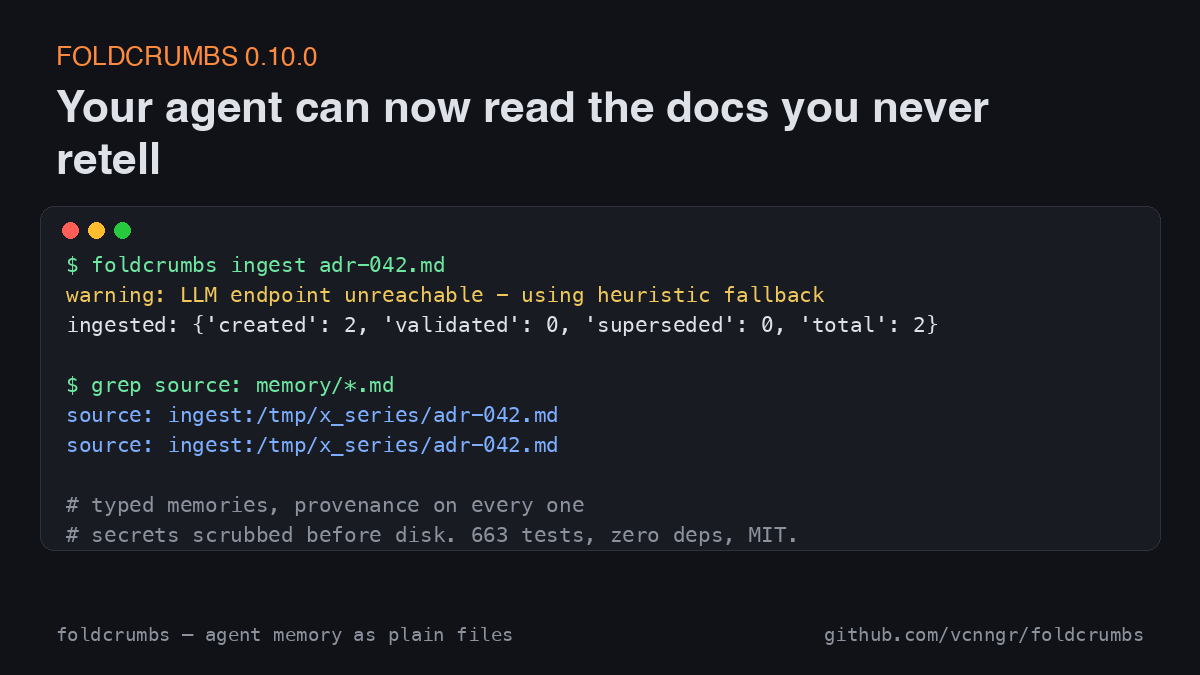
foldcrumbs 0.10.0: your agent can now read the docs you never retell.
ingest <file|url> → typed memories, provenance on every one, secrets scrubbed before disk. Still plain markdown. Still zero deps. 606 tests.
https://t.co/tyLPyHfbtZ
#opensource#AIagents
@VeritasForge_AI No reinstatement relation — supersession stays one-way by design. Transit is the only door: walk-through, never authority back. And it's all frontmatter, so a human CAN reopen the file and flip status — that's the point of plain text: the undo is an edit, not a feature.
@oaleviola Fair hit — files don't arbitrate, and foldcrumbs doesn't pretend to. What it does: the contradicting claim lands on MY record (supersedes_external), the federated view marks their memory contested, and only their instance can retire their file. Visibility, not auto-resolution.
Persistent memory for coding agents — plain markdown files, no cloud, no vector DB, no deps. Provenance on every memory, graph that walks superseded history. 606 tests, MIT.
If your agent forgets between sessions, this is for you.
#AIagents#MCP#opensource#LLM
I didn't want my agents' memory living in a cloud service I don't control.
foldcrumbs is agent memory as plain markdown files: greppable, diffable, offline. Provenance on every memory, a graph that walks superseded history. 606 tests, zero deps.
https://t.co/tyLPyHfbtZ
@VeritasForge_AI Exactly right. Readable forever, but out of recall and graph path by default (rule D3). One exception: human attestation via `graph transit <memory> on` — phase 2 walks it only if phase 1 finds nothing, every step marked “(superseded — transit)”. Imports strip the key. #MCP
@Velessus Same thesis from two angles — glad it landed. The survival argument is the real one: a tool dies, your memories are still just files. Worth a share if you know people still wiring their agents to a memory SaaS. #LLM#devtools
@Velessus “you can audit why a belief died” — better one-liner than mine. Steal it freely. If you run agents that forget between sessions, this is worth passing along — the repo’s all there: https://t.co/tyLPyHfbtZ #AIagents#opensource