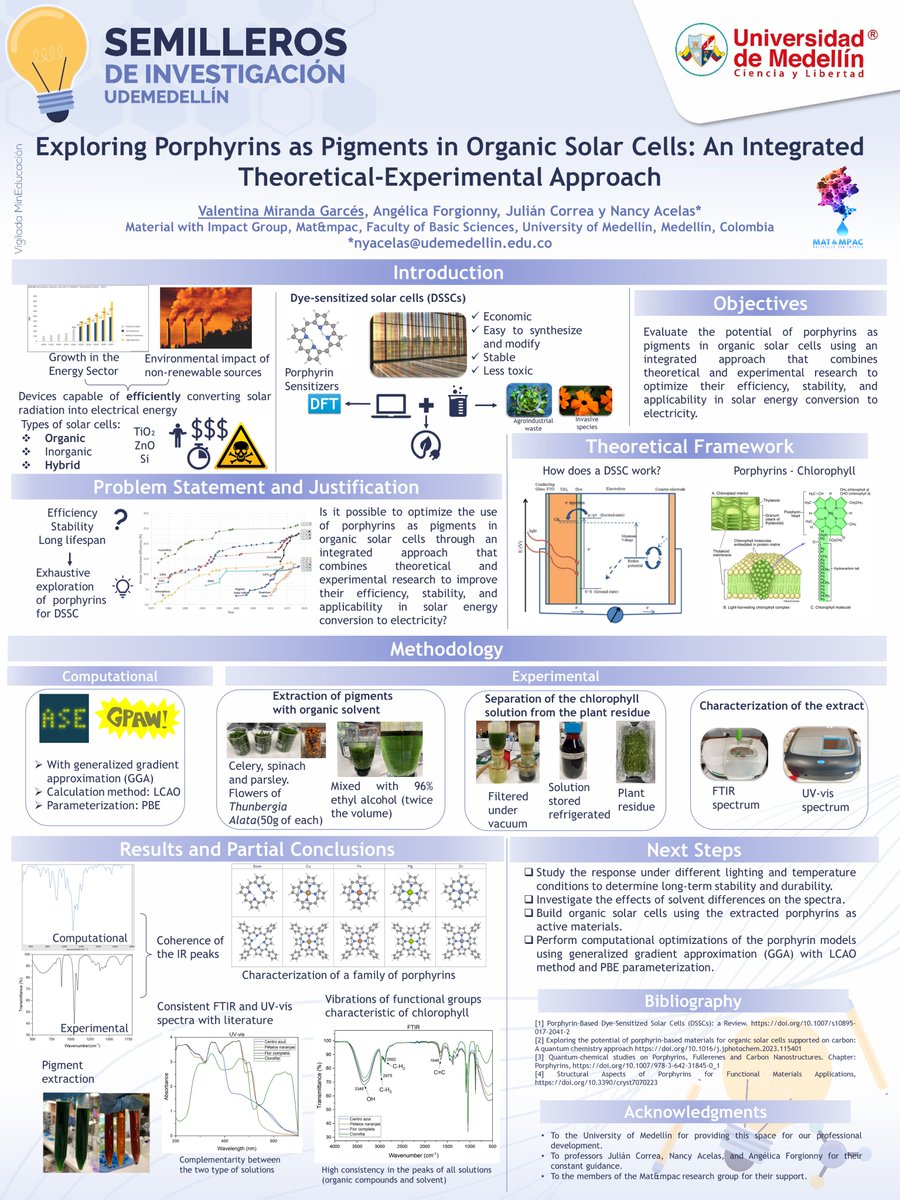
Thrilled to share my work with the @LatinXChem community! Exploring porphyrins from agro-industrial residues and invasive species as pigments for dye-sensitized solar cells (DSSCs) to boost efficiency and sustainability in solar tech. 🌱 ⚡️#LatinXChem24#LatinXChemGreen#Green30
@pfmoliveira@LatinXChem (3/3) Moreover, the use of porphyrins derived from natural plants means we are working with materials that are less hazardous and more biocompatible, in line with principle 8. This question is highly relevant to the project, thanks!
Thrilled to share my work with the @LatinXChem community! Exploring porphyrins from agro-industrial residues and invasive species as pigments for dye-sensitized solar cells (DSSCs) to boost efficiency and sustainability in solar tech. 🌱 ⚡️#LatinXChem24#LatinXChemGreen#Green30
@pfmoliveira@LatinXChem (2/3) Additionally, it is possible to identify various principles of Green Chemistry that align with the scope of the project. Firstly, the use of agro-industrial waste and invasive species aligns with principle 7, which is about renewable feedstocks.
@pfmoliveira@LatinXChem (1/3) By comparing the experimental spectra with those found in the literature, there is a match with the magnesium-centered porphyrin, which corresponds to the porphyrin present in chlorophyll type A.
@pfmoliveira@LatinXChem Hi Paulo! Thanks for your interest in the project. At the moment, we haven't identified the porphyrins in the extracts yet, but that's the plan. To build the cells, we are taking guidance from this article https://t.co/lSq6l7TAtR, for the dyes to be adsorbed by the TiO₂ layer