Third question on AI.
A question that also remains unasked is whether the AI boom can continue without leading to a massive increase in inequality.
A recent paper by Stijn Van Nieuwerburgh runs the numbers on how much revenue the AI industry needs to generate to recover its massive investment (summary and a link to the paper can be found here: https://t.co/QIGcoObcVc).
Van Nieuwerburgh’s arithmetic should make us more concerned. AI investments will average about 3.6% of GDP annually between 2025 and 2032. Van Nieuwerburgh calculates that, using a 10% rate of return, the industry would need to generate annual revenues of about $3.7 trillion by 2032 to recover these costs (growing from its current levels of about $200 billion or so). That is significantly more than 10% of current US national income, and will likely remain around 10% of national income by 2032, even if GDP growth rose from its current level.
A large fraction of this revenue will go to capital income. That means a massive increase in the share of capital in national income, which has already risen substantially over the last 25 years or so – now standing at an all-time high of about 47% (https://t.co/IuYldl173r).
Capital income is much more unequally distributed than labor income, so a massive increase in the capital share of national income will translate into a very sizable surge in inequality.
The rise in inequality may not stop with the capital share. My work with Pascual Restrepo documents that (automation-driven) increases in the capital share of national income are typically associated with rising labor income inequality as well (see, for example, https://t.co/2D9KUL3QfM). The same may happen in the next several years, boosting inequality further.
What is missing from our current debate is any discussion of a fundamental dilemma these numbers pose: can the AI boom avoid both an economically costly crash and a huge increase in inequality?
If the industry reaches these revenues, inequality surges. If the industry does not become profitable, a crash, with substantial costs in terms of lost output and jobs, becomes likely.
My assessment would be that the industry is unlikely to reach levels of revenue Van Nieuwerburgh calculates. First, diffusion has been and will likely continue to be slow. Second, competition from open-weight models, which are getting better, will limit how much proprietary models can charge. Third, despite important advances, I still believe that AI models will not be able to automate entire occupations anytime soon, thus limiting their value to businesses as cost-saving devices.
Whether this leads to a crash or not is more complicated and will depend on whether various AI companies are bailed out and what kind of support they receive.
Nevertheless, even if revenues fall short of these gargantuan amounts and we avoid a dramatic surge in inequality, I expect that the diffusion of AI will push up inequality between capital and labor and within labor.
If inequality does surge, a further question becomes central: can our democracy survive such astronomical levels of inequality?
Claude has discovered a previously unknown enzyme system hidden in the DNA of bacteriophages. Beside the enzyme’s gene sits a long array of repeating DNA—a structure that looks somewhat similar to CRISPR.
We don’t yet understand what this system does, but only a handful of known systems share its features, and all of them are able to cut, copy, and paste DNA. Historically, the discovery of such programmable systems has helped revolutionize medicine. CRISPR, for instance, is now the foundation of genetic medicines. But it will take much more work to learn what this system does, and whether it can be put to similar use.
Read more: https://t.co/RuEosScSMb
@Alokkumarzz@grok if you had to create a prompt for a agenetic investment account to perform what the professor performed, what would that prompt look like?
“The interesting thing about every accidental revolution in history from the Turing machine to the internet to penicillin, is that the people who lived through them mostly didn't notice while it was happening.”
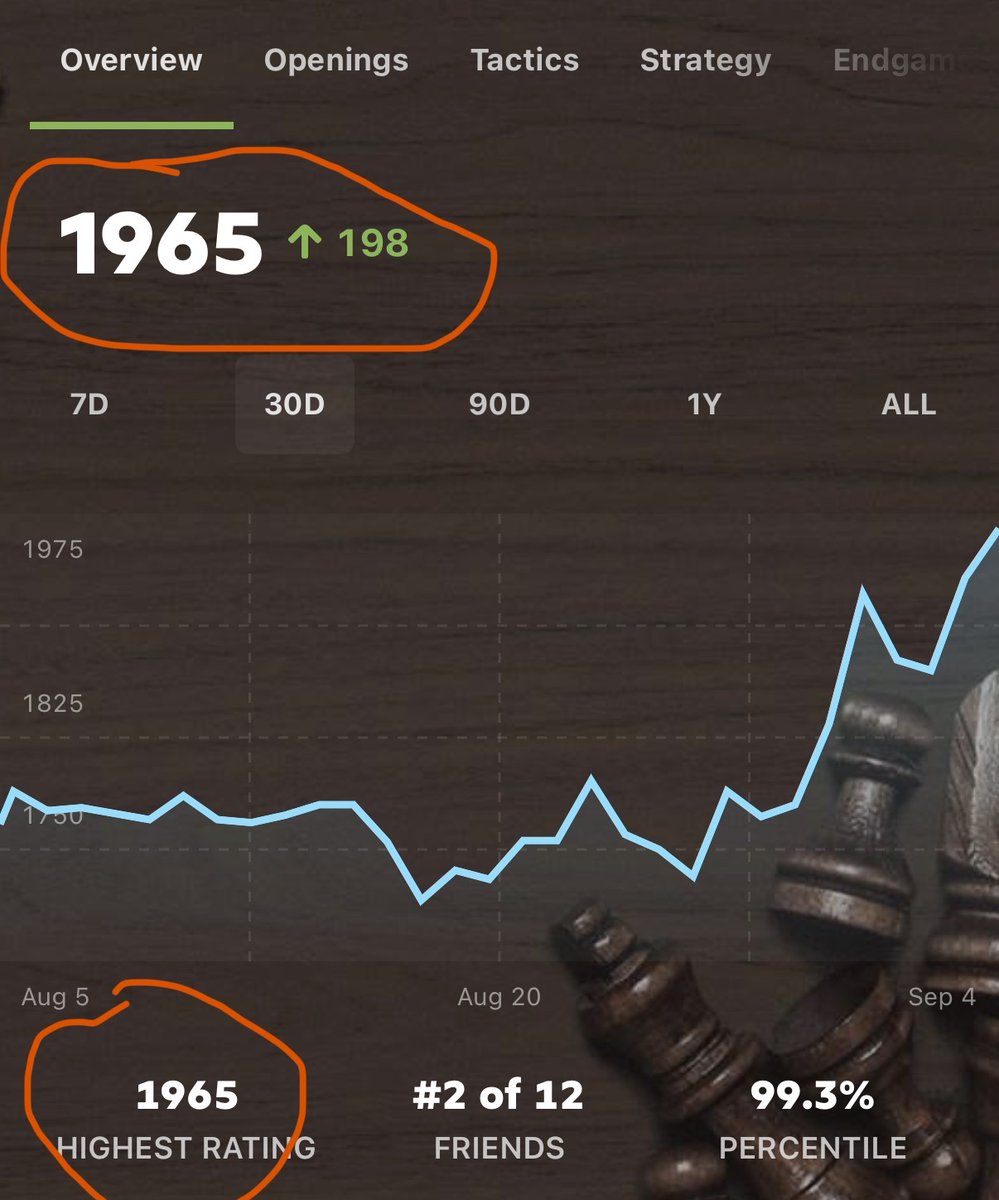
I was stuck at 1,767 for months.
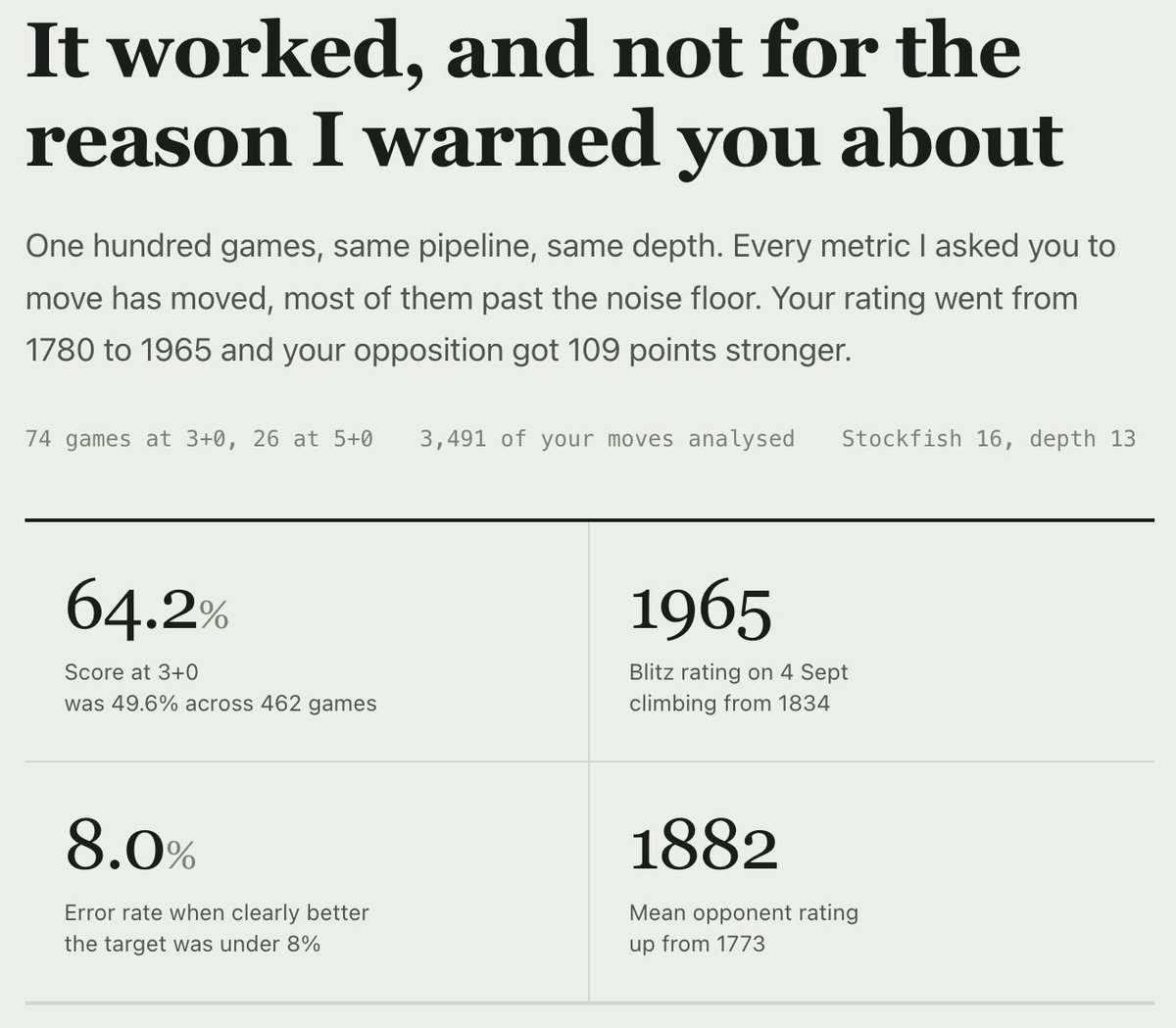
So I exported 500 of my @chesscom games, dropped them into @Claude, and asked one question: what am I actually doing wrong?
Five days later I'm at 1,965.
Here's what it found.
Comments:
Toward oneself: you measure yourself against your own standards and come up short. This produces guilt, self-criticism, inhibition, striving to improve. It’s uncomfortable but it’s a brake. It keeps the aggression that inferiority generates pointed inward, where it gets converted into self-reproach or effort.
Toward the external environment: the world, other people, circumstances feel larger and more threatening than you. The deficiency is located outside you. The world is hostile, unfair, contemptuous, and you are small in front of it.
The claim is that these normally coexist and counterbalance. When the outward-facing one massively outweighs the inward-facing one, nothing is holding the aggression back. The person doesn’t ask “what’s wrong with me,” so there’s no self-doubt to absorb the hostility, and it goes straight at the environment. That’s what “direct expression” means: unmediated. Not symbolized into a symptom, not displaced, not sublimated into ambition, not turned into guilt. Just acted out.
Kazimierz Dabrowski on feelings of inferiority.
“Feelings of inferiority have a positive role in the process of disintegration when disintegration participates in the creative formation of the personality, in the realization of the personality ideal, in the movement of the disposing and directing center to a higher level, and in the increase in activities of the third factor.”
The feeling of inferiority toward the external environment is negative, or pathological, when it has much more strength than the feeling of inferiority toward oneself. In this situation, which occurs in psychopathy and in some psychoses, there is direct expression of aggressive tendencies.
The feeling of inferiority toward oneself generally appears in individuals capable of development, especially accelerated development. It is manifested in nervousness, in psychoneurosis, and in psychosis, but it does not appear in psychopaths or in paranoid individuals.
“Without the feeling of inferiority toward oneself no process of self-education is possible. For self-education there must be a conscious personality ideal and a desire to ascend to this ideal. It is accomplished through increasing organization of the disposing and directing center, which activates the third agent and its obsession for evaluation of present levels of feelings and activities.”