“Oh missed that exit, let me reverse my car, just 100 meters, what bad can happen?”
So many people lose out on decades of life, while trying to save 5 mins. A lot of people will die while adapting to civilised way of using expressways.
US economic statecraft in the 21st century. US treasury secretary Scott Bessent spoke yesterday:
The nation that cannot produce what it needs is not truly secure. The nation that depends on its adversaries for critical inputs is not truly sovereign. And the nation that reduces its economics to consumption is not truly prosperous.
Kunal Shah is the classic Rags-to-Riches story. He grew up in a 100 sq.ft chawl, did delivery runs on 2-wheelers, couldn't speak English until he was 22. Today, his net worth is ₹15,000 Cr.
Kunal Shah is going to lead WhatsApp globally.
No IIT. No IIM.
His CV wouldn't have made it past the Indian corporate HR system :)
The West bets on builders, while Indian corporates still rely on IIT/IIM badges.
By now you should know that higher education is a scam.. they push you for overpriced higher education so that you take loan to be paid out of your future potential earnings.
I am seeing sharp rise in education loans in India also and this is not going to end well for those who are taking these loans and those who are guaranteeing this loan.
My piece in @livemint today.
India faces 2 choices: Indian households blow up their savings, giving F2s minimal cost exits.
RBI blows up reserves, defending the Rupee, swapping SIP Rs into USD, giving F2s low cost exits.
Our projected import ( merch+ services) cover is just 6 months. Deep red zone.
Our projected BOP deficit is ~13% ( that's optimistic IMO) of current reserves. Even in 2008, it was just 8%.
So get the magnitude of the problem.
We can't fight this 2 front war. It's a ticket to the IMF.
Sensible choice: sacrifice the Stock Market. It never busts a nation.
FX crises always do.
Remember the 80s multiple Latam Tequila crises?
My reco:
RAISE taxation on MF investing.
Lower F2 new investment taxes.
( We used to have 0 tax on F2s and 20% on locals, in the 90s. We needed dollars then. We need dollars now. )
So:
Stock market crashes.
That's fine. F2s try selling but there are few willing buyers on the other side.
Selling into illiquidity always crashes prices.
But we don't lose USDs because quantum of selling absorbed will a fraction of today.
And at 30-40% lower prices, after a crash, the same selling F2s will become buyers.
I have seen this multiple times in my sell side life. " Market is cheap now": becomes the chatter in Manhattan after some champagne. " Let's go back in"
We saw $20 billion flow in 09-10.$ 10 billion in 13-14.
Each after a massive crash.
Crashes almost always trigger massive F2 inflows.
We must make this happen.
We simply can't give easy exits.
Exits must be made costly.
Even unviable.
That's the way it used to happen before.
I am prepared to endure the pain on my India holdings for a while.
Stock markets always come back in a year or two.
No currency ever regains the glory of its pre-crisis levels. Almost none.
Absorb this fact slowly.
Since March this year, I have put ~ Rs.200 cr into India.
I am fine to take pain on my holdings if it saves the country.
Are you, the Jain, the Gupta, the Patel, and millions others, prepared to do the same?
MF distributors? Asset Managers?
Are you prepared to let go your swarth for the country?
Because else, 12 months from now, we will be teetering at abyss' edge.
Indian talents face systematic "cherry-picking" by the West at virtually every single level.
From the very beginning, India’s brightest professionals head to top universities and major companies in the US and Europe. The very best of them go on to become CEOs and senior technical or managerial executives at companies like Microsoft, Google, and Adobe.
Those who are well-educated and possess solid innovation capabilities — the mid-level talent — are frequently recruited by Google, Intel, and other multinationals into their high-end R&D campuses in Noida and Gurgaon on the outskirts of New Delhi.
The massive salary disparity means India’s most talented individuals rarely stay in the country, let alone in Indian companies, making it extremely difficult to develop a network for indigenous innovation and industrial progress.
It is in this way that the West has been siphoning and harvesting talents from India, causing a permanent brain drain for a country that is so desperate for human capital.
Long term SIP strategy
VIX > 20 , Increase your SIP amount
VIX < 20 , just normal SIP amount .
This may improve your CAGR by 1.5% .
Backtesting is still going on
Nifty 50: My View :
The index is currently trading below its long-term historical medians.
While recent corporate earnings growth has been on the softer side, the risk-reward ratio at these levels is beginning to look constructive for long-term investors.
The Current Valuation :
• Trailing P/E: 20.3x (5-Yr Median: 22.2x)
• 1-Yr Forward P/E: 18.5x
• P/BV: 3.2x (5-Yr Median: 4.0x)
• 5-Yr CAGR: 8.8% | Div Yield: 1.35%
Near-term consolidation is being driven by a mix of moderate earnings, a soft INR, volatile crude, and India missing out on the global AI momentum trade.
The Path Forward :
The valuation floor seems well-established. If we see a gradual pickup in corporate earnings growth alongside some potential relief in taxation, the index could steadily regain its momentum.
Target Range: 26,500–27,000
Timeframe: Next 9–12 months
@plutusadvisors@preetiplutus
Obviously, Vijay Gokhale is ignorant about how Chinese people view Indian democracy and why they would never see it as an ideological threat. Here is the reasoning.
Even if democracy can be viewed as India’s foundational pillar, significantly preventing the worst outcomes, it has also brought about suffocating, if not deadly, costs.
India adopted universal suffrage democracy while still economically and socially underdeveloped, thereby legitimising many deeply entrenched pre-modern social structures, which have become institutionalised and integrated into India’s governance today.
Idealists like the first prime minister of India, Jawaharlal Nehru, and the early Congress party envisioned oppressed social groups utilising their numerical advantage through democratic elections to create pressure groups, driving gradual social reform and overcoming entrenched societal issues, thus paving the way for economic prosperity.
Unfortunately, this ideal scenario didn’t materialise. Instead, groups formed around identities such as religion, caste, sub-caste, and ethnic affiliations have engaged in “vertical mobilisation” through electoral mechanisms, reinforcing traditional social structures and preserving vested economic interests. This has resulted in an institutionalised system that further hinders social dynamism and reinforces social rigidity.
Consequently, vested interest groups representing antiquated social structures legitimately hijack democratic processes, obstructing reforms beneficial to the entire society, thus significantly hampering social progress and economic development over the long term. Nevertheless, most people have no better alternative than to tolerate this situation.
What type of mistakes are the most challenging to correct? Those that everyone perceives as “correct”. This encapsulates the most profound constraint that democracy imposes on India.
In Atomic Habits, James Clear writes: "The more immediate pleasure you get from an action, the more strongly you should question whether it aligns with your long-term goals."
A good investing example is the technology boom of the late 1990s. Many investors abandoned diversified portfolios and rushed into internet stocks because the gains were immediate and exciting. Every day seemed to bring another story of someone doubling their money. The pleasure was instant. The validation was constant.
Meanwhile, a more disciplined investor who continued buying broad market index funds or stocks that were not trending in social circles looked foolish by comparison. There was little excitement and few dramatic gains to discuss at dinner parties. The reward was delayed.
When the bubble burst in 2000, many of the fashionable stocks collapsed. Investors who had chased immediate gratification suffered heavy losses, while those who had stayed focused on a long-term plan recovered and benefited from years of compounding.
The lesson is simple. In investing, the choices that feel best right now are often the ones that deserve the most scrutiny. Excitement is not the same as value. The strongest long-term results usually come from decisions that feel boring in the present but sensible over decades.
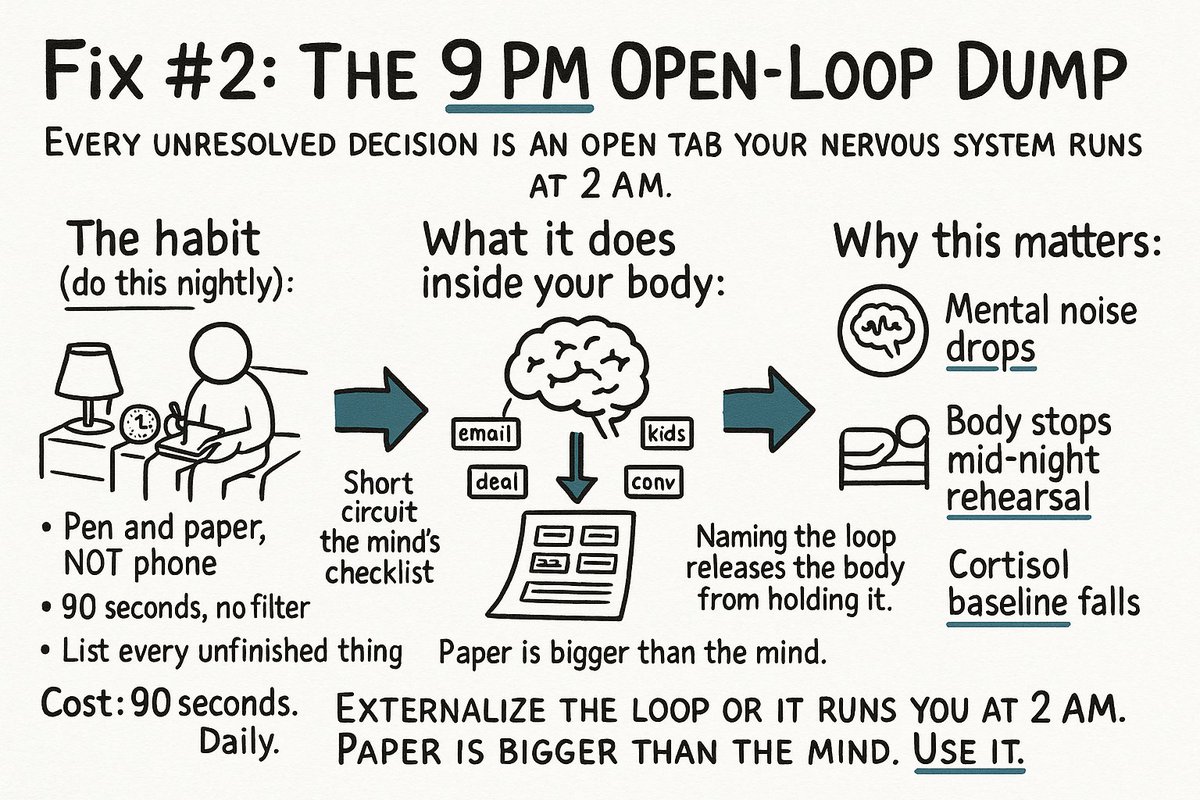
2. The 9 PM open-loop dump on paper.
Most 3 AM wake-ups are an unresolved decision your nervous system keeps running.
Pen and paper. 90 seconds. List every unfinished thing.
Externalize the loop or it runs you at 2 AM.