The focus on model performance misses the bigger picture, the network effects of intelligence. A model that improves through contributions becomes more valuable as more people use it, creating a compounding advantage.
This dynamic is different from traditional software where network effects are about user numbers. In AI, the network effect is about the collective intelligence that emerges from diverse contributions and applications.
Researchers at @MassGenBrigham have published a timely reminder, AI may be improving in medicine, but it still struggles with one of the most important parts of care, clinical reasoning.
Using a new benchmark called PrIME-LLM, researchers tested 21 leading models across real diagnostic scenarios. While many models identified the correct final diagnosis once enough data was provided, they performed poorly in the earlier stages: generating differential diagnoses, deciding what to test, and reasoning through uncertainty.
That distinction matters.
Medicine is not just about arriving at an answer. It is about navigating incomplete information, weighing probabilities, ruling out risk, and updating decisions as new evidence emerges. In other words, healthcare depends less on prediction alone and more on structured judgment under uncertainty.
This exposes a broader misconception in AI adoption, strong outputs do not always mean strong reasoning. A model can sound confident, reach the right endpoint, and still fail the process required to trust it in real-world environments.
The opportunity, then, is not physician replacement. It is clinical augmentation.
AI can accelerate documentation, summarize records, surface patterns, and support decision pathways. But the “art of medicine”—context, tradeoffs, accountability, and nuanced judgment, still requires human oversight.
This reinforces a principle that extends beyond healthcare, high-stakes AI systems must be measured not only by outcomes, but by how they reason, how they justify decisions, and how reliably humans can govern them. Intelligence without oversight is not enough.
AI-driven automation is raising deeper economic concerns
Mo Gawdat argued that as AI replaces cheap labor, it could undermine a core pillar of capitalism, consumer demand.
At the same time, new research models this as a coordination problem.
Firms automate to stay competitive, but if many do it at once, job losses can reduce spending across the economy, feeding back into weaker growth.
Recent data reflects the tension, with large-scale layoffs and falling costs of automation accelerating adoption.
Some see a path toward abundance and lower costs. Others worry about a mismatch between productivity gains and income distribution.
If AI concentrates both production and ownership, the system becomes fragile.
PAI3 approaches that layer by distributing AI workloads across user-owned nodes, widening participation in the value created by automation.
As AI scales, the challenge may not just be efficiency, but maintaining balance between productivity and demand.
We're facing a paradox in AI development, high-quality training data is becoming scarcer even as we generate more data than ever. The solution is better data ecosystems.
The most valuable AI training data is siloed in proprietary systems or held by individuals who don't trust centralized models. Creating mechanisms to access this data without compromising ownership is the key challenge.
We're seeing the emergence of data cooperatives and contribution protocols that allow high-quality data to flow to where it's most needed while preserving contributor rights. This is how we solve the scarcity paradox.
When a yield source is attractive and durable, looping is how you size into it, scaling exposure to real-world yield within DeFi’s composability rails.
ONyc keeps stablecoin capital productive, generating 16%+ APY when used as collateral on @Kamino and @Loopscale.
It became clear to me early on that AlphaNet by @Phoenix_Chain is not just about adding more strategies. It is slowly changing how I approach the way I choose them.
With over 100 institutional-grade strategies expected by the end of Q2, the focus is shifting toward better
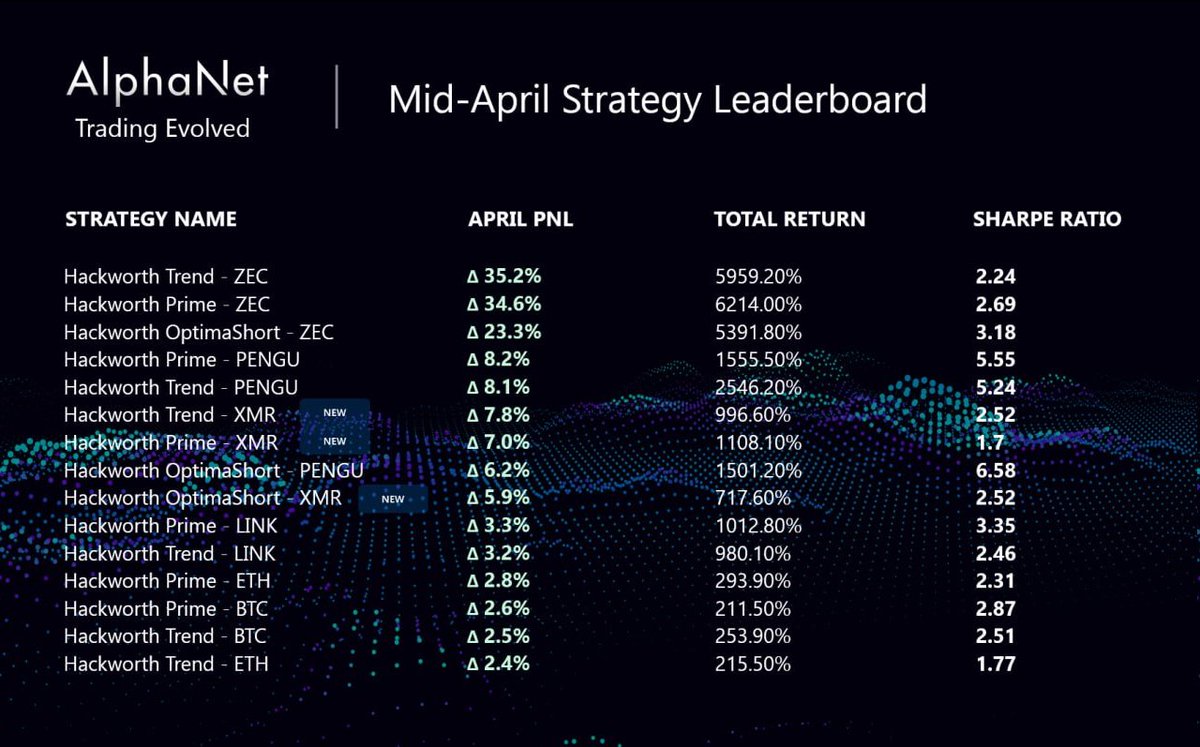
Not even halfway into April and I’m already seeing results on AlphaNet.
Hackworth Trend XMR just came in and started performing in under 10 days… that’s not something you ignore.
Feels like @Phoenix_Chain is actually delivering, not just promising.
Timing always tells a story, and right now, the timing feels right.
@Phoenix_Chain is already delivering through AlphaNet, even though the month is still young. Hackworth Trend XMR coming in strong so quickly makes it feel like the platform is not warming up slowly.
AI isn’t failing.
Trust is.
Enterprises aren’t rejecting AI - they’re rejecting risk.
Uploading sensitive data into systems you don’t control = compliance violations, legal exposure, shutdown.
PAI3 flips the model:
Own the infrastructure.
Keep data local.
Make AI usable again.
#AI #privateai