With the closure of Timewave Inc., the entire Valence codebase has now been open sourced. All smart contracts, off-chain services, client libraries are now licensed under Apache 2.0. https://t.co/TqmuRiIrIF
The Timewave era has come to a close. Timewave Inc. will be winding down. All code is now open source under Apache 2.0 on our Github. https://t.co/2RSEVIchaf
Sincere gratitude to all of our partners, collaborators, and supporters over the last 3 years.
Yours in time,
₿ITCOIN SUMMER VAULTS ARE LIVE
1. Deposit wBTC, eBTC, uniBTC, or solvBTC
2. Earn real yield, NTRN rewards, and partner airdrops
3. Go enjoy life while you earn
https://t.co/gB6BuCnbjs
Step-by-step guides and other helpful resources:
I haven't shared too much what we have deployed at @OrbitEarn so far and some of the feature choices of the yield layer. (Will do a deeper dive later)
We've been heads down on build and a super lean bootstrapped team, but made great progress.
The yield layer is only the foundation layer with the business focusing on the utility and distribution of DeFi/yield on top.
But the design principles of how we have built it are key to everything.
We designed the yield layer heavily around withdrawal liquidity and the ability to get in and out easily, risk management/diversification and the way that the strategies are layered.
We have built ontop of @ValenceZone libraries which have allowed us to deploy cross-chain strategies faster and more efficiently. Currently 33 are added, but will add Solana + new Arb strategies + in the future @HyperliquidX
The yield layer will expand to other assets (BTC, ETH ect) and also other risk profiles. (Good for integrators)
The basics:
A strategy manager sits on @arbitrum and controls allocation of assets across sub-strategy vaults (Can be an individual lending market, YBS or more).
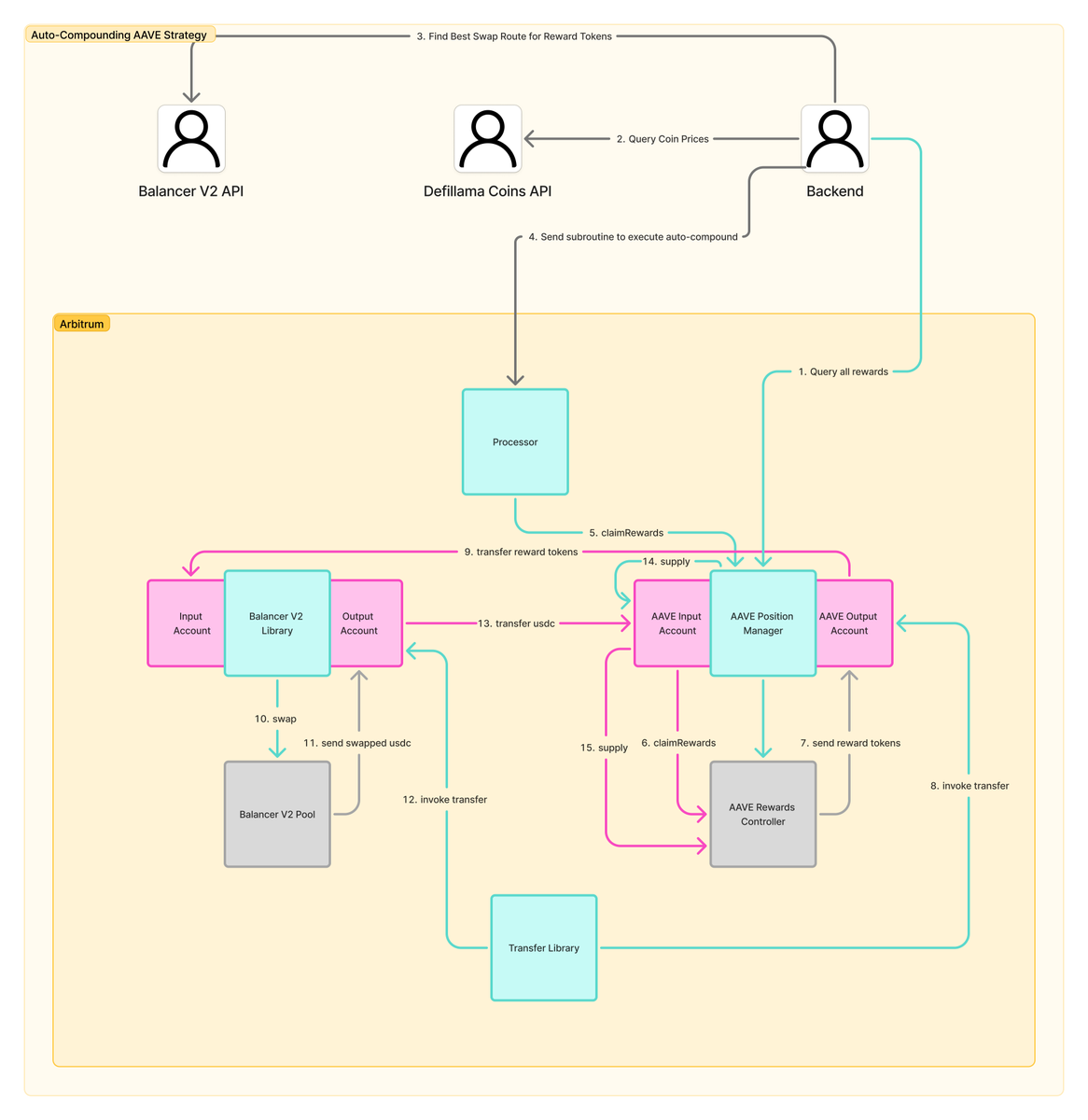
These can autocompound assets + external emissions back into the strategies as seen in this chart.
Strategies like @pendle_fi PTs have a slightly different profile as less liquid. These make up a total of 25% of the total strategy allocation but also need safeguards in liquidity crunches.
Full rebalancing occurs 1-2 times a day to reallocate across strategies (originally 4 hours but adjusted for gas optimisation). This looks at weighting, gas, risk-adjusted yield and more, and adjusts accordingly.
Initial across the first 33 strategies.
For deposits and withdrawals a lot has been done to make the process as instant as possible.
This features a 5%+ liquidity buffer in highly liquid strategies on Arbitrum at all times and also features a netting system that matches deposits and withdrawals in real time.
Withdrawals features a queuing system if liquid buffer is depleted or to prevent that from occurring. It takes into account tiers (Size of deposits relative to whole) and liquidity is pulled from strategies asyncronously,
It first prioritises local and liquid strategies (Faster and lower gas)
And then pulls based on availability of liquidity, with ETH strategies and Pendle PTs last, depending on side of withdrawal. (For a very large withdrawal, might make sense to pull from ETH mainnet AAVE as gas is less impact)
For the currently progress, everything is almost complete, we have been deploying and testing the strategies on Base and Arbitrum mainnet to pick up on bug fixes as the strategies run and allocate.
Then audits and some monitoring systems (Fault tolerance, safeguards).
But we will soon open it up to small deposits on early adopter side.
I wish it's something we could just launch super fast, but it needs a lot of testing to be robust for mainnet.
Our focus is then very much on the modules. But getting this layer right was important as the need for diversified and risk adjusted allocations combined with instant liquidity was key to building on top.
Coming to @arbitrum soon.
We've completed our security review of @neutron_org & @timewavelabs' Valence Protocol @ValenceZone. The audit covered core protocol systems including cross-chain execution and vault components.
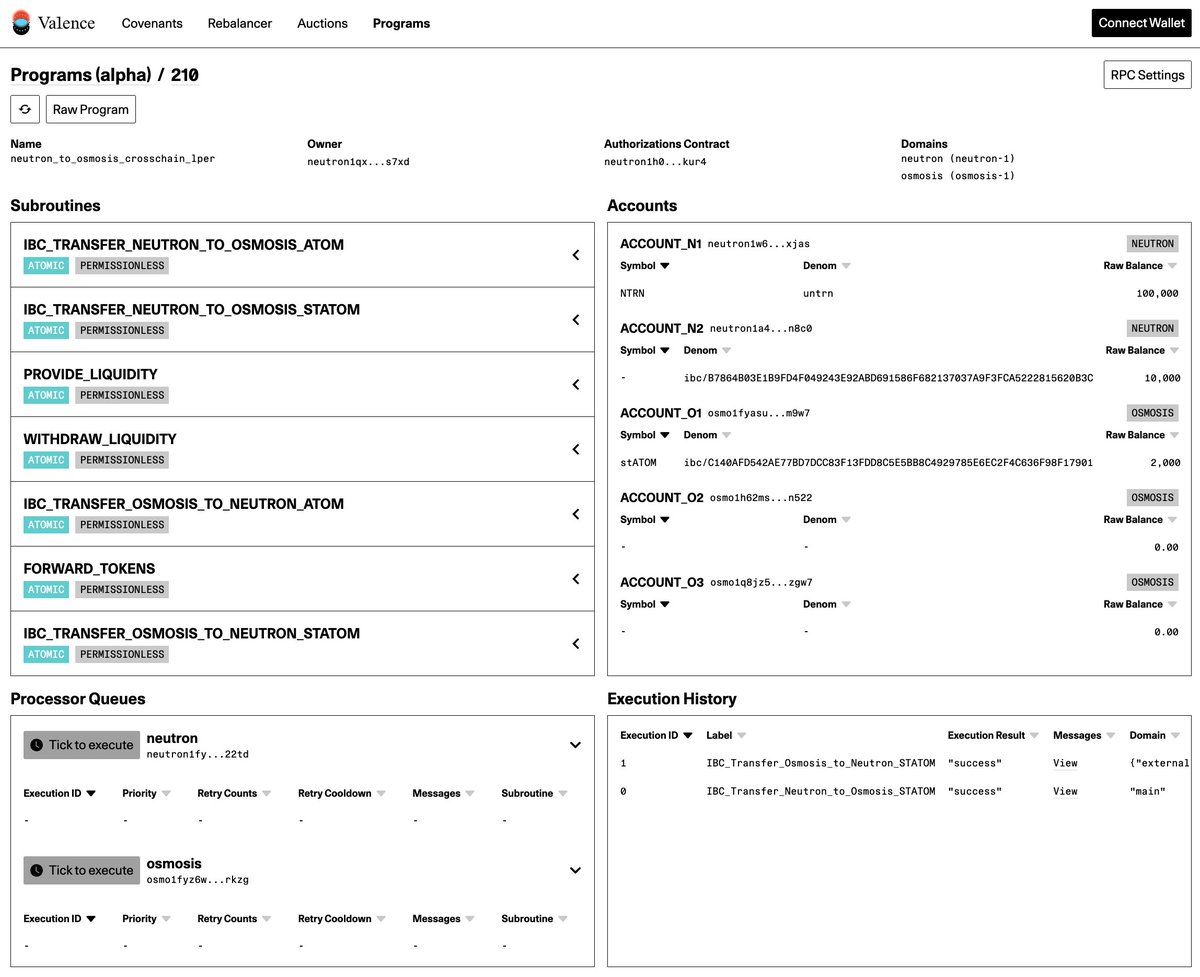
Did you know that Valence offers a developer interface that helps manage cross-chain programs?
The Programs UI tracks CosmWasm chains, with EVM support coming in a few weeks. Solana on deck.
To check it out, click the link below 👇
As we get closer to mainnet, we’ve finalised all the initial strategies for the yield optimiser, and we’re testing on testnet.
Next steps involve more robust testing, monitoring, and operational setup.
We’ve been collaborating closely with @ValenceZone to run the cross-chain orchestration and vaults, writing EVM components and position managers, and with @circle CCTP for bridging USDC between strategies.
The core initial strategies span @arbitrum, Ethereum mainnet, and @base, with @solana expected to be added in August.
Optimisation rebalances every 4 hours and takes into account a range of factors including yield, liquidity depth, market risk, smart contract risk, oracle risk, and more, to generate a risk-adjusted rate.
The protocol is designed with liquidity in mind, optimising for fast withdrawals via deposit netting and a liquidity buffer.
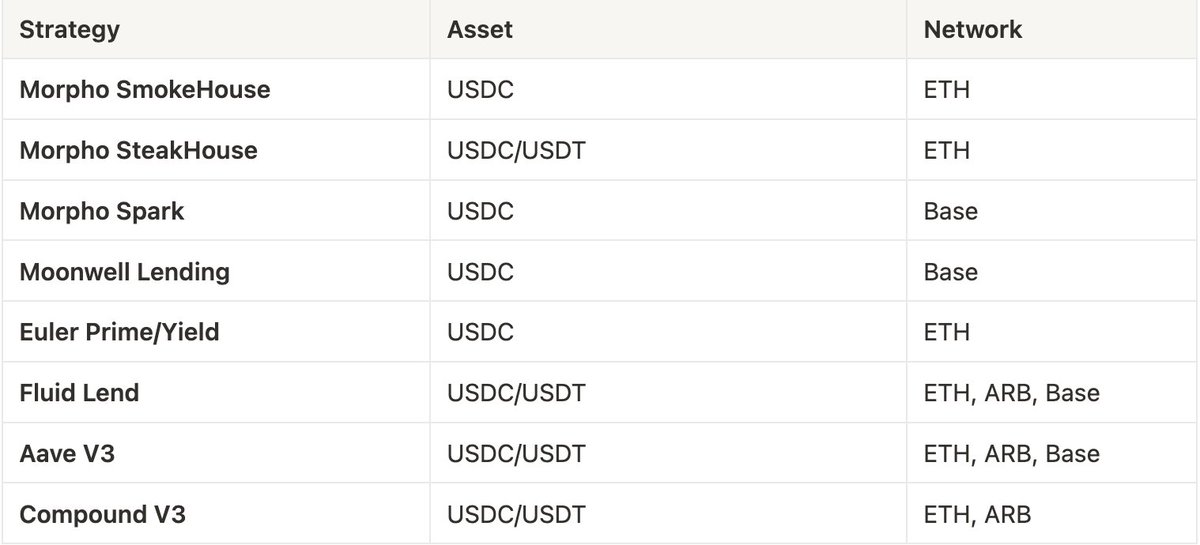
Today, we’re announcing the first batch of 33 strategies that will launch with the optimiser:
👇
- @MorphoLabs@gauntlet_xyz USDC Core, Frontier, Prime and USDT Prime on Eth
- Morpho Hakutora, @hyperithm, @MEVCapital, Relend, @SmokeHouse, @SteakhouseFi USDC on Eth
- Morpho Steakhouse USDT on Eth
- Morpho @SeamlessFi, @MoonwellDeFi, @sparkdotfi Flagship USDC on Base
- @eulerfinance Prime and Yield USDC on Eth
- @eulerfinance USDC on Arb
- @0xfluid Lend USDC on Eth, Arb and Base
- Fluid USDT on Eth
- @aave V3 USDC on Eth, Arb and Base
- Aave V3 USDT on Eth
- @compoundfinance V3 USDC on Eth and Arb
- Compound v3 USDT on Eth
- @MoonwellDeFi lend USDC on Base
- @pendle_fi PT @ethena sUSDe on Eth
- Pendle PT cUSDO @OpenEden_X on Eth
- Pendle PT @ResolvLabs wstUSR on Eth
- Pendle PT @SkyEcosystem USDS on Eth
Lombard joins the @neutron_org Bitcoin Summer Campaign
The campaign will kick off with a yield-bearing LBTC vault, before boosting deposits through maxBTC - a new DeFi protocol that will offer its holders sustainable real yield on BTC.
Valence's ecosystem of developers is growing.
Timewave continues to be the most demanding super user, but @HydroTeam_ and @OrbitEarn are also building with Valence.
What will you build?
The next generation of crypto will be defined by natively cross-chain applications.
If you’re building at that frontier, let’s talk.
🧵 What we do at Timewave:
For years, Bitcoin has been the face of crypto, but never the engine behind DeFi. That changes with Bitcoin Summer '25
@neutron_org is unlocking a new layer of utility, building the infrastructure Bitcoin has always needed. Not to replace its role, but to activate it
$NTRN powers this transition, turning $BTC into a productive onchain asset through real strategies and sustainable vaults
With support from partners like @ether_fi, @ValenceZone and @SolvProtocol, the focus is on yield that lasts, not incentives that fade
Bitcoin is no longer idle capital
It’s becoming part of the architecture
Explore everything about #NEUTRON's BTC summer here: https://t.co/xd5D6xhDDl
Or in this banger thread 👇🏻
Honestly so excited to get this product to market!
The contracts are deployed on Sepolia, and finalising the position managers and allocation for the first 28 aggregated strategies.
Working with @ValenceZone and their orchestration tech has been incredible, as well as building on top.
Orbits default strategy will sit around 8-10% and aggregate 28+ plus bluechip strategies across Base, Eth, Arb and Solana (And eventually Cosmos native Strats when live)
Shortly after closed mainnet cross-chain deposits and withdrawals will be enabled meaning users can access multi chain strategies in one click, through multiple ecosystems with no manual bridging.
We have also optimised for max liquidity, risk-adjustment and instant to near instant withdrawals below a certain size.
This is just the foundational layer, that sets the scene for the embedding of this yield and the building on top.
New blog post: Valence Powers the Networked Economy
Crypto today is fragmented.
Liquidity, users, and state are siloed across chains—forcing every protocol to act like its own island.
Valence is building something better:
A unified execution layer for the Networked Economy. 🧵