Terminado el Curso de Entrenador Profesional (N3), me gustaría compartir mi tesis final por si hay interesados: un análisis de las tendencias tácticas hegemónicas observadas en la pasada Euro https://t.co/yPF0kJ4ccb
Agradecer a la @FFCV_info por la formación durante estos años
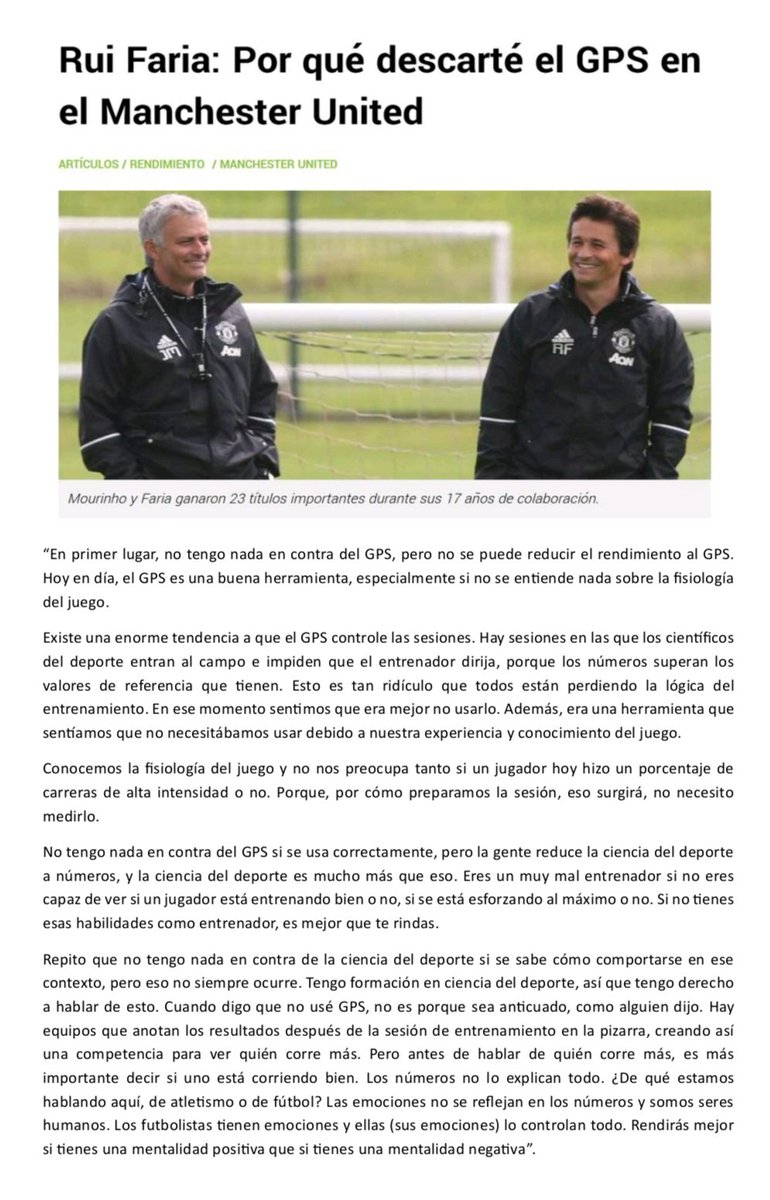
A diferencia del uso tecnológico que se muestra en el vídeo, los razonamientos de profesionales como Rui Faria (foto) no se difunden ni se promocionan tanto.
Quizá no interesen a muchos.
@joelporsch Is it really more specific to have a player permanently in an offside position while restricting them to one or two touches—adding a rule that doesn’t even exist in the game?
@joelporsch Yes, and I use those tasks as well. But if I want to stimulate specific player relationships, they emerge far more frequently in a rondo because of the smaller number of players and the multidirectional nature of the task.
@joelporsch Yes, because, as I said before, goals are present in other parts of the session—in fact, in most of it.
And because my feedback, which I believe is an even more powerful tool for shaping intentions, consistently directs players toward the ultimate objective: win.
@joelporsch That will never happen simply because you spend 10 minutes doing a rondo in a training session.
If you want a task that promotes penetration behaviors, a rondo is not the best choice. If you want to estimulate some passing relationships, rondos can be a very useful tool.
@joelporsch In that case, if the attacking players lose possession, they immediately become the defenders and can also be penalized.
Every coach will design rondos according to the behaviors they want to promote and their team’s intentions. I don’t think there’s a single ideal rule.
@joelporsch Negative points for the defenders, the last pair defending at the end of the sequence loses, defenders rotate based on time and achieve defensive points… the possibilities are endless.
@joelporsch We’re not going to have such a huge impact on our players that they’ll forget to attack the goal in a match simply because we spend 20 minutes a week training without direction.
@joelporsch For example, when I use a 4v2 rondo with the aim of improving ball circulation, I can direct the players’ attention to how specific teammates interact with each other under spatial and temporal pressure. Based on the information provided by the opponents (tempo, trajectories…
@joelporsch Nobody trains or plays simply to keep possession. The relationships that emerge in those tasks are just different.
Goals will always be present in the players’ minds in competition. As coaches, we don’t have enough influence to make players ignore the game strongest attractor.
@joelporsch No, because the behaviors you’re referring to are developed in many other tasks, which make up the vast majority of our training process.
Once again: we train WITH rondos (alongside other non-directional tasks), NOT ONLY with rondos.
@joelporsch Of course, when I use a rondo without goals, my objective isn’t to score.
To me, football’s specificity lies in its sources of information—especially the dynamic ones: the ball, teammates, and opponents.
We don’t train exclusively with rondos.
@joelporsch You’re thinking from the perspective of the game as a whole. The value of a rondo lies in highlighting specific sources of information and directing players’ attention toward them.
I’ve never used a rondo with the aim of teaching my players to keep possession forever.
@joelporsch Adding mini goals, together with the rules of the task, creates a different game dynamic. It doesn’t make the task better or worse; it simply makes it different.
@joelporsch Every training task has both positive and negative transfer. The key is to direct players’ attention and interactions toward what we want to develop, and toward the sources of information that will help them do so (task design + feedback.
@joelporsch For example, the coordination between a striker and an attacking midfielder to press and win the ball back will occur far more frequently in a rondo than in an 8v8 with mini goals.
@joelporsch For example, they can be used to stress or amplify specific behaviors and player interactions that would occur less frequently if the task included goals as the primary objective.
They’re just another tool. Whether they make sense or not depends on what you’re trying to develop.