Chainlink founder praises Blackrock for driving blockchain adoption.
@Chainlink founder @SergeyNazarov has publicly praised financial giant @Blackrock in driving blockchain adoption across several key areas, including...
- On-chain asset management
- Fund tokenization
- The growth of on-chain finance
He also articulated how Blackrock and other major institutions can benefit directly from $LINK's growing suite of infrastructure products.
More Chainlink content: https://t.co/Jpporju0KP
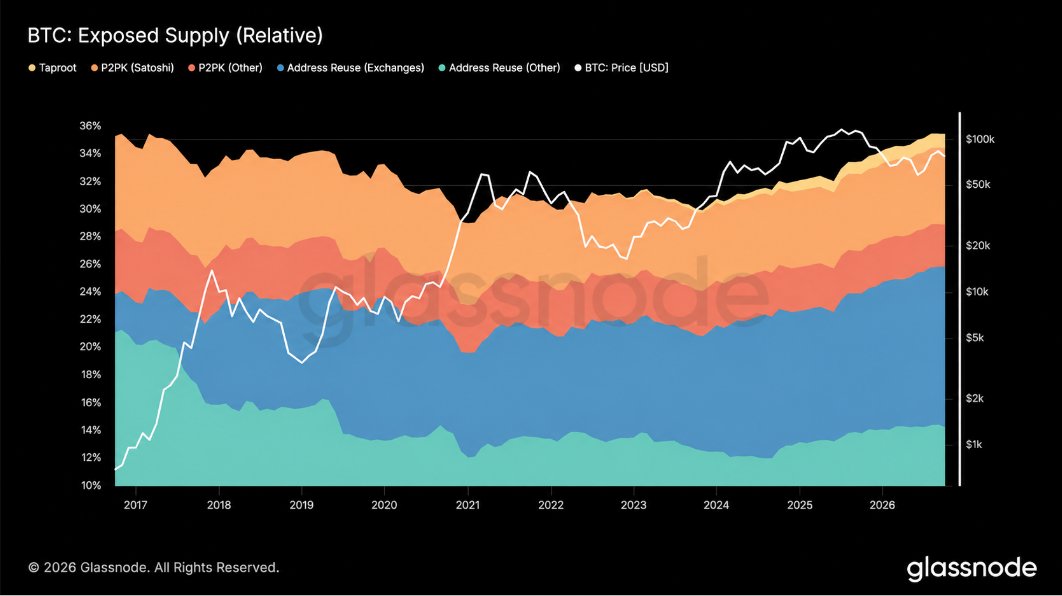
JUST IN: More than 1 in 3 Bitcoin, worth over $500 BILLION, is now exposed to future quantum computers.
Glassnode data shows 7.12 MILLION $BTC, or 35.4% of supply, has public keys already visible on the blockchain.
Most Bitcoin addresses reveal their public key the first time you send from them.
Any coins left in that address, or sent to it later, count as exposed.
“Moving those coins to a fresh address ends this exposure,” Glassnode says.
🚨 INSIGHT: Bitcoin has fallen below its short-term holder cost basis of $75,600, with roughly 65% of recently purchased $BTC now underwater, according to Glassnode.
Stablecoin supply has declined by $14.2 billion over 30 days, the fastest contraction since June 2022, while US spot Bitcoin ETFs recorded $1.6 billion in net outflows over 20 sessions.
Despite weakening demand, wallets holding 100 to 10,000 BTC have begun accumulating.
Glassnode identifies $73,000 as a key support level, warning that a sustained break below it could signal a longer consolidation.
⚡️ NOW: Tom Lee’s Bitmine reports a $6.3B net loss for the fiscal year ended Aug. 31, driven by unrealized losses on its ETH holdings as the price fell.
The firm holds about 5.9M ETH, roughly 4.9% of the circulating supply.
Crypto’s cash pile is shrinking.
Stablecoins just had their fastest drop since 2022, losing $14.5 BILLION in 30 days.
Glassnode says holders are redeeming stablecoins for dollars and taking that cash out of the market.
Tether alone shrank by $8.4 BILLION, more than half the drop.
Stablecoin supply now sits at $289 BILLION, $23 BILLION below its May peak and below where it started 2026.
Most stablecoins are minted to fund crypto trades, so when trading interest drops, demand for new ones falls, per CoinDesk.
It’s not just stablecoins. Bitcoin ETF flows have also turned NEGATIVE for 2026.
So has this happened before?
The last time stablecoins shrank this fast was in 2022, after Terra’s UST, which was the third largest stablecoin at the time, lost its $1 peg and collapsed.
At the worst point in May 2022, supply fell $28.6 BILLION in 30 days, about twice today’s pace.
Today, Tether, the largest stablecoin by market cap, is trading at $0.999, just below $1.
Payments tell a different story, with stablecoin payments hitting $482 BILLION in the first 9 months of 2026, up 45% from a year earlier, per Allium.
Glassnode says a return to supply growth would be the first sign that new money is coming in.
Perhaps the reason Bitcoin is falling (if you need one) is due to the upcoming Anthropic IPO.
You can see Bitcoin's performance going into the SpaceX IPO (blue line).
Investors will often try to free up capital for major IPOs.
BlackRock, Coinbase and Chainlink on what AI agents will need to pay
@BlackRock digital assets research head Will Su joined @alecglovett of @coinbase and @SergeyNazarov of @chainlink at BlackRock’s Aladdin Client Forum to talk about AI agents with wallets. Su pointed to a BlackRock paper that sees AI as the brains of a new machine economy and crypto as its money.
Lovett said agents need new low-cost rails for very high volumes, and that Coinbase is investing heavily in stablecoin payments, fast blockchains, and agent protocols. Nazarov expects tightly controlled use, with agents carrying an identity and set limits, like a Know Your Agent check.
On Nov 2, SEC staff updated the FAQ for the Application of the Federal Securities Laws to Certain Types of Crypto Assets. They say “a crypto system is ‘decentralized’ if it functions and operates autonomously with no person, entity, or group of persons or entities having operational, economic, or voting control of the crypto system.”
The staff looks for anyone who can act alone, outside the network's governance: to limit access, change how upgrades get voted on, pick who runs nodes, change the code or reverse transactions.
Here's how THORChain works on each point.
Operational - Funds sit in vaults run by groups of nodes, and every transaction needs a supermajority of nodes to authorize it. No single node can move funds or undo a swap. If the protocol detects an insolvency, it will automatically halt a whole chain, to protect the network. It can't target a single user. Operational mimirs exist to protect the network from attack or failure. These require a minimum of 3 node votes, but 4 nodes can then vote to reverse, 5 can counter the 4, and so on.
Economic - Fees are automatically charged on all swaps and automatically distributed on the network to the various stakeholders. Changes to fees, tokenomics, etc. are called economic mimirs and need 2/3 of active nodes.
Voting - Anyone can run a node if they bond enough RUNE to be churned into the network. No person picks the nodes. Parameters change only through on-chain node votes. Same with a protocol upgrade. No team or company can change a parameter on its own. Every node vote is recorded on-chain, and anyone can check it.
THORChain added ZEC trading on October 8th
We added some displays and improvements to our route displays to better show how the liquidity on THORChain stacks up against @near_intents and @Maya_Protocol so you can See Every Route, Swap the Best One
This is exactly why I FW with @THORChain
Think about it: even if you go after the developers, the founders, or anyone directly involved in building the protocol, what exactly can they do? They cannot wake up one morning and decide to shut down the network. They cannot pull a switch, freeze the entire system, or unilaterally decide who gets to participate.
The network is secured and governed by 111 nodes, and no single individual or group has the power to bring it to a halt at will.
That's the whole point. It shouldn't matter who you pressure, threaten, sanction or try to strong-arm. The system should continue to function regardless.
Because if a handful of people can be forced to change the rules or shut everything down, then you were never truly censorship-resistant in the first place. You were simply trusting that those people would never be pressured enough to abuse the power they hold.
And that's not a guarantee. Removing that power from individuals is.
This is what permissionless system design should look like. Not just promises of decentralization, but architecture that makes censorship practically impossible, even when those behind the project are the ones being targeted.
Not many projects in crypto can genuinely make that claim. This is one of the reasons I believe so strongly in THORChain.
You can’t make this up:
On Nov 4, Democrats swept the US midterm elections, and the S&P 500 added +$1.2 TRILLION in market cap.
Less than 24 hours later, the panic began.
On Nov 5, investors feared the new Congress would slow down AI spending, and stocks crashed.
By 3:30PM ET, the S&P 500 had hit its lowest point, erasing a record -$2.9 TRILLION in one day.
Then on Monday, the buyers came back.
Stocks gapped up at the open, adding +$1 TRILLION within hours.
By the 4PM ET close, the S&P 500 had added +$1.5 TRILLION, its best day since April.
That’s a $5.6 TRILLION swing in market cap in just 4 trading days.
We all just witnessed one of the wildest weeks in stock market history.
#BTC is playing out like it did last cycle.
Maybe it goes a little lower, but the “big bounce” could come at any time.
My personal guess for the lowest it could go before a big bounce is ~$65k. But it could also happen anywhere above that, too, just like it did in 2023.
It seems extremely likely to hold above the major support of the bottom pattern ($67k, allowing for brief wicks below).
Basically, somewhere between $65k and $74k seems likely to me for the local bottom (the higher low).
I would not wait for lower than that.
Remember: Bitcoin has already bled a lot versus the stock market, so BTC can be more resilient as much of BTC’s downside has been realized already.
I make my assumptions with the view that the cycle bottom is already in (just as I stated officially on August 20).
Swapping without connecting your wallet is back on THORChain⚡️
Any wallet in the world works:
- even wallets that don't support THORChain
- no contract approval to sign, just a regular send
- your keys never leave your wallet
https://t.co/TSk2BjkxnY
So far, $BTC is playing out exactly like it did last bear market.
After a big pump off the cycle lows, it dropped to tag the 200-day MA, just like it did back in March 2023.
Will it go lower? Based on the ugliness of stocks at the moment, I would not rule that out in the very short term.
However, the stock market has seen a recent, sharp, and rapid sell-off. Thus, stocks could be seeing a bounce soon-- perhaps sometime mid next week, and that could carry BTC up with it. So, we may be getting close to putting in our lower high for BTC!