¿Y si un “prompt” inteligente pudiera ayudarnos a prescribir mejores antibióticos?
La transformación digital ya está cambiando la infectología. Un estudio multicéntrico demostró que un prompt integrado en la historia clínica electrónica, basado en el riesgo individual de microorganismos multirresistentes, redujo entre 17% y 27% el uso innecesario de antibióticos de amplio espectro en pacientes con cancer sin comprometer la seguridad del paciente.
💻 La tecnología no reemplaza el juicio clínico; lo potencia. Cuando la inteligencia clínica, los datos en tiempo real y los programas de optimización de antimicrobianos (PROA) trabajan juntos, es posible tomar decisiones más precisas, reducir la presión selectiva y combatir la resistencia antimicrobiana.
El futuro del PROA no es solo elegir el antibiótico correcto, sino integrar la mejor evidencia con herramientas inteligentes en el momento de la decisión. @josemillanonate #EncuentroACIN2026 #InvestigaConACIN
Otro escándalo de los que se robaron a Medellín.
Recuerdan que la ciudad perdió sus jardines durante la alcaldía de estos ladrones?
Esta fue la razón. Le quitaron el mantenimiento al Jardín Botánico para entregárselo a un particular y poder robar.
No tengan dudas, les aseguro que diseñaron y armaron una estructura criminal para robarse a Medellín.
Y en esos días mientras direccionaron los contratos, estrenaba camioneta blindada el hermanito del jefe de la banda.
El pabellón Q los espera.
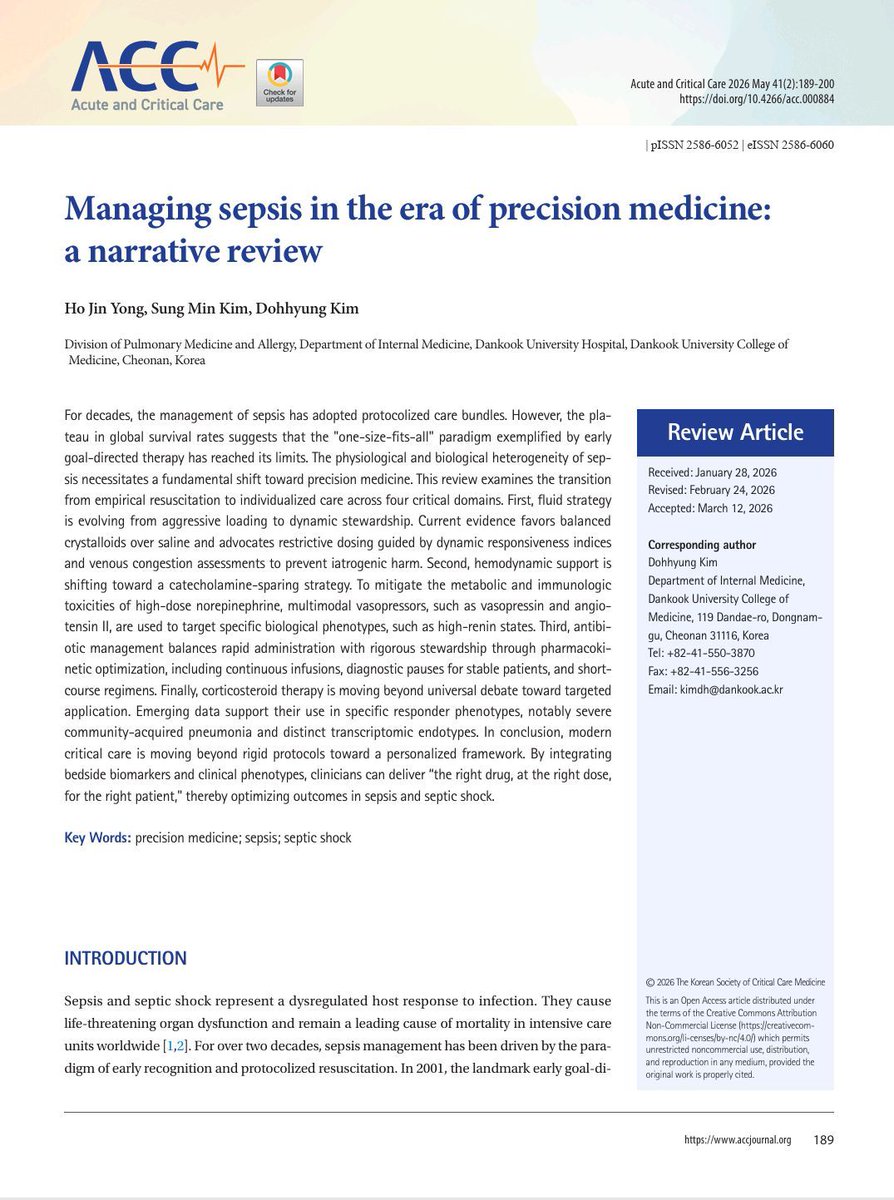
🦠Has sepsis entered the precision medicine era?
For more than two decades, sepsis management has been dominated by protocols, bundles, and standardized targets. Yet despite advances in supportive care, global mortality improvements have slowed, suggesting that a "one size fits all" strategy may have reached its limits.
Sepsis is not a single disease.
Two patients with the same SOFA score, identical lactate concentrations and similar vasopressor requirements may represent completely different biological entities. One patient may benefit from aggressive fluid administration, while another develops pulmonary edema, venous congestion and acute kidney injury.
Precision medicine proposes a different paradigm.
Instead of treating septic shock as a homogeneous syndrome, therapy should be tailored according to physiological, clinical and molecular phenotypes.
Fluid therapy is moving from liberal loading toward dynamic stewardship. Balanced crystalloids appear preferable to saline, static variables such as CVP are progressively abandoned, and assessment of fluid tolerance with dynamic tests and venous congestion evaluation is becoming increasingly relevant.
Hemodynamic support is also evolving.
The goal is no longer simply achieving a MAP above 65 mmHg.
The concept of decatecholaminization aims to minimize norepinephrine toxicity by introducing multimodal vasopressor strategies. Vasopressin may represent a kidney protective option in selected patients, while angiotensin II could become a targeted therapy for high renin phenotypes.
Antimicrobial therapy is entering the same precision framework.
Continuous beta lactam infusions, carbapenem sparing approaches, shortened treatment durations and biomarker guided discontinuation strategies are increasingly supported by evidence. The objective is not only early treatment but optimized treatment.
Perhaps the most intriguing field is immunomodulation.
The question is no longer whether corticosteroids work in sepsis.
The question is who responds.
Emerging transcriptomic analyses suggest that different sepsis endotypes may exhibit completely different responses to corticosteroid therapy, opening the possibility of truly personalized immunomodulation in the ICU.
The challenge remains implementation.
Rapid molecular diagnostics, point of care phenotyping and AI assisted clinical decision support systems will likely determine whether precision sepsis becomes routine practice or remains an attractive academic concept.
The future of sepsis care may not be another bundle.
It may be delivering the right intervention, at the right dose, to the right patient, at the right time.
#Sepsis #CriticalCare #ICU #PrecisionMedicine #Shock #Hemodynamics #ArtificialIntelligence #Vasopressors #AntibioticStewardship #IntensiveCare
Reference 📚
Yong HJ, Kim SM, Kim D. Managing sepsis in the era of precision medicine: a narrative review. Acute Crit Care. 2026;41(2):189–200. DOI: 10.4266/acc.000884.
El cirujano que minimiza el trabajo del anestesiólogo o que le habla a cualquiera para cubrir sus cirugías, sin un equipo fijo de confianza seguro es de capacidades limitadas, no sabe de excelencia quirúrgica y el paciente tampoco es su prioridad. Cero dudas.
💉🫀Manejo Efectivo del Shock - Desde la Fisiología Hasta la Medicina Personalizada
🔰📚Critical Care Medicine
DOI: 10.1097/CCM.0000000000007115
Enlace a Artículo Completo👇🏻🆓✅
https://t.co/rPEDXf5xvO
@sicsuper trato de cambiar el plan de @MovistarCo y no es posible. Cuelgan la llamada. Montar una PQR por teléfono y por la página no es posible. Me tienen amarrada a un plan que no deseo y cuando pido retirarme o poner queja no ha sido posible.